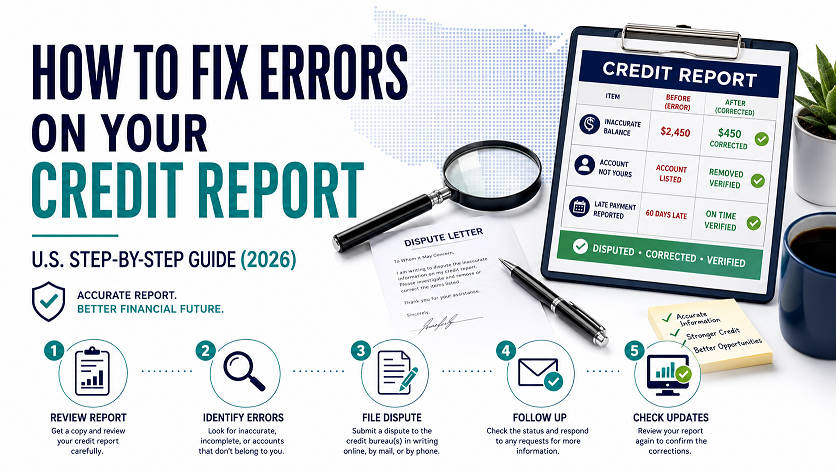
To fix a credit-report error, identify the exact inaccurate field, collect evidence, dispute it with every bureau reporting it and dispute it with the company that furnished the information. Keep proof of submission and compare the written result with an updated report. Investigations generally take 30 days, but some may take up to 45 days.
A useful dispute does not say, “Please remove all negative information.” It says which account or field is wrong, why it is wrong, what correction you want and which documents support that correction.
This guide covers factual report errors. A debt-validation request to a collector and an identity-theft blocking request are related but separate legal processes.
Name the exact account, month, balance, status or identity field that is wrong.
Attach copies of documents that directly support the requested correction.
Save reports, submissions, delivery proof, confirmations, responses and updated reports.
Common credit-report errors worth investigating
| Error type | Examples | Possible evidence |
|---|---|---|
| Identity | An account belongs to another person, mixed file, unfamiliar address tied to fraud. | Government ID, address records, identity-theft report or creditor correspondence. |
| Payment history | A payment marked late when it arrived on time; wrong delinquency month. | Bank statement, payment confirmation and account statement. |
| Balance or limit | Wrong balance, missing payment credit, incorrect credit limit or past-due amount. | Recent statements, payoff letter, settlement or receipt. |
| Account status | Open instead of closed, unpaid instead of paid, or wrong ownership status. | Closure confirmation, paid-in-full letter or creditor message. |
| Duplication | The same obligation appears more than once in a way that inaccurately duplicates the debt. | Reports showing both entries and account documentation. |
| Dates and age | Incorrect original delinquency timeline or information reported beyond the lawful period. | Older reports, statements and account history. |
A negative item is not automatically an error
Accurate late payments, collections and charge-offs generally cannot be forced off a report merely because they hurt a score. Disputing information you know is accurate can weaken a legitimate complaint and may be treated as frivolous.
Prepare your dispute file
Get reports from all three bureaus
Use AnnualCreditReport.com, the federally authorized source. Save each original report and its date.
Compare the same account
Equifax, Experian and TransUnion may show different data. Note every bureau reporting the error; correcting one report does not guarantee the others will change automatically.
Write one clear issue statement
Example: “The report shows a 30-day late payment for May 2026. The attached statement and bank confirmation show the full payment was received before the due date. Please correct May 2026 to paid as agreed.”
Collect copies of evidence
Use copies rather than irreplaceable originals. Redact unrelated account numbers while leaving enough information to identify the record.
Decide the requested correction
Ask for a specific update, such as correcting a balance, deleting an account that is not yours or changing a payment status.
Dispute the error with the credit bureau
Each nationwide bureau provides online and mail dispute options. Use the current address or portal shown on the bureau’s official website or your report. Online filing is convenient and creates electronic confirmation. Mail can be useful when the explanation or evidence packet is detailed.
Include your identifying information, report or confirmation number where available, the furnisher and account reference, the exact disputed field, your explanation, requested correction and supporting documents. If mailing, include a copy of the relevant report page with the item marked and consider a trackable delivery method.
Certified mail is not the only valid way to dispute. What matters is a complete, specific submission and reliable records showing what you sent and when.
Dispute with the company that supplied the data
A furnisher may be a bank, card issuer, lender, servicer, landlord or collector. The CFPB recommends disputing inaccurate information with both the bureau and the furnisher to fully protect your rights.
Send the furnisher the same clear explanation and relevant evidence. Use the dispute address shown on the report or an address the company designates for credit-report disputes—not automatically the payment address.
If the furnisher determines that its information was wrong, it generally must update or remove it and notify the credit reporting companies to which it supplied the incorrect information.
How long does an investigation take?
A credit reporting company generally must investigate within 30 days after receiving a dispute. Certain cases may take up to 45 days, including when relevant additional information is supplied during the investigation or in some disputes connected with a free annual report. The company generally must notify you of the results within five business days after completing the investigation.
Thirty days is not an automatic deletion countdown
Do not assume that an item must disappear merely because 30 calendar days have passed. Receipt date, permitted extensions, frivolous-dispute notices and response delivery all matter.
How to evaluate the investigation result
- Read whether the item was deleted, corrected, updated or verified.
- Compare every disputed field on the new report with the original.
- Confirm that the correction appears on every bureau that reported the error.
- Check that a deleted item was not later reinserted without applicable notice.
- Save the result and updated report with your evidence file.
If the furnisher maintains that the information is accurate, you may ask the bureau to include a brief statement of dispute in your file. That statement does not remove the account or guarantee a different lending decision.
Identity theft, mixed files and unauthorized inquiries
If an account resulted from identity theft, use IdentityTheft.gov to create a recovery plan. Identity-theft blocking has specific legal requirements and is not the same as an ordinary accuracy dispute.
Consider fraud alerts or security freezes when appropriate. Contact the business that opened the fraudulent account, preserve the identity-theft report and monitor all three bureaus. Never submit a false identity-theft affidavit for a debt you recognize.
An unfamiliar inquiry is not always fraud; it may be associated with a lender, landlord, insurer or another permissible transaction under a different business name. Investigate before disputing.
What to do when a legitimate error remains
- Review the dispute for missing identifiers, unclear wording or weak evidence.
- Send new or better evidence to the bureau and furnisher rather than repeating the same unsupported claim.
- Request relevant information about the procedure used to determine accuracy when appropriate.
- For an inaccurate or incomplete report complaint, complete the direct bureau dispute first.
- When the dispute is no longer pending or the applicable waiting period has passed, consider a CFPB complaint with the full timeline and attachments.
- Consult a consumer-law attorney when the error causes serious harm, involves identity theft, persists after documented disputes or affects a pending mortgage or housing decision.
Do not pay a company for a guaranteed deletion
You can dispute genuine inaccuracies yourself for free. A credit-repair company has no special power to remove accurate information or guarantee a score increase.
Frequently asked questions
Should I dispute online or by mail?
Either can work. Online is convenient; mail may suit complex evidence. Keep a complete copy and proof of submission whichever method you choose.
Do I have to send certified mail?
No. Federal law does not require certified mail for every credit-report dispute. A trackable method can help document delivery.
Will correcting an error raise my score?
It may, but no increase is guaranteed. The result depends on the corrected information, the rest of the report and the scoring model.
Can I dispute accurate information?
You can question whether it is complete or duplicated, but accurate, current negative information generally cannot be removed simply because it is unfavorable.
Should I dispute with both the bureau and creditor?
Yes. The CFPB recommends disputing inaccuracies with both the reporting company and the furnisher.
What if the bureau calls my dispute frivolous?
It must explain that determination. Review whether you identified the item clearly and provided enough information, then submit a focused dispute with relevant evidence.
The bottom line
A strong credit-report dispute is precise, documented and easy to investigate. Correct the underlying facts rather than arguing about a score. Keep a timeline, compare the updated reports and escalate only after completing the proper direct-dispute process.
27 thoughts on “How to Fix Errors on Your Credit Report — U.S. Step-by-Step Guide (2026)”