FHA Loan Credit Score Requirements 2026 — Complete Guide: Minimums, Down Payments, MIP Costs, and Who Should Apply
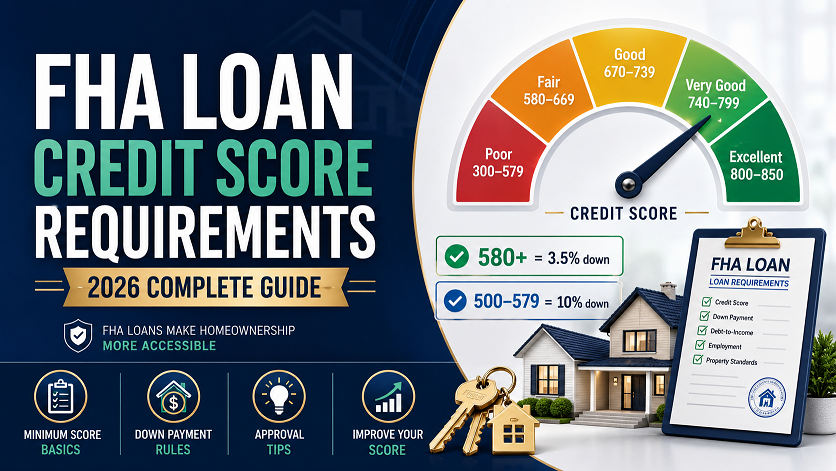
In 2026 the FHA minimum credit score is 580 for a 3.5% down payment and 500 for a 10% down payment. Borrowers below 500 are not eligible. All FHA loans require mortgage insurance — 1.75% upfront plus an annual premium of approximately 0.55% for most 30-year loans. FHA is best for buyers with scores below 680, limited down payment savings, or a recent credit setback. The average approved FHA borrower had a 692 credit score in 2024. As of April 2026, FHA now accepts VantageScore 4.0 alongside Classic FICO for underwriting.
FHA loans have been the backbone of American homeownership for buyers with limited credit or down payment savings since 1934. In 2026, they remain the most accessible path to homeownership for millions of Americans — especially first-time buyers, those recovering from financial setbacks, and anyone whose credit score falls below the conventional loan threshold of 620.
According to HUD’s FY2024 annual report, 82.64% of all FHA purchase loans went to first-time homebuyers. The average FHA borrower credit score is 692 — higher than the minimum, reflecting that even buyers with good credit often choose FHA for its low down payment flexibility and the ability to use gift funds.
This guide covers every FHA credit score requirement in 2026, the real cost of FHA mortgage insurance, how FHA compares to conventional loans at every score tier, and exactly what you need to do to qualify.
FHA Credit Score Minimums — The 3 Tiers Explained
The FHA does not lend money directly. It insures loans made by FHA-approved lenders, which protects lenders if a borrower defaults. Because of that government backing, FHA can accept lower credit scores than conventional loans. Here are the three official score tiers:
The standard FHA qualification. Most borrowers in this tier qualify with good lender options and competitive FHA rates. This is the minimum needed to access the lowest FHA down payment.
FHA still insures these loans, but lenders willing to go this low are rare. Most lenders set their own minimum at 580 or higher. You will need to specifically seek out FHA-specialist lenders.
Borrowers with scores below 500 do not qualify for any FHA-insured mortgage. Focus on 12+ months of credit rebuilding before applying. A secured credit card and consistent on-time payments are the fastest path to 500+.
These Are FHA Program Minimums — Not Lender Minimums
The 500 and 580 figures are HUD’s official FHA program thresholds. Individual lenders almost always set stricter overlay requirements. Most FHA lenders in 2026 require a minimum of 580 to 620. Some large bank lenders set their FHA minimum at 640. If your score is below 600, you need to specifically seek out lenders who operate near the FHA program minimums — community banks, credit unions, and FHA-specialist non-bank lenders.
What Score Do FHA Borrowers Actually Get Approved With?
The minimum and the average are very different numbers in FHA lending. While the program allows scores as low as 500, the real-world picture is considerably different:
| Score Range | FHA Eligibility | Approval Reality | Lender Availability |
|---|---|---|---|
| 500–579 | Eligible with 10% down | Very difficult. Most lenders decline. Specialist lenders only. | Very limited |
| 580–599 | Eligible with 3.5% down | Possible but challenging. Some lenders still decline at this level. | Limited |
| 600–619 | Eligible with 3.5% down | More lenders available. Still higher rates than 620+ borrowers. | Moderate |
| 620–659 | Eligible with 3.5% down | Good approval odds across most FHA lenders. This is where FHA shines vs conventional. | Wide |
| 660–719 | Eligible with 3.5% down | Excellent FHA terms. Consider whether conventional may be cheaper given MIP cost. | Very wide |
| 720+ | Eligible with 3.5% down | Best FHA rates. At this level, compare conventional carefully — you may save on MIP long-term. | All lenders |
The average credit score for FHA mortgage applications approved for home purchases was 692 in 2024 according to HMDA data — and it is likely similar in 2026. This means the typical FHA buyer has a score comfortably above the minimum. A 692 average does not mean you cannot get approved at 620, but it shows that FHA attracts buyers across a wide range, not just those at the bottom of the credit spectrum.
Lender Overlays — Why a 580 Score Is Not Always Enough
One of the most frustrating experiences for FHA applicants is meeting the FHA minimum and still being rejected. This happens because of lender overlays — additional requirements that individual lenders add on top of HUD’s official guidelines.
Lenders set overlays to reduce their own risk of buybacks and defaults. Even though FHA insures the loan, lenders still face operational and reputational costs when loans go bad. As a result:
- Many large bank lenders set their FHA minimum at 620 — 40 points above the FHA floor
- Some regional banks require 640 for FHA loans, even though HUD allows 500
- Non-bank mortgage lenders and FHA-specialist companies tend to operate closer to the 580 FHA minimum
- Credit unions sometimes offer the most flexibility for members with scores in the 580–620 range
If Your Score Is 580–619 — Do This Before Applying
Call or apply online with at least 3 to 5 different lenders before assuming you are declined. Ask specifically: “What is your minimum credit score for an FHA loan?” The answers will vary significantly. Non-bank lenders like Rocket Mortgage, Better.com, and loanDepot, as well as FHA-specialist companies, are more likely to approve near the program minimum than traditional bank lenders. Rate-shopping within a 14 to 45-day window counts as a single inquiry under FICO’s mortgage rate shopping protection.
FHA Mortgage Insurance Costs in 2026 — The Full Breakdown
FHA mortgage insurance (MIP) is the biggest long-term cost consideration of any FHA loan. Unlike conventional PMI which drops off automatically when you reach 20% equity, FHA MIP has different cancellation rules — and for most borrowers, it lasts the life of the loan. Understanding this cost is essential before deciding between FHA and conventional.
MIP Rates Vary by Loan Term and LTV
The annual MIP rate is not one-size-fits-all. It varies based on your loan term, loan-to-value ratio, and loan amount:
| Loan Term | LTV (Down Payment) | Annual MIP Rate | Monthly Cost on $300K |
|---|---|---|---|
| 30-year | Over 95% (less than 5% down) | 0.55% | $137.50 |
| 30-year | 90–95% (5%–10% down) | 0.50% | $125.00 |
| 30-year | Under 90% (more than 10% down) | 0.50% | $125.00 |
| 15-year | Over 90% | 0.40% | $100.00 |
| 15-year | Under 90% | 0.15% | $37.50 |
FHA MIP Cancellation Rules
This is the most important thing to understand about FHA mortgage insurance:
- Down payment less than 10%: MIP lasts for the entire life of the loan. The only way to remove it is to refinance into a conventional loan once you have 20%+ equity and a qualifying credit score.
- Down payment of 10% or more: MIP cancels automatically after 11 years of on-time payments — not when you reach 20% equity, but after the 11-year period.
- Conventional PMI comparison: Private mortgage insurance on conventional loans drops off automatically when your loan balance reaches 80% of the original home value — regardless of how many years have passed.
The FHA-to-Conventional Refinance Strategy
Many savvy FHA borrowers use FHA to buy now and refinance into a conventional loan later — once their credit score improves and their home equity reaches 20%. This strategy lets you access homeownership today with a lower score and down payment, then escape the lifetime MIP cost in 2 to 5 years when your financial position strengthens. Use this as a deliberate plan: buy FHA, build equity and credit, refinance conventional at 20% LTV and 680+ score.
FHA Loan Limits 2026 — By Area Type
FHA loan limits cap how much you can borrow. They vary by county and are updated annually by HUD based on home price changes. For 2026:
| Area Type | 1-Unit Home | 2-Unit Home | 3-Unit Home | 4-Unit Home |
|---|---|---|---|---|
| Low-cost areas (floor) | $541,287 | $693,000 | $837,627 | $1,040,625 |
| High-cost areas (ceiling) | $1,249,125 | $1,599,000 | $1,932,450 | $2,400,000 |
| Alaska, Hawaii, Guam, USVI | $1,873,688 | $2,398,500 | $2,898,675 | $3,601,125 |
Need to Borrow More Than the FHA Limit?
If you need a loan above the FHA limit in your county, you have two main options: a conventional conforming loan (up to $802,650 in most areas) or a jumbo loan (above $802,650, requiring 700+ credit score and 10–20% down). In most parts of the country, the conventional conforming limit gives you $261,363 more than the FHA limit for a single-family home — enough for most buyers who find FHA limits restrictive.
DTI Requirements — How Much Debt Can You Have for an FHA Loan?
Your debt-to-income ratio (DTI) is the percentage of your gross monthly income that goes toward all debt payments — including the new mortgage payment. FHA has the most flexible DTI limits of any major mortgage program:
| Credit Score | Standard Max DTI | With Compensating Factors | Notes |
|---|---|---|---|
| 580+ | 43% | Up to 50% | Strong reserves, low utilization, or history of paying similar housing payment |
| 500–579 | 43% | 43% maximum — limited flexibility | Manual underwriting typically required at this score range |
Compensating factors that allow FHA to approve higher DTI ratios include: cash reserves of 3+ months of payments, minimal discretionary debt, a history of paying a similar or higher housing payment, additional income that cannot be used for qualifying (such as part-time work that does not meet documentation requirements), and a larger down payment than the minimum required.
Complete FHA Loan Requirements Checklist 2026
Credit score is just one of several requirements for FHA loan approval. Here is the full checklist:
| Requirement | FHA Standard 2026 |
|---|---|
| Credit score | 580+ for 3.5% down | 500–579 for 10% down | Below 500 ineligible |
| Down payment | 3.5% (score 580+) or 10% (score 500–579) of purchase price |
| Down payment source | Own savings, gift funds from family or employer, government DPA programs |
| Debt-to-income ratio | 43% standard — up to 50% with compensating factors for scores 580+ |
| Employment history | 2 years of verifiable employment — same employer or same field preferred |
| Income documentation | W-2s, pay stubs, tax returns (2 years); self-employed borrowers need 2 years of tax returns |
| FHA loan limits | $541,287 (low-cost areas) to $1,249,125 (high-cost areas) for single-family homes |
| Mortgage insurance | 1.75% upfront MIP + 0.15%–0.55% annual MIP paid monthly |
| Property requirements | Must be primary residence | FHA appraisal required | Must meet FHA safety standards |
| Federal debt | No delinquent federal debt or defaulted government-backed loans (checked via CAIVRS) |
| Bankruptcy waiting period | Chapter 7: 2 years from discharge | Chapter 13: 1 year of repayment plan with trustee approval |
| Foreclosure waiting period | 3 years from completion — reduced to 1 year with documented extenuating circumstances |
| Citizenship | U.S. citizens, permanent residents, and certain non-permanent residents with valid Social Security numbers |
CAIVRS Check — Most Applicants Don’t Know About This
Before approving any FHA loan, lenders check the Credit Alert Interactive Verification Reporting System (CAIVRS) — a federal database of borrowers who have defaulted on government-backed loans including FHA, VA, USDA, and student loans. If you have a delinquent federal debt or a previous FHA loan foreclosure that is still outstanding, you will be blocked from FHA financing regardless of your credit score. Resolve any federal debt before applying.
FHA vs Conventional — Which Is Better for Your Credit Score in 2026?
The right choice between FHA and conventional depends primarily on your credit score and down payment. Here is a clear breakdown of when each wins:
✅ Choose FHA When…
- Your credit score is below 680 — FHA rates are more competitive at lower scores
- Your down payment is less than 5% — FHA’s 3.5% minimum beats conventional options
- Your DTI is above 43% — FHA’s 50% maximum is more flexible
- You had a bankruptcy 2–3 years ago — FHA’s waiting period is shorter than conventional’s 4–7 years
- You had a foreclosure 3 years ago — conventional requires 7 years
- You are a first-time buyer with limited credit history
- You plan to refinance to conventional once equity and score improve
- You want to use gift funds for more of the down payment
🏦 Choose Conventional When…
- Your credit score is 740 or higher — conventional rates beat FHA at this level
- Your down payment is 20% or more — no PMI, no MIP
- You want PMI that cancels automatically at 80% LTV — FHA MIP is permanent with less than 10% down
- You are buying a condo — FHA condo approval requirements are stricter
- You are buying an investment property — FHA requires primary residence
- The seller prefers conventional — some sellers do in competitive markets
- You need a loan above FHA limits for your county
For Home Onwers
Already own a home and looking to tap equity? Read our HELOC requirements guide for 2026.
The Score Crossover Point — Where FHA and Conventional Switch
At a credit score of around 680, the advantage shifts depending on your down payment:
| Credit Score | Down Payment | Better Choice | Reason |
|---|---|---|---|
| 500–579 | 10% | FHA | Only option — conventional not available below 620 |
| 580–619 | 3.5%–5% | FHA | Conventional not available below 620; FHA offers best terms |
| 620–659 | Less than 10% | FHA | FHA rates more competitive; similar MIP to conventional PMI at this score |
| 660–679 | Less than 10% | Compare both | Rates similar — run numbers with your specific loan amount |
| 680–739 | 5%–20% | Conventional | Conventional PMI cancels — FHA MIP permanent — conventional wins long-term |
| 740+ | Any amount | Conventional | Best conventional rates + no lifetime MIP = conventional wins clearly |
2026 Update — FHA Now Accepts VantageScore 4.0 Alongside Classic FICO
In April 2026, HUD announced that FHA lenders can now use VantageScore 4.0 alongside Classic FICO for underwriting FHA loans — matching the change already approved for Fannie Mae and Freddie Mac conventional loans.
This is significant for FHA applicants in two specific situations:
- If you have paid medical collections: VantageScore 4.0 ignores paid collections entirely. Under Classic FICO, paid collections still appear and carry weight. If a lender is using VantageScore 4.0, your score may be meaningfully higher than your Classic FICO score if you have resolved past medical debts.
- If you have a thin credit file: VantageScore 4.0 can generate a score with as little as one month of credit history, while Classic FICO requires six months. Thin-file borrowers who cannot get a Classic FICO score may now qualify for FHA financing under VantageScore 4.0.
During 2026, adoption of VantageScore 4.0 by FHA lenders is ongoing. Ask your lender directly which model they use. If your Classic FICO score is below 580 but you believe your VantageScore 4.0 would be higher — due to paid collections or thin file — specifically seek lenders who have adopted the new model.
VantageScore 4.0 is now accepted for FHA underwriting. See our complete VantageScore 4.0 guide for how it may change your qualifying score.
How to Qualify for an FHA Loan — Step-by-Step
Check Your Credit Score From All Three Bureaus
Get your free reports from AnnualCreditReport.com. Lenders pull your score from all three bureaus — Equifax, Experian, and TransUnion — and use the middle score. If two borrowers are applying together, the lender uses the lower of the two middle scores. Knowing your exact score from each bureau tells you your realistic qualifying position before you apply.
Dispute Any Errors on Your Report
Under the FCRA, you have the right to dispute inaccurate items on your credit report. Check for: collection accounts that should be removed under 2026 medical debt rules (paid medical collections and unpaid collections under $500), items past their 7-year reporting window, accounts you do not recognize, and incorrect balances. A successful dispute can improve your score within 30 to 60 days. File disputes directly with each bureau at Equifax.com, Experian.com, and TransUnion.com.
Pay Down Credit Card Balances
Credit utilization — the percentage of your available revolving credit you are using — is the second biggest factor in your credit score. Paying down balances to below 30% of each card’s limit, and ideally below 10% overall, can raise your score by 20 to 50 points within one billing cycle. If you need to reach 580 from 555, this is often the fastest path.
Save Your Down Payment — And Document Every Dollar
You need at least 3.5% of the purchase price as a down payment (for scores 580+), plus 2% to 5% in closing costs. FHA allows gift funds from family members, employers, charities, and government agencies — but every gift must be documented with a signed gift letter and evidence of the transfer. Large unexplained deposits in your bank account will delay or kill your application. Keep a clean paper trail of all funds for at least 60 days before applying.
Get Pre-Approved by Multiple FHA Lenders
Shopping multiple FHA lenders before applying is critical — especially if your score is near the minimum. FHA rates and overlays vary significantly between lenders. Request official Loan Estimates from at least 3 lenders. Multiple mortgage inquiries within a 14 to 45-day window count as a single inquiry under FICO’s rate shopping rules. Compare the full APR — not just the interest rate — including lender fees, to find the true best deal.
Do Not Make Any Major Financial Changes After Pre-Approval
Getting a new credit card, buying a car, co-signing for someone else, or changing jobs can all stop your mortgage from going through — even days before closing. Before they fund the loan, your lender will check your credit again. Keep everything stable: no new credit, no new debt, no job changes, no large unexplained deposits between pre-approval and closing.
See What FHA Loan You Qualify For Right Now
Use our free Loan Affordability Calculator — enter your income, debts, and credit score to see your estimated maximum loan amount, rate range, and monthly payment based on 2026 lending data.
Frequently Asked Questions
What is the minimum credit score for an FHA loan in 2026?
The FHA minimum credit score in 2026 is 580 for a 3.5% down payment and 500 for a 10% down payment. Borrowers below 500 are not eligible for FHA-insured financing. However, individual lenders often require higher scores — typically 580 to 640 — through their own overlay requirements. The average approved FHA borrower in 2024 had a credit score of 692 according to HMDA data, reflecting that FHA attracts buyers across a wide range of scores.
Can I get an FHA loan with a 500 credit score in 2026?
Yes — the FHA allows scores as low as 500 with a 10% down payment. However, finding a lender willing to approve at 500 is difficult in practice. Most FHA lenders set their own minimum at 580 or 600. You will need to specifically seek out FHA-specialist non-bank lenders or credit unions. If your score is near 500, spending 2 to 3 months paying down balances and resolving any errors to reach 580 will open significantly more lender options and the 3.5% down payment tier.
How much is FHA mortgage insurance in 2026?
FHA mortgage insurance in 2026 has two components. The upfront premium (UFMIP) is 1.75% of the loan amount — on a $300,000 loan that is $5,250, typically rolled into the loan. The annual premium for most 30-year FHA loans is 0.55% of the loan balance, divided into monthly payments — approximately $137.50 per month on a $300,000 loan. If you put less than 10% down, this annual MIP lasts for the life of the loan.
How long do you pay FHA mortgage insurance?
If your down payment is less than 10%, FHA mortgage insurance lasts for the entire life of the loan — 30 years for a 30-year mortgage. It does not cancel when you reach 20% equity, unlike conventional PMI. If your down payment is 10% or more, FHA MIP cancels automatically after 11 years of on-time payments. The most common strategy to eliminate FHA MIP early is refinancing into a conventional loan once your equity reaches 20% and your credit score qualifies for competitive conventional terms.
What is the FHA loan limit in 2026?
In 2026 the FHA loan limit for a single-family home is $541,287 in low-cost counties and $1,249,125 in high-cost counties. Limits are set by HUD annually and vary by county. Special higher limits apply in Alaska, Hawaii, Guam, and the U.S. Virgin Islands. Use the HUD FHA loan limit lookup tool at hud.gov to find the exact limit for your specific county.
Is FHA or conventional better for a 620 credit score?
At 620, FHA is usually better if your down payment is less than 10%. FHA rates are more competitive at lower scores because government backing absorbs more lender risk. However, if you plan to stay in the home long-term, the lifetime FHA MIP cost is a significant disadvantage. A common strategy: use FHA to buy now at 620, then refinance to conventional in 2 to 4 years when your score reaches 680+ and you have 20% equity — eliminating MIP.
What DTI do you need for an FHA loan in 2026?
FHA allows a standard debt-to-income ratio of up to 43%. With a credit score of 580 or higher and compensating factors — such as significant cash reserves or a history of paying a similar housing cost — FHA can approve DTIs up to 50%. This is the most flexible DTI limit of any major mortgage program, making FHA particularly valuable for buyers with significant existing debt such as student loans or car payments.
Related Free Tools
Related Guides
- NerdWallet — FHA Loan Requirements 2026
- LendingTree — FHA Loan Requirements and Limits 2026
- Lower.com — FHA Credit Score Requirements 2026
- Freedom Mortgage — FHA Loan Credit Score Requirements
- CrossCountry Mortgage — FHA Loan Requirements Checklist 2026
- AmeriSave — FHA Down Payment Requirements 2026
- HUD FY2024 Annual Report — FHA Borrower Demographics
- HUD.gov — 2026 FHA Loan Limits by County
- FHFA and HUD Joint Announcement — April 22, 2026 (VantageScore 4.0 for FHA)