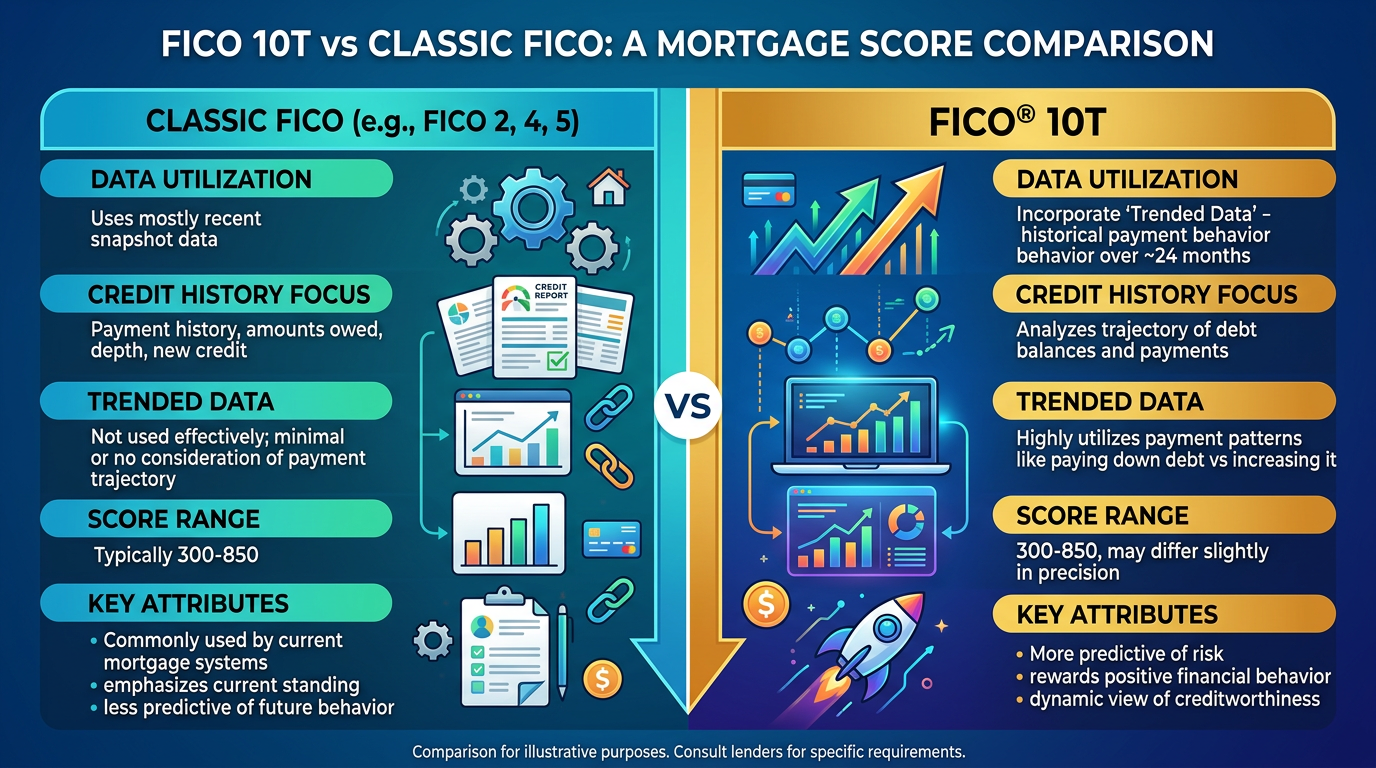
FICO Score 10T is a newer 300–850 credit-scoring model that uses trended credit data, while Classic FICO mortgage scores largely evaluate a more traditional snapshot of a consumer’s credit report. However, approval for future mortgage use does not mean every lender is already using FICO 10T. As of August 28, 2026, Fannie Mae and Freddie Mac described FICO 10T as approved for future use, while Classic FICO remained in use for lenders outside the limited modern-model rollout. Ask the lender which score model and loan program it will use before paying for any consumer score.
The move from Classic FICO mortgage scores to newer models has created understandable confusion. Borrowers may see a FICO Score 8 in a banking app, buy another score online, and then receive three different mortgage scores from a loan officer. FICO 10T adds another name—but it does not make those earlier scores interchangeable.
This guide explains what actually changes, what remains uncertain, and how to prepare for a mortgage without trying to manipulate a model. It focuses on conforming mortgages sold to Fannie Mae or Freddie Mac. FHA, VA, USDA, jumbo and portfolio lenders can follow different program rules and overlays.
FICO 10T and Classic FICO mortgage scores use the familiar 300–850 scale.
FICO 10T incorporates balance and payment trends when qualifying data is available.
Model use depends on rollout status, lender participation and the mortgage program.
August 2026 mortgage rollout status
- Approved models: FHFA has approved Classic FICO, FICO Score 10T and VantageScore 4.0 for the government-sponsored enterprises.
- VantageScore 4.0: Fannie Mae and Freddie Mac announced limited use by approved lenders through tri-merge credit reports in 2026.
- FICO 10T: the enterprises state that implementation will follow later, with advance lender guidance before availability.
- Classic FICO: lenders not participating in an approved modern-model rollout continue using Classic FICO under enterprise guidance.
- Historical data: Fannie Mae and Freddie Mac published historical FICO 10T data on July 1, 2026 to support industry analysis and readiness.
Practical meaning: do not assume a mortgage application submitted today will use FICO 10T merely because the model is approved. Confirm the model directly with the lender.
The rollout has changed more than once. In January 2025, the enterprises moved an earlier implementation date to a date to be determined. In April 2026, their policies were updated to recognize modern models, with VantageScore 4.0 entering a limited rollout and FICO 10T designated for later availability. This is why undated claims that FICO 10T “replaced” Classic FICO are unreliable.
Approved is not the same as broadly implemented
FHFA approval means a model met the applicable validation framework. Operational use also requires lender, credit-reporting, automated-underwriting, pricing, delivery and investor systems to be ready.
FICO 10T vs. Classic FICO: the main differences
| Feature | Classic FICO mortgage scores | FICO Score 10T | Why a borrower may care |
|---|---|---|---|
| Score range | 300–850 | 300–850 | The number looks familiar, but the calculation can differ. |
| Credit data | Traditional bureau-file snapshot under older mortgage models | Current report data plus trended data when available | Direction and persistence of balances can add context. |
| Model generation | Older bureau-specific FICO models | Newer FICO 10 suite model | A consumer can receive different numbers from the same underlying history. |
| Rental data | May consider reported accounts under existing model design | FICO highlights rental tradeline treatment in 10T | Only data actually present in the report can be evaluated. |
| Collections | Older model treatment | Updated collection treatment according to FICO | Effect depends on the collection data and complete file. |
| Current GSE use | Continues for lenders outside limited modern-model use | Approved; broad GSE availability follows later guidance | The lender’s active process determines the relevant model. |
“Classic FICO” is not one universal score. Traditional conforming mortgage lending commonly obtains bureau-specific older FICO models from Equifax, Experian and TransUnion. The resulting numbers can differ because the models and bureau data can differ. Mortgage underwriting rules then determine how multiple borrower and bureau scores are handled.
FICO 10T is also not the FICO Score 10 that a consumer might encounter elsewhere. The “T” identifies the version designed to use trended bureau data. Both are part of the FICO Score 10 suite, but lenders choose models for particular use cases. Never treat “FICO score” as a complete model name.
What is trended credit data?
A standard credit-report snapshot can show that a card currently has a $3,000 balance and a $5,000 limit. Trended data may provide a longer view of reported balances, scheduled payments and actual payments across prior months. That history can help a scoring model distinguish patterns that look identical in a single-month snapshot.
Consider two hypothetical borrowers who each show a $3,000 card balance today:
- Borrower A has steadily paid balances down from $4,800 to $3,000.
- Borrower B has steadily increased balances from $600 to $3,000.
A snapshot sees the same current balance and limit. Trended information supplies direction and payment context. This example explains the concept; it does not predict how many points either borrower would gain or lose. FICO does not publish a consumer formula that allows an exact result to be calculated from a few data points.
Trended data does not reveal bank-account spending
FICO 10T evaluates eligible information furnished to the credit bureaus. It does not mean the score automatically reads every transaction in a checking account. Nor can it analyze rent, utilities or telecom payments that never reach the relevant credit file through an accepted reporting channel.
Paying in full can still be visible as a responsible pattern
Consumers sometimes believe they must carry interest-bearing debt to build a score. They do not. Creditors generally report account information on their own schedule, so a statement balance can appear even when the consumer pays it in full by the due date. Paying interest is not a scoring requirement.
The durable strategy is simple
Pay every account on time, avoid balances that strain the budget, reduce revolving debt steadily, and do not open or close accounts only to chase a rumored model advantage.
Who might receive a different FICO 10T result?
Any new model can rank some files differently, but a different score is not automatically better or worse. The following profiles may be evaluated differently because the newer model has more recent design features and can consider trends:
Consumers paying revolving balances down
A sustained decline in card balances may provide more context than one isolated utilization reading. This does not guarantee a higher FICO 10T score, because payment history, derogatory information, account age, inquiries and other factors still matter.
Consumers accumulating card debt
A rising balance pattern can signal increasing repayment pressure even before a payment is missed. The financial concern matters beyond scoring: higher minimum payments can also affect the debt-to-income ratio used in mortgage underwriting.
Renters with reported rental tradelines
FICO says FICO 10T includes rental tradeline treatment. But paying rent does not guarantee that the information appears at all three bureaus, and a reporting service may charge fees. Before buying a rent-reporting service, verify the bureaus and model compatibility, cancellation policy, privacy terms and total cost.
Thin-file or previously unscorable consumers
Modern models are designed to evaluate available information differently, but they cannot invent a history that has never been reported. Mortgage lenders may also use cash-flow, rent-payment or automated-underwriting options that operate separately from the score itself. Ask what documentation the chosen program accepts.
Consumers with collection accounts
FICO describes updated collection treatment in FICO 10T. The result depends on collection type, status, age, amount, bureau data and the rest of the file. Accurate collection information should not be disputed as fraudulent merely to seek a score change. For factual errors, follow a documented credit-report dispute process.
A credit score is only one mortgage decision input
Whether a lender uses Classic FICO, FICO 10T or another permitted model, the score does not approve a mortgage by itself. The lender and applicable automated underwriting system can also evaluate:
- income, employment and documentation;
- monthly debt obligations and debt-to-income ratio;
- down payment, reserves and gift funds;
- property type, occupancy and appraisal;
- loan-to-value ratio and mortgage insurance;
- recent bankruptcies, foreclosures or major delinquencies;
- loan program rules and lender overlays; and
- identity, fraud, compliance and ability-to-repay checks.
A higher score can sometimes help a borrower qualify for better mortgage pricing, but no fixed score guarantees approval or a particular interest rate. Rates and fees also respond to loan type, term, points, property, down payment, occupancy, market conditions and lender pricing.
Will the minimum mortgage credit score change?
Do not assume that switching models simply replaces one familiar minimum with a new universal number. Fannie Mae and Freddie Mac policies, automated-underwriting findings and lender overlays determine eligibility. FHA, VA and USDA programs have their own rules, and individual lenders may impose stricter standards. Our mortgage credit-score requirements guide compares the major loan types without promising approval.
How to prepare for FICO 10T and Classic mortgage scoring
Check all three credit reports early
Use AnnualCreditReport.com, the federally authorized source. Review names, addresses, accounts, limits, balances, payment status, collections and public-record information.
Dispute only factual errors
Attach evidence and identify the exact information that is wrong. A legitimate negative item is not an error merely because it harms eligibility.
Never miss a due date
Use reminders or carefully funded automatic payments. A new late payment before closing can affect the score and underwriting decision.
Reduce revolving balances steadily
Paying card debt down improves cash flow and can reduce utilization. Avoid shifting debt between cards without reducing the total obligation.
Pause unnecessary applications
New accounts can add inquiries, lower average account age and create payments that must be documented. Do not finance furniture or a vehicle before closing without discussing it with the loan officer.
Preserve funds for closing and emergencies
A score-improvement tactic should not consume the down payment, reserves or emergency savings. Liquidity can matter during underwriting and after homeownership begins.
Ask the lender the model and program
Confirm whether the quote uses Classic FICO, FICO 10T, VantageScore 4.0 or another score, and whether it is for conventional, FHA, VA, USDA, jumbo or portfolio financing.
Avoid paying a credit-repair company for a “FICO 10T hack.” No company can guarantee a deletion, mortgage approval, score increase or lower rate. False disputes, credit privacy numbers and synthetic identities can cause financial and legal trouble. Review the warning signs in our credit-repair scams guide.
Mortgage preapproval, rates and lender comparison
When shopping for a home loan, compare written offers rather than score claims. A useful mortgage comparison includes the interest rate, annual percentage rate (APR), discount points, lender fees, mortgage insurance, estimated cash to close, prepayment terms and whether the rate is locked.
The lowest advertised mortgage rate may require a stronger profile, larger down payment or payment of points. APR can help compare certain borrowing costs, but it does not capture every future cost or guarantee that two loans have identical assumptions. Compare Loan Estimates for the same loan amount, property type, down payment, term and lock period.
A consumer score purchased online may be educational but may not match the score used for the mortgage application. Before buying a score-monitoring subscription, ask the lender what model it uses and whether the quoted service supplies that exact model. Free access to credit reports is often sufficient for checking accuracy.
Model changes do not eliminate lender shopping
Two lenders using the same credit score can still offer different APRs, fees, points and underwriting outcomes. Compare at least a few written offers using the same assumptions and timeframe.
Frequently asked questions
Is FICO 10T used for mortgages in 2026?
It is an FHFA-approved model, but Fannie Mae and Freddie Mac stated in their 2026 implementation materials that FICO 10T availability would follow later guidance. Classic FICO remained applicable for lenders outside limited modern-model participation. A lender may also use FICO 10T in another portfolio or risk-management context, so ask about the exact loan.
Did FICO 10T replace Classic FICO?
No universal replacement had occurred as of August 28, 2026. The mortgage market is transitioning through policy, data and operational stages. Model use varies by lender and program.
What does the “T” in FICO 10T mean?
It identifies the FICO Score 10 version that incorporates trended bureau data—historical balance and payment information—when such information is available.
Is FICO 10T harder than Classic FICO?
Not universally. A newer model can rank particular profiles differently, but the direction and size of a change depend on the full bureau file. No public point-conversion chart can predict every consumer’s result.
Does FICO 10T look back 24 or 30 months?
Trended bureau data can cover a historical period, but consumers should avoid relying on one simplified month count as a scoring formula. Coverage can depend on the bureau data furnished and model implementation. The safer approach is consistent repayment over time.
Can paying credit cards before the statement date help?
It may reduce the balance that is reported, depending on the issuer’s reporting schedule. But frequent tactical payments are not a substitute for reducing debt, paying on time and maintaining cash for the mortgage transaction.
Will rent payments automatically appear in FICO 10T?
No. The payment information must reach the relevant credit report in an eligible form. Landlord or reporting-service participation, bureau coverage and data accuracy can vary.
Can I request that a lender use my highest score model?
Usually the lender follows the models and score-selection rules allowed for the loan program. You can ask which programs are available, but you generally cannot substitute an unrelated consumer score for the required mortgage score.
The bottom line
FICO 10T modernizes mortgage credit scoring by adding trended-data analysis and updated treatment of certain credit information while retaining the familiar 300–850 range. Its approval is important, but the implementation status matters just as much. As of August 28, 2026, enterprise materials described FICO 10T as approved for future availability, not as a universal replacement already used for every conforming mortgage.
Borrowers do not need to predict a proprietary algorithm. Check all three reports, correct genuine errors, pay every account on time, reduce card debt, avoid new obligations before closing, protect savings and compare complete mortgage offers. Then ask each lender which scoring model and loan program it is actually using.
Related guides
Primary and official sources
- FHFA: Credit Scores policy and implementation updates
- Fannie Mae: Credit Score Models and Reports Initiative
- Freddie Mac: Credit Score Models and Reports Initiative
- Fannie Mae and Freddie Mac: Credit Report and Credit Score Model Playbook
- FHFA: Validation of FICO 10T and VantageScore 4.0
- FICO: FICO Score 10 suite and trended data
- AnnualCreditReport.com: Federally authorized credit-report access
- Consumer Financial Protection Bureau: Loan Estimate guidance
5 thoughts on “FICO 10T vs. Classic FICO: What Changes for Mortgages?”