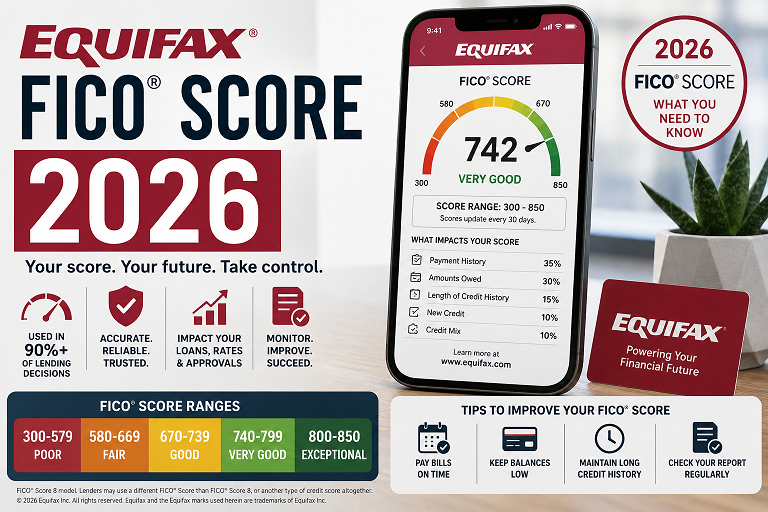
An Equifax FICO Score is a FICO score calculated from information in an Equifax credit report. Equifax supplies report data; FICO supplies the scoring model. There is no single universal Equifax FICO Score because lenders and consumer services may use different FICO versions. Before comparing scores, identify the bureau, model name, model version and calculation date.
“My Equifax score is lower” sounds like a simple complaint, but it can describe several different situations. One person may be comparing an Equifax-based VantageScore with an Experian-based FICO Score. Another may be comparing two FICO versions calculated from the same Equifax report. A mortgage applicant may be looking at a traditional mortgage score while a monitoring app displays a newer general-purpose model.
Those numbers are not interchangeable. The useful task is to identify what changed: the report data, the model, the bureau or the date.
- Equifax versus FICO
- Why you have multiple Equifax-based scores
- Equifax scores used in mortgage lending
- Why Equifax, Experian and TransUnion scores differ
- How to check your Equifax report and score
- How lenders may use Equifax data
- How to improve an Equifax-based score
- How to dispute an Equifax report error
- Frequently asked questions
A consumer reporting company that maintains credit-report information.
A scoring company that creates multiple models lenders and other businesses may use.
Selects a bureau, model or combination according to the product and underwriting process.
Equifax and FICO are not the same company
Equifax, Experian and TransUnion are the three nationwide consumer reporting companies. They collect and maintain account information supplied by creditors, lenders, servicers, collectors and other furnishers.
FICO develops scoring models that analyze information from a consumer report. A FICO Score based on Equifax data is therefore a score produced by a FICO model using an Equifax report at a particular time.
| Component | What it does | Why it matters |
|---|---|---|
| Credit bureau | Maintains the credit-report data used in the calculation. | An account or balance may appear differently across Equifax, Experian and TransUnion. |
| Scoring company | Creates the mathematical model, such as a FICO or VantageScore model. | Two models can weigh the same report information differently. |
| Model version | Defines the exact formula and scale used for that score. | A FICO Score 8 is not the same product as an older mortgage score or a FICO Auto Score. |
| Calculation date | Determines which reported information was available at that moment. | A recently paid card may still show its previous balance until the furnisher updates the bureau. |
Why you can have several Equifax FICO Scores
FICO has released multiple generations of its general-purpose score and specialized scores for industries such as auto lending and credit cards. Lenders do not all upgrade at the same time, and the model used for one financial product may differ from the model used for another.
| Score type | Typical purpose | What to verify |
|---|---|---|
| Base FICO General-purpose FICO Score | May be used in credit-card, personal-loan or other underwriting and consumer score services. | Exact version, bureau source and lender—not a claim that one version is used everywhere. |
| Mortgage Traditional mortgage FICO | Historically used in many mortgage processes under established agency requirements. | The bureau-specific model name and whether the lender has transitioned to newer requirements. |
| Industry FICO Auto or Bankcard Score | Designed to emphasize risk relevant to auto lending or credit-card accounts. | The scale and version; some industry scores use a broader range than common base scores. |
| Alternative VantageScore or another score | Monitoring, tenant screening and certain lender or business uses. | Do not label it a FICO Score merely because Equifax data was used. |
Do not rely on the logo alone
A score shown on an Equifax-branded service is not automatically a FICO Score. Read the score disclosure for the scoring company, model and bureau. The same rule applies to scores shown by banks, card issuers and monitoring apps.
Which Equifax FICO Score is used for mortgages?
Under the traditional tri-bureau mortgage framework, lenders have commonly used older, bureau-specific FICO models. The traditional mapping is often described as follows:
| Credit bureau | Traditional mortgage score commonly identified as | Important note |
|---|---|---|
| Equifax | Equifax Beacon 5.0 / FICO Score 5 | This is the traditional Equifax-based mortgage score—not FICO Score 2. |
| Experian | Experian/Fair Isaac Risk Model v2 / FICO Score 2 | The “2” label is associated with the traditional Experian mortgage model. |
| TransUnion | FICO Risk Score Classic 04 / FICO Score 4 | The traditional TransUnion-based mortgage model. |
Federal housing finance policy has been moving toward newer credit-score models and changes to the number of credit reports used in certain mortgage processes. Approval of a model, implementation by the Enterprises and operational use by an individual lender are separate stages. Because timelines and requirements can change, ask the mortgage lender which score models and reports will be used for your application.
When three usable scores are obtained for one borrower, lenders have traditionally used the middle score rather than the mathematical average. Multi-borrower rules can be more complicated and can change with the program and implementation framework.
Planning a mortgage?
A free monitoring score is useful for tracking, but it may not match the score used in mortgage underwriting. Avoid opening unnecessary accounts or making major debt changes without considering the entire application, including reserves, down payment and debt-to-income ratio.
For a broader loan-program discussion, see what credit score you may need for a mortgage.
Why an Equifax score may differ from Experian or TransUnion
The reports contain different information
A furnisher may not send information to all three bureaus. One bureau may show an account that another does not. Credit limits, balances, payment status or dates can also differ if information was furnished or processed differently.
The reports updated at different times
Creditors commonly provide periodic updates, but the exact reporting date and processing time vary. Comparing scores on different days can therefore produce a difference even when both are accurate.
The scoring models are different
An Equifax-based FICO Score should not be compared as though it were identical to an Equifax-based VantageScore. Even two FICO versions can respond differently to collections, inquiries, utilization patterns and other report characteristics.
One report contains an error
An incorrect late payment, duplicate account, mixed file, wrong balance or identity-theft account can affect only one bureau. Compare the underlying reports before assuming the score itself is defective.
The score was generated for a different industry
An auto lender may use an industry-specific score, while a card issuer may use a bankcard score or its own internal risk model. The results can differ even when the same Equifax report is involved.
How to check your Equifax report and identify the score
Get the Equifax credit report
Use AnnualCreditReport.com, the federally authorized source, to request your Equifax report. A report is not the same as a score; it contains the account information used in scoring.
Read the score disclosure
If a service provides a score, locate the scoring company, model name or version, bureau source, score range and calculation date. Save those details with the number.
Compare like with like
Compare Equifax FICO Score 8 with the same FICO version based on another bureau when possible. Do not draw conclusions from a FICO-versus-VantageScore comparison.
Compare report fields
Review account ownership, status, limits, balances, late-payment history, collections, public-record information and inquiries. Focus on factual differences, not merely the score gap.
Ask the lender what it used
If you applied for credit, review the disclosures and adverse-action or risk-based-pricing notice as applicable. Ask which bureau and model informed the decision instead of assuming.
How lenders may use Equifax report data
No public list can reliably promise which bureau every lender will pull. A national lender may use different bureaus by state, product, applicant, channel or backup process. Some lenders obtain more than one report or combine scores with internal data.
| Financial decision | Possible score/report approach | Other major factors |
|---|---|---|
| Mortgage | Bureau-specific mortgage scores under applicable program and lender requirements. | Income, assets, debts, down payment, reserves, property and loan program. |
| Auto loan | A base or auto-specific score using one or more bureau reports and lender models. | Vehicle value, term, down payment, income and prior auto history. |
| Credit card | A base or bankcard score plus issuer-specific underwriting. | Income, existing exposure, recent applications, payment history and relationship. |
| Personal loan | A consumer score, alternative model or proprietary risk system. | Income, employment, debt-to-income ratio, loan amount, term and origination fee. |
| Tenant screening | A credit report, tenant score or screening report; not necessarily a FICO Score. | Rental history, income, eviction records and lawful screening criteria. |
Because credit affects commercial products such as mortgage rates, auto loan APRs, rewards cards and personal loan pricing, it is important to compare the full offer. A higher score does not make a high-fee product affordable, and a lower monthly payment can cost more when the repayment term is longer.
How to improve an Equifax-based FICO Score
There is no legitimate Equifax-only “hack.” Improve the information appearing in the Equifax report and the financial habits behind it.
Correct genuine report errors
Dispute inaccurate or incomplete information with Equifax and, when appropriate, the company furnishing it. Provide specific evidence. Do not dispute an accurate account merely because it is negative.
Pay every account by the due date
Use reminders or autopay while monitoring the payment account. Preventing another late payment is more valuable than a temporary score tactic.
Reduce reported revolving balances
High card utilization can affect many scoring models. Pay debt according to an affordable plan and verify the lower balance after the issuer updates Equifax.
Avoid unnecessary applications
Apply when credit serves a real need and compare APR, fees and total repayment. Do not open accounts solely to manufacture a different score.
Keep older useful accounts thoughtfully
An older no-fee card may support account age and available credit. Closing can still be reasonable when fees, fraud or overspending risk outweigh the benefit.
Give accurate positive history time
No company can guarantee that adding an authorized-user account, rent report or credit-builder product will increase an Equifax FICO Score by a particular number of points.
Review revolving utilization
Calculate overall and per-card ratios before deciding where an extra payment may help most.
For a complete plan, read how to improve a credit score without risky shortcuts.
How to dispute an error on an Equifax report
- Download or save the report and identify the exact account and field.
- Collect copies of statements, payment confirmations, identity-theft records or other relevant evidence.
- Use the current Equifax dispute channel and instructions shown on its official site or your report.
- State what is inaccurate, why and what correction you are requesting.
- Save confirmation, correspondence and the investigation result.
- If the result still appears wrong, contact the furnisher, provide new evidence, submit a CFPB complaint or consult a consumer-law attorney.
Do not use a false identity-theft claim
Identity-theft blocking rights are for accounts or information resulting from actual identity theft. Use IdentityTheft.gov for a genuine recovery plan; do not label a recognized debt as fraud to seek deletion.
Use the free templates in our credit repair letter guide and the detailed walkthrough for fixing credit-report errors.
Common Equifax score myths
“Equifax is always my lowest score”
There is no rule making Equifax lower. The result depends on the report information, model and date used.
“Checking my own Equifax report hurts my score”
Requesting your own report or checking a score through a consumer service is generally a soft inquiry and does not reduce the score. A lender’s inquiry after an application may be treated differently.
“My free Equifax score is my mortgage score”
Not necessarily. Confirm the model displayed by the service and ask the lender which mortgage score framework applies.
“FICO Score 2 is the Equifax mortgage model”
Under the traditional mortgage mapping, FICO Score 2 is associated with Experian. The traditional Equifax mortgage model is commonly identified as Equifax Beacon 5.0/FICO Score 5.
“Paying a collection guarantees a higher score”
Payment can resolve the debt and update the balance, but the scoring effect depends on the model and entire file. Payment does not automatically delete accurate reporting.
Frequently asked questions
What is an Equifax FICO Score?
It is a score created by a FICO model using information from an Equifax credit report. The label should also identify the model version and score date.
Does Equifax have one official FICO Score?
No. Multiple FICO models can be calculated using Equifax data. A consumer service and lender may display or use different versions.
Why is my Equifax score different from Credit Karma?
First check the labels. Credit Karma may provide a VantageScore, while the Equifax score you are comparing may be a FICO model. The report source, model and date may all differ.
Which Equifax score do mortgage lenders use?
In the traditional framework, the Equifax-based mortgage score is commonly known as Equifax Beacon 5.0/FICO Score 5. Mortgage credit-score requirements are transitioning, so confirm the current model and report requirements with the lender.
Can I get my Equifax report for free?
Yes. AnnualCreditReport.com is the federally authorized source for requesting reports from Equifax, Experian and TransUnion. A free report does not necessarily include a free score.
Can Equifax delete accurate negative information?
Accurate information generally is not removable merely because it is negative. Consumers can dispute information they believe is inaccurate or incomplete and can challenge obsolete information.
The bottom line
An Equifax FICO Score is not a separate kind of credit reputation owned by Equifax. It is one model’s interpretation of one bureau’s report at one moment.
When a score seems unusually low, write down the bureau, model, version and date. Then compare report information and correct real errors. That process is more useful than chasing a supposed Equifax-specific trick or relying on an approval cutoff published without evidence.
5 thoughts on “The Ultimate Guide to Equifax FICO Scores (2026)”