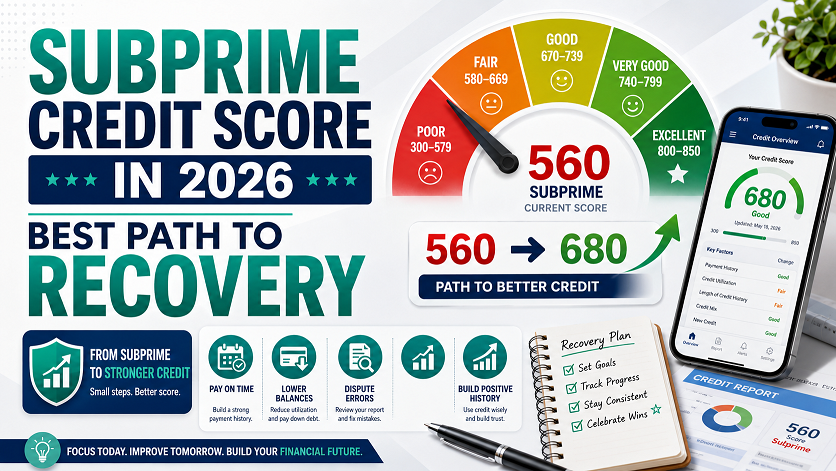
A subprime credit score is not a single nationwide cutoff or a permanent label. It is a risk category defined differently by lenders, scoring models and research datasets. Recovery usually starts by preventing new late payments, correcting genuine report errors, reducing expensive revolving debt and adding only one affordable credit-building account when needed. A realistic 6–12 month plan can strengthen the underlying report, but nobody can guarantee a particular score, approval date or interest rate.
Being placed in a subprime tier can make borrowing more expensive and restrict which credit cards, auto loans, personal loans or apartments are available. The wrong response is to apply everywhere, accept the first high-cost offer or pay a “credit sweep” company. Each can deepen the problem.
This guide is for consumers who need a practical path from high-risk borrowing toward safer credit. It does not repeat the broad definition of a good score or promise rapid point gains. Instead, it explains how subprime classifications work, how much expensive financing can cost under transparent assumptions and what to prioritize month by month.
- What subprime means
- Why a score enters a high-risk tier
- The cost of subprime borrowing
- First 30 days: financial triage
- Prioritized 6–12 month plan
- Safer credit-building products
- Auto, personal loan and mortgage decisions
- Disputes, collections and identity theft
- How to measure progress
- Frequently asked questions
What is a subprime credit score?
“Subprime” generally describes borrowers whom a lender or analyst places in a higher-risk category. It does not identify one score range across every product. A bank can use a FICO model, a VantageScore model, an industry-specific score, internal underwriting data and separate pricing tiers. The score you see in an app may not be the score used for an auto loan or mortgage.
For a concrete example, a November 2025 Federal Reserve analysis of the New York Fed Consumer Credit Panel/Equifax defined subprime as an Equifax Risk Score below 620, near-prime as 620–719 and prime as above 719. Those boundaries belong to that dataset; they are not a law or universal approval rule. Another lender may label the same person differently.
| Term | What it actually tells you | What it does not tell you |
|---|---|---|
| Subprime | A particular lender, model or dataset considers the application/report higher risk | That every lender will deny you or use the same cutoff |
| Credit score | A model’s numerical assessment of report data at a point in time | Your income, savings, collateral, DTI or complete underwriting result |
| Prequalification | An initial estimate based on limited information, sometimes using a soft inquiry | Guaranteed approval, final APR, limit or loan amount |
| Approval | The lender accepted the application under stated terms | That the product is affordable or competitively priced |
Ask a lender which score model and version it used, the key adverse-action reasons, and which factors besides score affected the decision. If credit contributed to a denial or worse terms, federal notices may provide useful reasons and information about the report source. Those reasons are more actionable than a generic label.
Why a credit profile becomes subprime
A score usually reflects multiple report variables. The most effective recovery step depends on the actual cause rather than the number alone.
- Recent late payments: a missed card, auto, mortgage or student-loan payment can weigh heavily, particularly when recent or severe.
- High revolving utilization: card balances close to limits can indicate elevated risk even when payments remain current.
- Collections or charge-offs: these serious derogatory items require validation, accuracy review and a financial decision—not a false dispute.
- Default or repossession: severe payment failures can affect both score and underwriting for years.
- Thin or young file: limited history can produce a low or nonexistent score even without major negatives.
- Frequent applications: many new accounts and hard inquiries in a short period can increase risk signals.
- Report errors or identity theft: wrong late payments, mixed files, duplicate balances or fraudulent accounts can depress the profile unfairly.
Pull all three reports through AnnualCreditReport.com. Make an account inventory showing status, balance, limit, minimum payment, APR, due date and whether the information is accurate. Do not begin with a generic deletion letter.
How much can subprime borrowing cost?
Federal banking guidance recognizes that subprime loans generally carry higher rates and fees because lenders price for greater expected risk. The cost difference can be enormous, especially for auto financing. A May 2026 Federal Reserve note found average rates around 25% in the buy-here-pay-here segment studied, compared with 5.6% for prime borrowers using traditional auto finance. Those findings describe the studied markets, not a quote available to every applicant.
| Illustrative loan | Monthly payment | Total of 60 payments | Total interest |
|---|---|---|---|
| $20,000 at 5.60% | About $382.95 | About $22,976.82 | About $2,976.82 |
| $20,000 at 25.00% | About $587.03 | About $35,221.59 | About $15,221.59 |
| Difference | About $204.08 more | About $12,244.77 more | About $12,244.77 more |
The higher-rate example costs more than $12,000 extra under the stated assumptions. It also creates a larger payment, increasing the chance of future delinquency. A cheaper vehicle, larger verified down payment, credit-union comparison or delayed purchase can matter more than negotiating a few dollars from the sticker price.
Credit-card costs deserve the same scrutiny. The CFPB has warned that retail cards can carry high APRs and that easier approval does not equal good value. Compare purchase APR, annual fee, deposit, penalty provisions and whether the issuer reports to all three nationwide bureaus. Never carry a balance for the purpose of building credit; interest is not required to create payment history.
First 30 days: stabilize before trying to optimize
Protect every current account
Bring due dates into one calendar, turn on reminders and set autopay only when the checking-account buffer can support it. Preventing a new late payment is the first priority.
Cover essential living costs
Keep housing, utilities, food, insurance, transportation and medicine ahead of elective extra debt payments. A plan that causes another missed bill is not recovery.
Stop new high-cost borrowing
Pause payday loans, fee-heavy cards, buy-here-pay-here shopping and repeated applications while you map the problem.
Review all credit reports
Separate accurate negatives from errors. Record bureau, account, disputed field, evidence and required follow-up.
Contact creditors before default
Ask about hardship, due-date changes or structured repayment. Obtain the exact terms, reporting treatment and fees in writing.
Do not prioritize points over solvency
Draining emergency savings to lower card utilization may leave no money for rent or the next minimum payment. Keep a reasonable buffer and choose a sustainable repayment amount.
A prioritized 6–12 month subprime credit recovery plan
| Period | Primary objective | Actions | Evidence of progress |
|---|---|---|---|
| Days 1–30 | Stop deterioration | Inventory debts; protect current accounts; dispute documented errors; contact creditors before further delinquency; remove unnecessary applications | No new missed payments; complete report inventory; written hardship decisions |
| Months 2–3 | Reduce immediate risk | Build a starter emergency buffer; pay revolving balances using a chosen method; resolve identity theft; confirm dispute updates | Lower reported card balances; corrected fields; cash buffer begins |
| Months 4–6 | Create consistent positive data | Maintain on-time payments; review whether one low-fee secured card or credit-builder loan fills a genuine gap; avoid stacking products | Several consecutive current statements; no unnecessary new accounts |
| Months 7–9 | Lower cost and exposure | Continue debt reduction; request fee waivers or product changes where appropriate; compare refinance only if real offers reduce total cost without harmful terms | Lower utilization and interest expense; stronger cash flow |
| Months 10–12 | Prepare for a planned application | Review reports again; correct residual errors; preserve stable balances and employment/income documents; shop in a controlled window | Cleaner reports, documented affordability and fewer surprises |
Choose a debt-paydown method you can maintain
The avalanche method directs extra money to the highest APR while paying every minimum; it typically minimizes interest. The snowball method targets the smallest balance first and may improve motivation. Neither changes the need to keep all accounts current. If minimums are unaffordable, contact a nonprofit credit counselor and creditors rather than pretending an aggressive spreadsheet solves the cash-flow gap.
Manage utilization without myths
Lower revolving utilization can help when high balances are a major risk factor, but “always stay under 30%” is not a magic threshold. Scores can respond to several utilization measures, including individual and aggregate balances. Lower is generally safer, but 0% on every card is not required and carrying interest-bearing debt is unnecessary.
Pay before the statement closes when you want a lower balance reported, but first confirm the issuer’s reporting practice. A due-date payment prevents lateness; a statement-date payment changes the balance likely to appear on the report. They solve different problems.
Secured cards and credit-builder loans: useful or expensive?
A secured credit card requires a refundable deposit that generally supports the credit limit. It may help a thin or damaged file when the issuer reports accurate monthly history. It is not automatically the best option and approval is not guaranteed.
Compare secured credit cards by:
- Annual fee and any monthly or application fees.
- Minimum deposit and whether it is refundable.
- Purchase APR, although paying in full avoids ordinary purchase interest when the grace-period rules apply.
- Reporting to Equifax, Experian and TransUnion.
- Graduation or deposit-return policy, without assuming it will occur.
- Prequalification availability and whether it uses a hard inquiry.
- Foreign transaction fees and other costs relevant to actual use.
A credit-builder loan commonly places borrowed funds into a locked account while the consumer makes payments. It may add installment history, but fees and interest can make it poor value when the file already contains current installment loans. Compare total payments with the amount ultimately released and confirm bureau reporting.
One product is often enough
Opening several secured cards and credit-builder loans creates fees, deposits, inquiries and more due dates. Add a product only when it fills a specific reporting gap and fits the budget.
Auto loans, personal loans and mortgages with subprime credit
Auto financing
Negotiate the vehicle price, trade-in and financing separately. Ask for the amount financed, APR, term, monthly payment and total of payments. Remove optional add-ons you do not want before signing. A long term can make a costly vehicle appear affordable while increasing interest and negative-equity risk.
Compare a bank or credit-union preapproval before visiting a dealer. If the only available offer has extreme cost, consider a lower-priced vehicle, larger down payment from nonborrowed funds, or waiting while the report improves. Verify that the lender—not merely a third-party collector—reports positive payments.
Personal loans and consolidation
A debt-consolidation loan helps only when its verified APR and fees reduce total cost, the payment is sustainable and paid-off cards do not refill. Prequalification can help compare potential terms, but final underwriting may differ. Calculate net proceeds after origination fees and total repayment over the full term.
Mortgages
Mortgage eligibility is not determined by a generic subprime label. Programs evaluate specific mortgage scores, DTI, down payment, reserves, property, income and loan history. A low advertised minimum is not an approval promise. Housing counseling from a HUD-approved agency can help applicants understand readiness without steering them into high-cost credit repair.
Disputes, collections and identity theft
Accurate negative information generally cannot be removed simply because it hurts. Dispute factual errors with the bureau and the company furnishing the data. Identify the exact field, explain why it is wrong and attach relevant statements, payment records, identity documents or correspondence.
For collections, first verify ownership, amount, dates and whether the debt is yours. Debt validation under the FDCPA and a credit-report dispute under the FCRA are different processes. Paying a collection does not guarantee deletion or a score increase. Get settlement terms in writing and consider applicable limitation periods and tax consequences; state law varies.
For identity theft, use IdentityTheft.gov and follow the separate blocking and recovery process. Never file a false identity-theft report to remove legitimate debts. Use our detailed credit-report dispute guide for evidence and escalation steps.
How to measure recovery without chasing daily scores
Monitor factors you can verify monthly:
- Number of new late payments: target zero.
- Total and per-card reported utilization.
- High-interest principal reduced.
- Emergency savings available.
- Errors corrected across each bureau.
- Months since the most recent derogatory event.
- Number of unnecessary hard inquiries and new accounts.
- Total fees and interest paid.
Scores from different services may move differently because the bureau data, model and update time differ. Record the score name and source instead of comparing unlike numbers. A lender’s approval criteria can also tighten or loosen while your own report improves.
The New York Fed reported $18.8 trillion in total U.S. household debt and 4.7% of outstanding debt in some stage of delinquency for the second quarter of 2026. That national context is useful for understanding the market, but it cannot predict an individual’s recovery. Your payment history, balances and report accuracy are the relevant operational measures.
Frequently asked questions
What score is considered subprime?
There is no universal cutoff. Some Federal Reserve research uses an Equifax Risk Score below 620 for a particular dataset, but lenders and models define tiers differently.
Can a subprime score recover in six months?
The underlying report can improve in six months, especially when high card balances or errors are central. Serious accurate negatives usually require more time. No point increase is guaranteed.
Is 580 always a subprime score?
It may fall into a higher-risk tier under many systems, but the label, approval and pricing depend on the lender, product, score model and complete application.
Should I pay collections first or credit cards?
First prevent new late payments and protect essentials. Then verify collections and compare legal, underwriting and cash-flow consequences while high-APR current cards continue accruing interest.
Do secured cards guarantee score improvement?
No. They may add positive history when used responsibly and reported, but fees, new-account effects and the rest of the file determine results.
Do I need to carry a balance to build credit?
No. Paying the statement balance in full can establish payment history without ordinary purchase interest when the card’s grace-period terms apply.
Is 30% utilization the perfect target?
No single percentage guarantees a result. Lower reported revolving utilization is generally safer, but scoring examines multiple factors and thresholds.
Can credit repair remove accurate late payments?
No legitimate company can guarantee deletion of verified accurate information. Disputes are for incomplete or inaccurate reporting.
Are buy-here-pay-here auto loans safe?
They can be extremely expensive. Compare APR, total payments, add-ons, repossession terms and bureau reporting with bank or credit-union alternatives.
Will debt consolidation fix my credit?
Not by itself. It can simplify payments or reduce cost when terms are better, but new debt, fees and reused cards can worsen the outcome.
How often should I check my credit reports?
Check during initial recovery, after disputes or major account changes and before an important application. Use the federally authorized report source.
When should I apply for new credit?
Apply when the product fills a genuine need, the payment is affordable and reports are accurate—not merely because a score app suggests approval odds.
Bottom line
Leaving a subprime tier is not about finding a loophole. Stabilize every current obligation, protect essential spending, verify all reports, reduce expensive revolving debt and add new credit only when it solves a documented gap.
Measure success through fewer late payments, lower balances, corrected data, lower interest expense and stronger savings. Those improvements matter even before a scoring model or lender changes its label.
Related guides
Official sources reviewed
- Federal Reserve: consumer delinquency and score tiers
- Federal Reserve: subprime buy-here-pay-here auto lending
- New York Fed: Household Debt and Credit Report
- CFPB: 2025 Consumer Credit Card Market Report
- CFPB: high cost of retail credit cards
- CFPB: disputing credit-report errors
- Federally authorized credit-report source
- FTC IdentityTheft.gov
3 thoughts on “Subprime Credit Score in 2026: A 6–12 Month Recovery Plan”
Comments are closed.