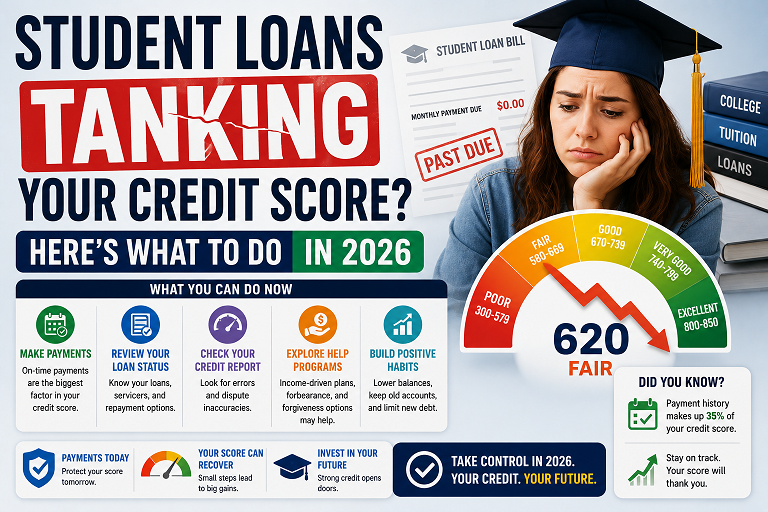
If student loans are hurting your credit, start with the loan’s actual status—not a promised score increase. Pull all three credit reports, identify whether each loan is federal or private, and compare the reports with your servicer records. A current loan may require only an error dispute or lower overall revolving balances. A delinquent federal loan calls for immediate servicer contact and an affordable current repayment option. A defaulted federal loan generally requires rehabilitation or consolidation to return to good standing. Private-loan remedies depend on the contract and lender.
Student loans can affect credit for years, but the right response depends on what happened. Missing one payment, defaulting, seeing a duplicate tradeline and having a correctly reported high balance are four different problems. Treating them as one generic “credit repair” issue wastes time and can make the situation worse.
This guide is current as of August 29, 2026. Federal student-loan programs have changed rapidly: the SAVE plan ended by court order in March 2026, and new repayment-plan rules took effect in 2026. Always confirm the option shown inside your own StudentAid.gov account before acting.
- Choose the correct action by loan status
- How student loans affect credit
- Federal versus private loans
- What to do when delinquent
- Federal default: rehabilitation or consolidation
- How to dispute reporting errors
- Current repayment-plan considerations
- Rebuild credit responsibly
- Avoid relief scams
- Frequently asked questions
Student-loan action table: start with your current status
| What you see | What it may mean | Best first action | Official contact |
|---|---|---|---|
| Current and accurate | The loan is being paid as agreed, even if the balance is large | Keep payments on time; do not pay a credit-repair company to dispute accurate data | Current servicer |
| Payment due or recently missed | Delinquency begins when a scheduled payment is not made by its due date | Contact the servicer immediately; ask what payment, plan, deferment or forbearance options are actually available | StudentAid.gov for federal loans; lender for private loans |
| Federal loan in default | Most federal loans typically default after more than 270 days without required payment | Compare federal rehabilitation and Direct Consolidation; verify collection consequences | MyEdDebt.ed.gov or the contact listed in StudentAid.gov |
| Private loan in default | The contract controls when default occurs and what remedies apply | Ask the lender or collector for written status, payoff and hardship or settlement terms; consider qualified legal help | Private lender/servicer and CFPB complaint portal |
| Wrong late payment, balance, owner or status | Possible furnishing or credit-report error | Document the discrepancy and dispute with both the bureau and the company furnishing the information | Credit bureau and servicer |
| Loan you do not recognize | Possible identity theft, school fraud, transfer confusion or duplicate reporting | Check StudentAid.gov, contact the listed company and use IdentityTheft.gov if identity theft is involved | Federal Student Aid, FTC and bureau |
| Closed or transferred loan still appears | Old tradelines can remain, but balances and status must be accurate | Confirm the old account shows transferred/closed with the correct balance and the new servicer reports correctly | Old and new servicers |
Do not stop paying because you filed a dispute
A credit-report dispute does not ordinarily suspend a valid payment obligation. Continue following the current agreement unless the lender or servicer provides a different written instruction.
How student loans affect your credit score
A student loan is an installment account. Credit reports can show the creditor or servicer, account status, original and current balance, scheduled payment, payment history and dates. Scoring models then evaluate that data with the rest of the report. There is no fixed rule that a missed student-loan payment costs a particular number of points.
Payment history
Late payments and default can be serious because payment history is highly influential in common scoring models. The effect varies with how late the payment is, how recently it happened, how many accounts are affected and the rest of the file. Multiple loan tradelines may be associated with one billing relationship, so a servicer problem can create several negative entries. That does not automatically make the entries duplicates; verify each underlying loan.
Balance and installment utilization
Student-loan balances may fall slowly, or even rise temporarily when interest accrues. A high installment balance is not treated like a maxed-out credit card. Paying down legitimate debt may help the overall profile, but no responsible source can promise a specific score gain from an extra student-loan payment. Preserve emergency savings and higher-priority bills before sending money solely to chase points.
Age and credit mix
An older, current installment account can contribute to credit age and mix. Paying it off is still a valid financial goal even if a score moves temporarily when the account closes. Interest cost, cash flow and debt freedom matter more than optimizing every short-term scoring fluctuation.
Hard inquiries and refinancing
Applying to refinance private or federal student debt with a private lender can produce a hard inquiry and a new account. More importantly, refinancing federal loans into a private loan is generally irreversible and can surrender federal repayment, deferment, discharge and forgiveness protections. Compare the total loan terms and lost protections—not just the advertised interest rate.
Federal versus private student loans
Log in to StudentAid.gov to identify federal loans and servicers. Loans absent from that federal record may be private, institutional or otherwise require checking the credit report and original paperwork. Do not assume the company sending the bill owns the loan; it may only service it.
| Feature | Federal student loans | Private student loans |
|---|---|---|
| Repayment options | Plans and eligibility are set by federal law and program rules; options may include fixed, graduated, extended or income-linked structures depending on loan type and current rules | Options depend on the note, lender and state law; hardship programs are lender-specific |
| Default timing | Most federal loans typically default after more than 270 days of missed required payments | Contract controls; default may occur sooner |
| Recovery from default | Rehabilitation and consolidation are the two main official paths, with different credit and timing consequences | No federal rehabilitation right; negotiate directly and get every promise in writing |
| Forgiveness/discharge | Potential federal programs may apply based on employment, disability, school conduct or other eligibility | Generally limited to contract terms and applicable law |
| Where to verify | StudentAid.gov and official federal servicer pages | Promissory note, lender/servicer disclosures and regulator resources |
A cosigner changes private-loan stakes. Missed payments can affect both borrowers’ reports, and a lender’s cosigner-release conditions can be strict. Ask for the written release policy; never rely on a salesperson’s informal assurance.
What to do when a student loan is delinquent
Confirm the amount and due date
Compare the bill, bank records and online account. Check whether autopay failed, a transfer changed instructions or an application remains pending.
Contact the servicer now
Ask what amount restores the account, whether a payment was misapplied and which current affordable-payment options fit your loan type. Record the date, representative and confirmation number.
Submit complete documents
If applying for a repayment plan, deferment or forbearance, provide every required document and monitor the account until approval is visible. An application does not always prevent bills from coming due.
Protect essential expenses
Do not agree to a payment that leaves no money for housing, utilities, food, insurance or medicine. Ask for the lowest legitimate sustainable option.
Escalate unresolved servicing errors
Use the servicer’s escalation channel, Federal Student Aid Feedback Center for federal-loan issues, and CFPB complaint process when appropriate.
Deferment and forbearance can temporarily pause or reduce required payments when eligibility rules are met, but interest consequences differ. They are not automatic credit-repair devices and may increase total cost. Obtain the effective dates and interest treatment in writing.
Early contact preserves options
A loan that is delinquent but not yet defaulted may still qualify for repayment-plan changes or temporary relief that becomes harder to use after default. Do not wait for a collection notice.
Defaulted federal loans: rehabilitation versus consolidation
Federal Student Aid identifies loan rehabilitation and loan consolidation as the two main ways to leave default. Both can restore the loan to good standing, but they work differently and do not erase every accurate part of the credit history.
| Question | Rehabilitation | Direct Consolidation |
|---|---|---|
| How it works | Enter an agreement and make the required series of on-time payments; Federal Student Aid currently describes nine payments for rehabilitation | Create a new Direct Consolidation Loan after meeting the applicable default-resolution conditions |
| Speed | Usually slower because qualifying payments must be completed | Often faster once requirements and processing are complete |
| Credit-report treatment | The default notation is removed after successful rehabilitation, but accurate earlier late payments may remain | The old default history may remain; the new consolidation loan is reported separately |
| Costs and balance | Ask about collection costs, payment calculation and interest | Unpaid interest may capitalize, and consolidation can affect repayment/forgiveness details |
| Use limits | Historically restricted; rules change July 1, 2027, so verify current eligibility for each loan | Eligibility depends on loan type and prior consolidations |
Neither route guarantees a score increase. Rehabilitation can remove the default status from the report, but the underlying pre-default late payments can remain if accurate. Consolidation can return federal aid eligibility more quickly in some circumstances, yet it does not retroactively delete accurate default history.
Default can also trigger federal collection tools beyond ordinary private debt collection, including Treasury offset and administrative wage garnishment when legal requirements are met. Review notices promptly. Borrowers facing Social Security offset, disability, school-related claims or severe hardship should check official discharge and objection procedures instead of paying a private “relief” company.
How to dispute student-loan credit-report errors
Get reports from AnnualCreditReport.com and compare all three because the information may differ. Highlight the exact field that is wrong: account ownership, balance, payment month, delinquency date, loan status, transfer status or identity.
- Collect proof. Use statements, payment confirmations, bank records, account screenshots, correspondence and StudentAid.gov records.
- Write a narrow dispute. Identify the account, disputed field, correct fact and requested correction. Avoid form letters demanding deletion of accurate data.
- Dispute with the bureau and furnisher. CFPB guidance supports contacting both the credit-reporting company and the company that provided the information.
- Preserve records. Save submissions, attachments, tracking and results. Online disputes are valid; mail can be useful when you need a paper trail.
- Review every result. Confirm all bureaus were corrected and the balance/status did not reappear incorrectly after a servicing transfer.
- Escalate with evidence. Follow the dispute channel before filing a CFPB complaint about inaccurate reporting; include prior results and a concise timeline.
Most standard FCRA disputes have an investigation framework commonly described as 30 days, with circumstances that can extend it. Identity-theft blocking follows a separate process and requires truthful identity-theft documentation. A disagreement about affordability is not proof that reporting is inaccurate.
For a detailed workflow and letter evidence, use our credit-report error guide and credit dispute letter templates.
Federal repayment-plan changes to verify in 2026
Do not rely on an old article telling every borrower to join SAVE. Federal Student Aid’s current court-action guidance states that the SAVE plan was ended following a March 10, 2026 court order. Affected borrowers should follow official notices and use the federal repayment calculator to review currently available plans.
Federal Student Aid also describes significant changes beginning July 1, 2026, including newer repayment structures and transition rules that vary by loan disbursement date and loan type. Parent PLUS, consolidation and older FFEL loans can have different choices. The correct recommendation cannot be made from credit score alone.
Compare these details before selecting a plan
- Required monthly payment based on verified household information.
- Whether the plan is available for each exact loan type.
- Interest accrual, capitalization and projected total repayment.
- Whether months count toward a forgiveness program relevant to you.
- Recertification or annual documentation requirements.
- Whether consolidation is required and what benefits or payment counts could change.
- What happens if income, family size or employment changes.
A lower payment can prevent delinquency and protect cash flow, but it can also extend repayment and raise total interest. Use StudentAid.gov’s current calculator, download the results and compare them with the servicer’s written confirmation.
How to rebuild credit after student-loan problems
Once the account is current or default is resolved, improvement comes from accurate reporting and consistent behavior across the whole credit file. There is no legitimate “student loan credit sweep.”
- Automate carefully. Autopay can reduce missed-payment risk, but keep a cash buffer and verify the first withdrawal after any servicer change.
- Keep card balances controlled. Revolving utilization can change more quickly than old student-loan history, but never borrow simply to manipulate a score.
- Avoid unnecessary applications. Space new credit decisions and compare prequalification where available.
- Monitor all reports. Watch transfers, rehabilitation completion and consolidation balances until reporting stabilizes.
- Build an emergency reserve. Even a modest buffer can prevent the next missed payment.
- Pay every account on time. New positive history does not erase accurate negatives, but it can gradually strengthen the file.
Do not close a useful credit card merely because student debt caused stress, unless fees or overspending make closure appropriate. Do not open a secured card if you cannot fund the deposit without missing essential bills. The best credit-building plan is one the household can sustain.
Student-loan relief and credit-repair scams
Federal Student Aid does not charge a fee to apply for federal repayment plans, consolidation or official forgiveness and discharge programs. Treat unsolicited messages promising instant forgiveness, a secret Biden/Trump program, guaranteed deletion or a government affiliation as warning signs.
- Never share your StudentAid.gov password or one-time authentication code.
- Do not sign a power of attorney without understanding its scope.
- Do not pay a company to submit forms you can file through official channels for free.
- Verify federal servicers and contacts inside StudentAid.gov, not through a search ad or caller-provided link.
- Get private-loan settlements in writing before paying and understand tax, cosigner and credit-report consequences.
- Never file a false identity-theft report or dispute accurate loans as “not mine.”
No company can guarantee a credit-score result
Legitimate federal default resolution changes loan status under program rules. It does not create a right to delete every accurate late payment, nor can it guarantee mortgage, auto-loan or credit-card approval.
Frequently asked questions
How long before a federal student loan defaults?
Federal Student Aid says most federal loans typically default after more than 270 days without a required payment. Delinquency begins earlier, so contact the servicer immediately.
Can one late student-loan payment ruin my credit?
It can hurt, but no universal point loss applies. Severity, recency, the number of affected tradelines and the rest of the credit file determine the result.
Will rehabilitation remove all late payments?
No. Successful federal rehabilitation removes the default notation, but accurate late payments reported before default may remain.
Is consolidation better than rehabilitation?
Neither is universally better. Consolidation may be faster; rehabilitation has different credit-report treatment. Compare eligibility, costs and program effects.
Is the SAVE plan available in 2026?
No. Current Federal Student Aid guidance says a March 10, 2026 court order ended SAVE. Use StudentAid.gov to review currently available plans.
Can I dispute accurate student-loan late payments?
You may dispute information you believe is inaccurate, but a truthful dispute is not a method for deleting verified, accurate history.
Why does one bill create several credit-report accounts?
Student debt is often issued as multiple underlying loans serviced through one bill. Verify each loan number before assuming the tradelines are duplicates.
Does paying off a student loan immediately raise a score?
Not necessarily. Scores can move either way after an installment account closes. Focus on interest, cash flow and overall debt rather than a promised point gain.
Can private student loans be rehabilitated?
Private loans do not have the federal rehabilitation right. Any workout, modification or settlement depends on the lender, contract and applicable law.
Should I refinance federal loans to lower the rate?
Only after comparing total cost and the permanent loss of federal protections. A private refinance cannot generally be converted back into federal debt.
Where can I see all my federal student loans?
Use your secure StudentAid.gov account. Then compare its loan and servicer records with all three credit reports.
What if my servicer will not correct an error?
Preserve evidence, complete bureau and furnisher disputes, use Federal Student Aid’s feedback process for federal issues and consider a CFPB complaint.
Bottom line
Student-loan credit recovery begins with diagnosis. Identify every loan, confirm whether it is federal or private, label it current, delinquent, defaulted or incorrectly reported, and then use the official remedy for that status.
Act quickly before delinquency becomes default, but reject anyone promising instant deletion or guaranteed points. Sustainable repayment, accurate reports and consistent payment behavior are the durable path forward.
Related guides
Official sources reviewed
- Federal Student Aid: delinquency and default
- Federal Student Aid: getting out of default
- Federal Student Aid: collections on defaulted loans
- Federal Student Aid: IDR court actions
- Federal Student Aid: 2026 program updates
- CFPB: dispute credit-report errors
- CFPB: submit a complaint
- Federally authorized credit-report source
- FTC IdentityTheft.gov
2 thoughts on “Student Loans Hurting Your Credit Score? What to Do in 2026”
Comments are closed.