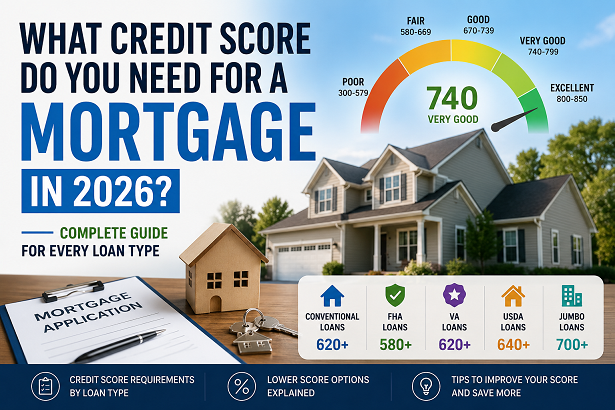
There is no single credit score required for every mortgage. FHA permits eligible financing with a minimum decision credit score of 500, although a score of at least 580 is required for FHA’s maximum financing and lenders may set higher standards. VA does not establish one universal numerical minimum. USDA, conventional, jumbo and other mortgages use program-specific automated or manual underwriting rules plus lender overlays. A stronger score may improve available pricing, but no score guarantees approval or a particular mortgage rate.
“What credit score do I need to buy a house?” sounds like a question with one number as the answer. In practice, the answer depends on the loan program, underwriting method, property, down payment, debt-to-income ratio, reserves, credit history and lender.
A borrower with a 620 score might receive an automated approval for one conventional scenario but not another. A veteran below a lender’s ordinary cutoff might qualify through a different VA lender. An FHA applicant may meet HUD’s program floor but still be declined because of a lender overlay or weaknesses elsewhere in the file.
This guide provides the loan-type overview. It does not replace a lender’s current underwriting decision, and it avoids “approval odds” or advertised-rate tables that become outdated quickly.
HUD, VA, USDA, Fannie Mae and Freddie Mac apply different eligibility frameworks.
A lender may adopt standards stricter than the agency or investor minimum.
Income, debts, down payment, reserves and property details matter alongside credit.
Important 2026 update
The common advice that “all conventional mortgages require 620” is now too broad. Fannie Mae states that a minimum credit score is not required for casefiles approved through Desktop Underwriter. Freddie Mac similarly states that a minimum Indicator Score is not required for mortgages receiving an “Accept” decision through Loan Product Advisor. Manual underwriting, special products and individual lenders can still have numerical requirements.
2026 mortgage credit score requirements by loan type
| Mortgage type | Official score framework | Down payment context | Main eligibility limits | Common source of confusion |
|---|---|---|---|---|
| Conventional—automated | No single fixed minimum for a Fannie Mae DU approval or Freddie Mac LPA “Accept” result | Varies by transaction and program; low-down-payment options may be available | Automated risk assessment, income, debts, property, LTV and product rules | A lender can still impose a 620 or higher overlay. |
| Conventional—manual | Numerical minimums vary by GSE, rate type, LTV, units and product | Greater equity or reserves may be required for riskier scenarios | Detailed manual-underwriting matrices | One headline number cannot summarize every matrix combination. |
| FHA | 500 program floor; 580 for maximum financing under HUD’s MDCS rules | As low as 3.5% at 580+; generally at least 10% for 500–579 | FHA appraisal, mortgage insurance, occupancy and underwriting rules | Many FHA lenders require a score above HUD’s floor. |
| VA | VA does not publish one universal minimum score | Eligible borrowers may have a no-down-payment option, subject to entitlement, price and lender review | Service eligibility, residual income, credit, occupancy and lender underwriting | Online lender cutoffs are overlays, not a VA-wide rule. |
| USDA Guaranteed | Credit is evaluated through GUS or manual underwriting; 640 is often associated with streamlined automated treatment, not a universal approval promise | Eligible loans may offer 100% financing | Household income limits, eligible rural area, primary residence and repayment ability | A score below 640 is not automatically the same as program ineligibility. |
| Jumbo/portfolio | No nationwide government minimum | Often larger down payment and reserve requirements, depending on lender | Bank or investor policy, loan size, assets, property and borrower profile | Requirements can differ sharply among lenders. |
These are not guaranteed-approval thresholds
Meeting a score rule does not guarantee approval, and missing a lender’s cutoff does not prove that every lender or loan program will decline the application. Always ask whether a stated cutoff is an agency rule, automated-underwriting result or lender overlay.
What credit score is needed for a conventional mortgage?
A conventional mortgage is not insured or guaranteed by FHA, VA or USDA. Many conventional loans are sold to Fannie Mae or Freddie Mac, but banks can also retain loans or sell them to other investors.
For Fannie Mae, Desktop Underwriter evaluates the combined risk of the application. The current Selling Guide states that DU casefiles do not have one minimum credit score requirement. For Freddie Mac, Loan Product Advisor can return an “Accept” decision without a minimum Indicator Score. Those policies do not mean credit is irrelevant. The systems evaluate credit history and other risk factors, and the score may affect mortgage pricing, mortgage insurance, product eligibility or the lender’s own decision.
Why do lenders still say 620?
Some lenders use 620 as an operational overlay, and some manual-underwriting or special-product scenarios have published numerical requirements. The number remains a useful market reference, but it should not be presented as a universal Fannie Mae/Freddie Mac law.
Fannie Mae’s manual guidance, for example, distinguishes fixed-rate and adjustable-rate mortgages and applies other product rules. Freddie Mac’s manual matrix changes with loan-to-value ratio, occupancy, unit count and transaction type. A borrower should request a program-specific explanation rather than rely on a general blog cutoff.
Can you get a conventional loan without a score?
Some GSE pathways permit borrowers without usable traditional credit scores when nontraditional credit or automated-underwriting requirements are satisfied. These files require careful documentation and are not offered by every lender. Rent, utility, insurance and other payment histories may be relevant under specific rules, but paying those bills does not automatically create a score.
For deeper model information, see FICO 10T vs. Classic FICO for mortgages. Model approval and lender rollout should not be confused with a new universal minimum score.
FHA loan credit score requirements
HUD’s FHA guidance provides the clearest program-level score tiers. A borrower with a minimum decision credit score below 500 is not eligible for FHA-insured financing. A score from 500 through 579 generally limits the loan to 90% loan-to-value, meaning at least 10% equity or down payment in a purchase context. A score of 580 or higher can qualify for maximum FHA financing, which may permit a 3.5% minimum down payment.
These are FHA insurance rules, not promises that an FHA-approved lender must approve every eligible score. Lenders evaluate payment history, disputed accounts, collections, income, debt ratios, cash needed to close, property condition and other requirements. Many lenders set a higher minimum score than HUD’s floor.
FHA costs to compare
FHA loans can help borrowers who have smaller down payments or credit challenges, but the comparison should include mortgage insurance, interest rate, APR, lender fees and total monthly payment. A conventional loan with a higher rate is not automatically more expensive, and an FHA loan with a lower advertised rate is not automatically cheaper. Request both scenarios when eligible.
Our dedicated FHA credit score requirements guide covers the program in greater depth. This pillar intentionally avoids duplicating the complete FHA handbook discussion.
VA loan credit score requirements
The Department of Veterans Affairs does not establish one universal minimum credit score for all VA-guaranteed home loans. VA requires lenders to determine that an eligible borrower is a satisfactory credit risk and has sufficient income after obligations. Lenders frequently create their own numerical overlays, which is why one VA lender may quote 620 while another uses a different standard.
VA eligibility also depends on qualifying service, entitlement and a valid Certificate of Eligibility. The lender reviews income, debts, residual income, payment history, occupancy and property requirements. A low score does not erase those standards, and a high score does not replace them.
What if one VA lender declines the application?
Ask for the adverse-action reasons and determine whether the issue is a VA requirement or the lender’s overlay. Another VA-approved lender may use different standards, but repeated applications should be purposeful. Correct factual credit-report errors, address documentation gaps and compare current written terms.
USDA mortgage credit requirements
USDA’s Single Family Housing Guaranteed Loan Program supports eligible primary-residence purchases in qualifying rural areas for households within income limits. Credit is evaluated through the Guaranteed Underwriting System or manual underwriting.
A 640 score is widely associated with streamlined or automated USDA treatment, but it should not be described as the only possible qualifying score or a guaranteed approval. Files with lower or limited scores may require additional review, documentation or manual underwriting, subject to USDA and lender requirements.
Credit score alone cannot establish USDA eligibility. The property address must qualify, household income must be within the applicable limit, the home must be a primary residence, and the borrower must demonstrate repayment ability. Check the current USDA eligibility tools and handbook rather than relying on a lender advertisement.
Jumbo, portfolio and non-QM mortgage scores
A jumbo mortgage exceeds the conforming loan limit applicable to the property. Because Fannie Mae and Freddie Mac do not purchase ordinary jumbo loans, the bank or investor establishes underwriting standards. Many jumbo programs favor strong scores, substantial reserves and lower debt ratios, but there is no federal jumbo-score minimum that applies to every lender.
Portfolio lenders keep certain mortgages instead of selling them under a standard agency framework. This can create flexibility for self-employed borrowers, unusual properties or strong-asset applicants, but terms vary. Non-QM loans may use alternative income documentation or serve specialized situations; they can carry higher rates, fees or down-payment requirements. “Non-QM” does not mean no underwriting or guaranteed approval.
Commercial terms such as bank-statement mortgage, asset-depletion loan, investment-property financing and debt-service coverage ratio loan describe different products. Compare licensing, APR, points, prepayment penalties, documentation, cash reserves and total cost—not just the score headline.
How your credit score affects mortgage rates and costs
The CFPB explains that credit is one factor affecting mortgage eligibility and rates. In general, a stronger credit profile may qualify for more favorable pricing, but the rate also depends on:
- loan type, amount and term;
- fixed versus adjustable rate;
- down payment and loan-to-value ratio;
- property type and occupancy;
- discount points and lender credits;
- mortgage insurance or guarantee fees;
- debt-to-income ratio and reserves;
- rate-lock period; and
- current financial-market conditions.
Do not use a national “average rate by score” table as a personal quote. Such tables often omit points, fees, property assumptions and lock dates. A useful comparison uses Loan Estimates issued near the same time for the same loan amount, property, down payment, term and loan type.
APR versus interest rate
The interest rate helps determine principal-and-interest payments. APR is a broader annualized cost measure that incorporates certain loan charges. APR can help compare similar mortgages, but it does not capture every ownership cost and may rely on assumptions about how long the loan remains open.
Should you pay points for a lower rate?
Discount points are upfront charges used to obtain a different interest rate. Calculate the monthly-payment reduction and divide the upfront point cost by that saving to estimate a simple break-even period. The decision depends on how long you expect to keep the mortgage, available cash and alternative uses for the money. Never drain emergency savings solely to reach a lower advertised rate.
Shop more than the score
CFPB guidance recommends requesting preapprovals from at least three lenders and comparing Loan Estimates. Different lenders can offer different rates, fees and overlays to the same borrower.
How mortgage lenders choose a credit score
Consumers have many credit scores. A score shown by a credit-card app may use a different bureau, model or date from the score obtained for mortgage underwriting. Traditional mortgage processes commonly review credit information from Equifax, Experian and TransUnion and apply program rules for selecting a representative score.
For one borrower, a lender may use a designated middle score when three usable scores are available. Multiple-borrower calculations depend on the current program and underwriting rules; do not assume the highest co-borrower score controls. Recent GSE scoring-model changes also require careful attention to actual rollout status.
Buying a generic consumer score before applying does not ensure that you are seeing the mortgage score. Checking all three reports for accuracy is usually more important. Learn the distinction in our Equifax FICO score guide.
How to prepare your credit for a mortgage
Review all three reports
Use AnnualCreditReport.com and check identity details, accounts, limits, balances, payment status and collections. Checking your own reports does not lower scores.
Correct genuine errors early
Disputes can require investigation and documentation. Do not submit false disputes against accurate information. Use our credit-report error guide.
Protect every payment date
A new late payment can change the score and underwriting result. Use reminders or carefully funded automatic payments.
Reduce revolving balances
Lower card debt can improve cash flow, utilization and debt obligations. Keep funds for closing costs and emergencies rather than emptying savings.
Avoid unnecessary new debt
Do not open a vehicle loan, credit card or furniture account before closing without discussing it with the mortgage professional.
Document income and assets
Collect pay records, tax documents, bank statements, gift documentation and explanations requested for the chosen program.
Compare program-specific preapprovals
Ask which loan type, scoring model, down payment and lender overlay were used. A vague online prequalification is not the same as a reviewed preapproval.
Request and compare Loan Estimates
Compare rate, APR, points, lender fees, mortgage insurance, monthly payment and cash to close using matching assumptions.
The CFPB notes that mortgage-rate shopping within a focused period is treated specially by scoring models; its current consumer guidance describes multiple mortgage credit checks within a 45-day window as recorded as a single inquiry. Because scoring models can differ, keep the shopping period concentrated rather than stretching applications across months.
Frequently asked questions
Is 620 a good enough credit score to buy a house?
It may be sufficient for some conventional, FHA, VA or USDA scenarios, but it does not guarantee approval. Current automated-underwriting rules, lender overlays, income, debt, down payment and property details determine the outcome.
Can I get a mortgage with a 580 score?
HUD permits FHA maximum financing at a minimum decision credit score of 580, but lenders may require a higher score and must evaluate the complete application. Other programs and lenders use different rules.
Can I buy a house with a 500 credit score?
FHA rules allow potential eligibility at 500 through 579 with a maximum 90% LTV, but finding a lender willing to approve at the program floor can be difficult. Meeting the score and down-payment tier does not guarantee approval.
What credit score is needed for a first-time home buyer?
First-time-buyer status does not create one universal score requirement. FHA, conventional low-down-payment, VA, USDA and state assistance programs have different eligibility and underwriting rules.
What is the minimum VA loan credit score?
VA does not establish one nationwide numerical minimum. VA-approved lenders assess credit risk and may set their own score overlays.
Does USDA require a 640 score?
A 640 score is commonly linked to streamlined automated treatment, but it should not be treated as a universal USDA eligibility cutoff or approval promise. Lower-score files can face manual review and stricter documentation.
Which credit score do mortgage lenders use?
It depends on the program, lender and implementation status. Mortgage lenders generally obtain bureau-specific scores and follow program rules, which may differ from the consumer score in a banking app.
How much will a higher score lower my mortgage rate?
No universal point-to-rate formula applies. Pricing changes with the lender, market, loan type, LTV, property, points and other factors. Compare written Loan Estimates instead of relying on an estimated rate table.
Should I wait to improve my credit before buying?
Compare the cost of waiting with current affordability, housing needs and available loan terms. A loan officer or HUD-approved housing counselor can model scenarios without guaranteeing future rates or home prices.
The bottom line
The credit score needed for a mortgage in 2026 depends on much more than a single cutoff. FHA retains a 500 program floor and a 580 threshold for maximum financing. VA does not impose one universal numerical minimum. USDA combines credit analysis with income and property eligibility. Fannie Mae and Freddie Mac automated underwriting no longer supports the blanket claim that every conventional borrower must have at least 620, although manual rules and lender overlays remain.
Treat score ranges as screening information, not approval promises. Review all reports, correct factual mistakes, maintain on-time payments, reduce expensive debt, protect closing funds and compare at least three current offers. The best mortgage is the affordable, well-documented loan that fits the borrower’s full financial situation—not simply the loan advertised with the lowest score requirement.
Related mortgage and credit guides
Official sources
- HUD: FHA minimum decision credit score rules
- HUD: FHA loan overview and down payment
- Department of Veterans Affairs: VA Lenders Handbook
- USDA Rural Development: Housing program handbooks
- Fannie Mae: General requirements for credit scores
- Freddie Mac: Credit score requirements and Loan Product Advisor
- CFPB: Credit scores, mortgage eligibility and rates
- CFPB: Request and compare multiple Loan Estimates
- AnnualCreditReport.com: Federally authorized credit-report access
13 thoughts on “What Credit Score Do You Need for a Mortgage in 2026?”