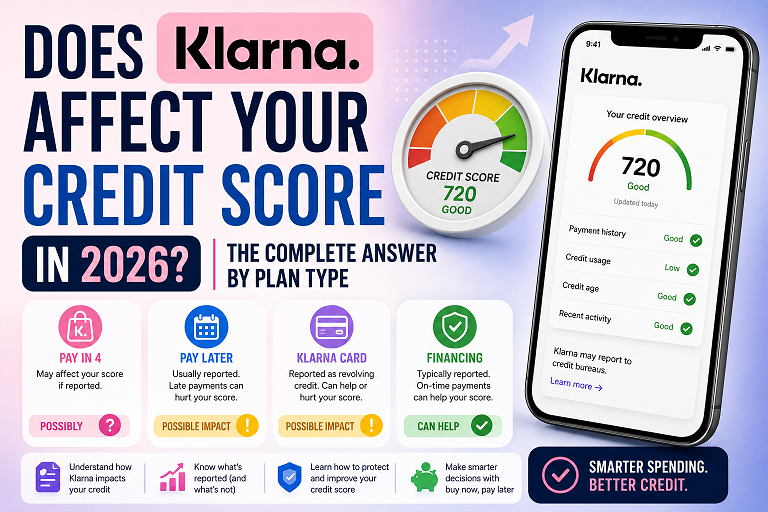
Klarna can affect your credit differently depending on the product. In the United States, Klarna says it uses a soft credit check for Pay in 4 and Pay in 30, so applying for those options does not create a score-impacting hard inquiry. Klarna does not report those short-term plans as ordinary repayment activity. Monthly Pay over time is reported to Experian and TransUnion, although Klarna currently says that data is visible only to you and does not yet affect your score. Any unpaid account sent to collections can create a separate risk to your credit.
“Does Klarna affect your credit score?” sounds like a yes-or-no question, but Klarna offers several products with different credit checks, repayment periods and reporting rules. Advice that treats Pay in 4, Pay in 30, Monthly Pay over time and the Klarna Credit Card as the same product can be dangerously incomplete.
This guide explains Klarna’s current U.S. policies, how a soft inquiry differs from a hard inquiry, what happens after a missed payment, and whether Klarna is a sensible way to build credit. Terms can change, so check the disclosure displayed for your specific purchase before accepting it.
Soft credit check; Klarna says repayment is not shared with credit bureaus.
Credit check plus reporting to Experian and TransUnion under the current U.S. policy.
An unpaid balance may be sent to collections and could harm the consumer’s credit profile.
Klarna credit impact at a glance: August 2026
| Klarna product | Application check | Routine reporting | Potential credit effect |
|---|---|---|---|
| Pay in 4 | Soft credit check | Klarna says it does not share this activity | No hard-inquiry effect; an unpaid collection can still create risk |
| Pay in 30 | Soft credit check | Klarna says it does not share this activity | No hard-inquiry effect; missed debt can still progress to collections |
| Monthly Pay over time | A credit check is performed; read the application disclosure | Loan and repayment activity shared with Experian and TransUnion | Klarna currently says the furnished data is consumer-only and does not affect scores; policy and model treatment may change |
| Klarna Credit Card | Klarna says application uses a soft check | Klarna’s bureau-reporting help page says card activity is not shared | Product-specific terms control; do not assume it builds credit |
Important: this table describes Klarna’s published U.S. policy on the date checked. It is not a promise about a future policy, a debt collector’s reporting, or every score a lender may use.
Does Klarna perform a credit check?
Klarna says it performs a soft credit check when a U.S. shopper uses Pay in 4 or Pay in 30. A soft inquiry can appear in the consumer-facing portion of a credit report, but it is not treated like a hard application inquiry in mainstream credit scores and is not shown to lenders in the same way.
A soft check does not guarantee approval. Klarna can assess each purchase separately using information such as the requested amount, repayment history with Klarna, outstanding plans and information obtained during its eligibility review. Approval for one purchase does not create a permanent Klarna credit limit or guarantee approval for the next transaction.
For Monthly Pay over time, Klarna states that a credit check is performed. Because applications and available products can differ, the safest practice is to read the credit authorization and Truth in Lending disclosure before selecting “accept.” Look specifically for the bureau, inquiry type, annual percentage rate, finance charge, payment schedule and total of payments.
Soft check versus hard check
A soft check is generally used for eligibility, account review or prequalification and does not reduce a typical credit score. A hard inquiry is associated with an application for credit and may influence a score for a period. The disclosure for the exact Klarna product—not a blog post—determines what you authorize.
Can checking Klarna eligibility lower your score?
Under Klarna’s currently published Pay in 4 and Pay in 30 policy, the soft check itself should not lower the score. That does not mean using BNPL is financially neutral. The scheduled payments reduce future cash flow, and missed bank debits may cause overdraft or nonsufficient-funds fees depending on the funding account and bank policy.
Consumers should also avoid repeatedly applying for longer-term installment offers without reading the inquiry language. “Checking an option” and completing a credit application are not always identical actions across lenders or products.
Does Klarna report to credit bureaus?
Klarna’s current U.S. help page says it shares new loans, on-time payments, late payments and defaults for Monthly Pay over time with Experian and TransUnion. It says it does not share activity for Pay in full, Pay in 4, Pay in 30 or the Klarna Credit Card.
The unusual detail is how the Pay over time data is presently used. Klarna says the furnished history is currently visible only to the consumer; other institutions cannot view it through the ordinary lender-facing history, and it does not yet affect the consumer’s score. This can change as bureau systems, lender access and scoring models evolve. Therefore, an article should not claim that Klarna financing will “never” affect a credit score.
Why might Klarna appear on a credit report but not change a score?
A credit report and a credit score are different products. A bureau may store information in a section or specialty file that is not supplied to every lender or used by a particular scoring model. A score is calculated from eligible report data using a named model and version at a particular time.
This explains how a consumer may see Klarna Pay over time information without experiencing a score change. It also explains why checking only a free app cannot prove what a mortgage, auto-loan or credit-card lender will see. Our guide to how credit scores work explains the difference between reports, models and underwriting decisions.
Which bureaus does Klarna report to?
For Monthly Pay over time, Klarna currently names Experian and TransUnion. It does not name Equifax on its U.S. reporting page. A consumer should not assume identical information appears at all three bureaus. Obtain reports through AnnualCreditReport.com and inspect each one separately.
If a Klarna account is inaccurate, first compare the report entry with the loan agreement and payment records. Dispute factual errors with the bureau displaying them and, where appropriate, with the company furnishing the data. The credit-report error guide gives a documentation and escalation process.
What happens if you miss a Klarna payment?
Klarna says it will retry a failed scheduled payment. If that attempt also fails, the missed amount may be added to the next scheduled payment. Late fees may apply according to the order or credit agreement. Pay over time may also involve interest and late charges stated in its agreement.
A missed payment can have consequences even when the original Pay in 4 plan is not routinely reported:
- Klarna may restrict additional purchases until the overdue amount is resolved.
- The next scheduled payment may become larger when a missed amount is added.
- The connected bank or card issuer may assess an overdraft, returned-payment or other fee under its own terms.
- An outstanding balance may be sent to a collection agency.
- A collector or furnisher may report eligible collection information, subject to applicable law and bureau policies.
“Not routinely reported” does not mean “no consequences”
Do not ignore a Pay in 4 balance because its normal on-time history is absent from traditional credit reports. Collection activity, fees, account restrictions and cash-flow damage are separate risks.
What should you do before a payment is late?
Open the order in the Klarna app and review the available payment-management options. Klarna says some orders allow one due-date extension, although Pay over time purchases are excluded from that extension process. If a financial hardship is developing, contact Klarna before the account moves deeper into delinquency. Save confirmation numbers, chat transcripts and payment receipts.
If a collector contacts you, do not send a false dispute or assume that a debt-validation request automatically erases accurate debt. Confirm the collector, amount and original account, then use the appropriate rights described in the credit repair and debt-validation letter templates.
Can Klarna help build credit?
Pay in 4 and Pay in 30 should not be selected as credit-building tools under the current U.S. policy because Klarna says it does not furnish their routine payment activity. Paying these plans on time prevents fees and account problems, but it does not create the same broadly visible positive tradeline as a traditional card that reports monthly to all three bureaus.
Monthly Pay over time is furnished to two bureaus, but Klarna currently says that history does not affect scores and cannot be viewed by other institutions. It would therefore be misleading to promise that opening Klarna financing will raise a score. Borrowing and paying interest solely in pursuit of an uncertain scoring benefit is usually poor value.
Safer credit-building alternatives
- A no-annual-fee credit card: use it for a small planned expense, keep the reported balance manageable and pay by the due date.
- A secured card: compare deposit, annual fee, reporting to all three bureaus and graduation terms. See our secured and rebuilding-card comparison.
- A credit-builder loan: compare total cost, administrative fees, reporting and the timing of fund access before enrolling.
- Authorized-user status: it may help when the issuer reports the account and the primary user maintains low balances and on-time payments, but results are not guaranteed.
The foundation remains simple: accurate reports, on-time payments, low revolving balances, limited unnecessary applications and time. No Klarna purchase, tradeline or credit-repair service can guarantee a particular point increase.
Can Klarna affect a mortgage, auto loan or personal loan?
Even when a BNPL plan is absent from a lender’s standard credit report, its payment obligation can matter to affordability. Mortgage applicants are commonly asked about debts and may need to provide bank statements. Repeated Klarna debits can reduce available cash, contribute to overdrafts or prompt questions during underwriting.
A lender’s treatment depends on the loan program, report, underwriting system and documentation. Do not hide a debt when an application asks for current obligations. Misrepresenting liabilities can be more serious than the debt itself.
Before applying for a mortgage or major auto loan:
- Stop taking on discretionary installment plans that strain the budget.
- Pay every existing plan on time and retain proof of payoff.
- Review all three credit reports for inaccurate balances or collections.
- Avoid draining down-payment or emergency savings for nonessential purchases.
- Ask the loan officer how documented BNPL obligations are treated.
For mortgage preparation, use the current mortgage credit-score requirements guide. It explains why a score is only one part of approval.
How to use Klarna and other BNPL plans responsibly
Start with the cash price
Decide whether the purchase is necessary and affordable before looking at the smaller installment amount. Four manageable-looking payments still equal the full retail price.
Read the exact terms
Confirm the number and dates of payments, APR, finance charge, late-fee policy, service fee, credit authorization and bureau-reporting disclosure.
Count every active plan
List all BNPL payments across Klarna and other providers. Several small plans can overlap and consume more of the next paycheck than expected.
Protect the funding account
Keep enough money available before each automatic debit and set calendar reminders. Consider possible bank overdraft or returned-payment charges.
Handle returns carefully
Follow both the merchant’s and Klarna’s return process. Continue monitoring scheduled payments until the refund and plan adjustment are confirmed.
Check reports after a problem
If an account enters collections or appears inaccurately, gather statements and dispute only information that is incomplete, inaccurate, duplicated or not yours.
Compare Klarna with a credit card
| Question | Klarna Pay in 4 | Traditional credit card |
|---|---|---|
| Interest | Typically four interest-free installments, subject to the displayed offer | Can avoid purchase interest by paying the statement balance under the card’s grace-period terms |
| Credit check | Klarna says soft check | Application usually creates a hard inquiry |
| Routine reporting | Not shared under Klarna’s current policy | Usually reported monthly to one or more bureaus |
| Payment structure | Fixed short schedule for each purchase | One revolving account with a monthly minimum and statement balance |
| Main risk | Stacking several plans and losing track of debits | Revolving a balance at a high APR and increasing utilization |
Neither product is automatically better. A genuine zero-interest BNPL plan may cost less than revolving a high-interest card balance, but only if every payment is affordable. A card paid in full can offer broader reporting and stronger credit-building utility, but it can become expensive if balances carry over. Compare total cost, protections, payment dates and personal spending behavior.
Frequently asked questions
Does Klarna Pay in 4 affect your credit score?
Klarna says Pay in 4 uses a soft credit check and is not reported as routine payment activity, so the application and on-time payments should not directly change a mainstream score. An unpaid account sent to collections can create a separate risk.
Does Klarna Pay in 30 affect credit?
Under the current U.S. policy, Pay in 30 uses a soft check and its activity is not shared with credit bureaus. Read the current checkout disclosure because policies can change.
Does Klarna Pay over time report to credit bureaus?
Yes. Klarna says it shares Monthly Pay over time loans and repayment activity with Experian and TransUnion. It currently says that data is visible only to the consumer and does not affect scores.
Does applying for Klarna cause a hard inquiry?
Klarna identifies Pay in 4 and Pay in 30 checks as soft inquiries. Pay over time involves a credit check, so read the specific authorization before submitting the application rather than assuming every Klarna product works the same way.
Can Klarna improve my credit score?
Do not open Klarna solely to build credit. Short-term plans are not routinely furnished, and Klarna says reported Pay over time data currently does not affect scores. No score increase is guaranteed.
Can a missed Klarna payment hurt credit?
A Pay over time late payment is furnished under Klarna’s policy, although that data currently is not score-impacting. Any unpaid Klarna balance may be sent to collections, which can create a separate negative credit-report risk.
How long does Klarna stay on a credit report?
There is no single answer. Pay in 4 and Pay in 30 are not routinely reported by Klarna, Pay over time data has special current visibility, and a collection follows different reporting rules. Check the specific bureau entry and dispute inaccurate dates or ownership.
Which credit score does Klarna check?
Klarna does not promise one universal consumer-facing score or approval cutoff for every purchase. Eligibility can depend on product, transaction and account history. Avoid websites claiming a guaranteed minimum score.
Can Klarna see my other debts?
A permitted credit check can provide information from a consumer report, and Klarna may use its own account and repayment data. The information reviewed depends on the product and authorization.
Will paying Klarna early raise my score?
No specific increase should be expected. Early payoff may reduce the outstanding obligation and simplify the budget, but score treatment depends on whether the account is reported and whether a scoring model uses that data.
Can Klarna affect mortgage approval?
It can affect cash flow and documented obligations even if a plan is not visible in a standard report. A lender may review bank statements and ask about debts. Answer application questions accurately.
What should I do if Klarna is wrong on my report?
Collect the agreement, statements and payment proof. Dispute the specific factual error with the reporting bureau and furnisher. Do not dispute accurate information merely because it is unfavorable.
Bottom line
Klarna does not have one universal effect on credit. Pay in 4 and Pay in 30 use soft checks and are not routinely reported under Klarna’s current U.S. policy. Monthly Pay over time is reported to Experian and TransUnion, but Klarna presently says that information is consumer-only and not score-impacting. The larger practical risks are unaffordable payment stacking, fees, cash-flow pressure and collections.
Use BNPL as a payment method—not as permission to spend more and not as a guaranteed credit-building strategy. Confirm the current offer, compare total repayment with alternatives and accept only a schedule that fits the budget without depending on the next loan.
3 thoughts on “Does Klarna Affect Your Credit Score in 2026?”