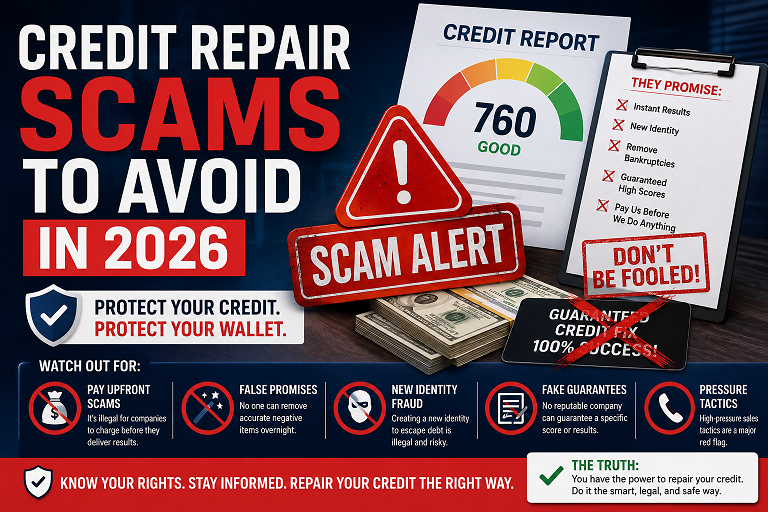
Major credit-repair scam warnings include demands for advance payment, promises to remove accurate current information, guaranteed score increases, instructions to dispute everything, false identity-theft reports, “new credit identities” and pressure to hide information from lenders. You can dispute genuine credit-report errors yourself for free.
Credit repair is not the same as credit counseling or debt settlement. A credit-repair company usually sells help challenging information on consumer reports. A counselor may help with budgeting and debt-management plans. A settlement company may negotiate debts. Each service has different risks, costs and legal rules.
Ten credit-repair scam warning signs
| Warning sign | Why it is dangerous |
|---|---|
| Payment before promised work | Federal law restricts advance fees for credit-repair services; telemarketing rules can add stricter timing. |
| “We erase all bad credit” | No company can legally force removal of accurate, current negative information. |
| Guaranteed 100-point increase | Scores depend on models and entire files; fixed results cannot be guaranteed. |
| Dispute every account | Formulaic or unsupported disputes may be treated as frivolous and can waste genuine rights. |
| False identity-theft affidavit | Knowingly filing a false report can be a crime. |
| CPN or “new credit identity” | Using an altered, fabricated or stolen identifier can expose a consumer to fraud charges. |
| Secret government program | Scammers invent affiliations, deadlines and special access to create urgency. |
| No written contract | Consumers should receive required written disclosures, costs, services and cancellation information. |
| Do not contact the bureaus | You have a direct, free right to dispute inaccuracies. |
| Pressure to misstate income or debt | Lying on a credit application creates serious legal and financial risk. |
Federal rights when hiring credit repair
The Credit Repair Organizations Act generally requires truthful advertising, written disclosures and a contract describing services, cost, timing and cancellation rights. Consumers have a three-business-day right to cancel without charge. Credit-repair organizations cannot legally collect payment before completing promised services in the manner required by law.
When telemarketing is involved, the Telemarketing Sales Rule can impose additional restrictions. A company cannot avoid consumer protections simply by calling a fee “membership,” “audit,” “software” or “monthly access.”
A polished website is not proof
Testimonials, bureau logos, “AI disputes,” attorney imagery and influencer promotions do not verify legality or results. Read the contract and independently check the business.
Dangerous credit-repair tactics to reject
Tradeline piggybacking for sale
Being added legitimately to a family member’s account is different from paying a stranger for temporary authorized-user status. Purchased tradelines can be costly, removed without warning and viewed as deceptive by lenders.
Credit sweeps
A “sweep” often means mass-disputing accurate accounts or falsely labeling them identity theft. Temporary deletion during an investigation is not a permanent correction; verified information may return.
File segregation
Some sellers advise using an Employer Identification Number or fabricated “credit privacy number” in place of a Social Security number. An EIN is not a lawful replacement identity for a personal credit application.
Fake rent, payroll or business records
Manufactured documents may lead to application fraud, account closure or prosecution. Never upload documents a service created when they do not reflect real transactions.
How to check a credit-repair company
- Ask for free written information before sharing a Social Security number or bank details.
- Read the complete contract, total price, recurring charges, services, schedule and cancellation form.
- Search the company and owners with terms such as “complaint,” “lawsuit,” “FTC” and “attorney general.”
- Check your state attorney general and consumer-protection regulator.
- Confirm any claimed attorney’s license directly with the state bar.
- Ask exactly what the company will do that you cannot do free.
- Reject guaranteed deletions, score gains, mortgage approvals or interest rates.
- Use a credit card rather than irreversible payment methods when lawful payment is due, preserving dispute options.
Legitimate help should be explainable
A trustworthy provider should explain limitations, never dispute accurate information without a factual basis and never prevent you from reviewing correspondence submitted in your name.
What to do if you already paid a scam
- Cancel in writing immediately and save proof. If within three business days, clearly invoke the federal cancellation right.
- Contact the card issuer, bank or payment service quickly to ask about stopping or disputing the transaction.
- Revoke recurring-payment authorization in writing and monitor statements.
- Change passwords and enable multi-factor authentication if credentials were shared.
- Freeze credit reports or add a fraud alert when identity information may be misused.
- Save ads, contracts, messages, recordings, invoices and dispute copies.
- Report the business to ReportFraud.ftc.gov, the CFPB and state attorney general.
Be cautious of recovery scammers who promise to retrieve lost money for another upfront fee.
Safer ways to improve credit
- Get reports through AnnualCreditReport.com.
- Dispute specific inaccuracies with the bureau and furnisher using evidence.
- Pay active accounts by the due date and reduce expensive revolving balances.
- Use a reputable nonprofit credit counselor for budgeting or a debt-management review.
- Consult a consumer-law attorney for persistent reporting errors, identity theft or unlawful collection.
Use our credit-report error guide and free dispute-letter templates before paying anyone.
Credit repair, counseling, settlement and consolidation are different
| Service | What it generally does | Key risk or question |
|---|---|---|
| Credit repair | Reviews reports and helps challenge allegedly inaccurate information. | Will it dispute only documented errors, and when is payment due? |
| Credit counseling | Reviews a budget and debts; may offer a debt-management plan. | Are fees reasonable, creditors participating and payments affordable? |
| Debt settlement | Attempts to negotiate less than the full balance, often after accounts become delinquent. | Credit damage, collection or lawsuit risk, fees and potential tax consequences. |
| Debt consolidation | Uses a new loan or transfer to combine existing balances. | APR, origination or transfer fees, loan term and total repayment. |
A company can sell more than one service, so the label in an advertisement is not enough. Ask what happens to your monthly payments, whether creditors will continue receiving money, whether accounts are expected to become delinquent and what happens if a creditor refuses the proposal.
Be especially careful when a salesperson calls a high-fee consolidation product “credit repair.” A new loan does not remove accurate late payments, collections or charge-offs. It can simplify payments, but a longer term may increase total interest even when the monthly amount falls.
Questions to ask before signing
- What exact work will you perform, and what result is not guaranteed?
- When may you legally charge each fee, and is any amount recurring?
- Will I receive and approve every dispute before submission?
- Do you sell or share my Social Security number, report data or leads?
- What is the cancellation procedure after the three-day federal period?
- Will you advise me to stop paying creditors, and what are the consequences?
- Who handles complaints, and where is the company legally registered?
- Does any salesperson, affiliate or influencer receive compensation for my enrollment?
If answers are vague, rushed or only verbal, do not enroll. Take the contract away from the sales call and review it independently.
Frequently asked questions
Is every credit-repair company a scam?
No, but no company has special power to remove accurate information. Verify fees, contract, methods and compliance before hiring.
Can credit repair charge upfront?
Federal law restricts advance payment before promised credit-repair services are completed, with additional telemarketing rules potentially applying.
Can I cancel after signing?
Federal law generally provides three business days to cancel a credit-repair contract without charge.
Can a company guarantee deletion?
No legitimate provider can guarantee removal of accurate current information or promise that a bureau or furnisher will decide in your favor.
Is a CPN legal?
A number sold as a substitute credit identity is a major fraud warning. Do not misrepresent an EIN, altered number or another person’s identifier as your Social Security number.
Where should I report a scam?
Report to the FTC, CFPB and state attorney general; contact the payment provider promptly if money was taken.
The bottom line
Real credit improvement is based on accurate reports, affordable debt management and time. Anyone promising a secret identity, instant sweep or guaranteed score is selling risk—not repair.
12 thoughts on “Credit Repair Scams to Avoid in 2026: 12 Red Flags That Cost You Money & Legal Trouble”