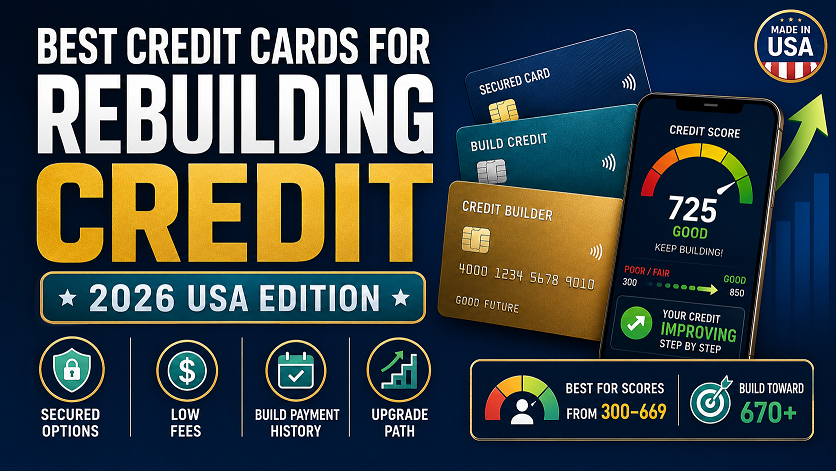
The strongest credit cards for rebuilding credit generally report to all three nationwide credit bureaus, charge no or low annual fees, use a refundable security deposit, and offer a path to deposit return or an unsecured account. No card can guarantee a score increase. Pay every bill on time, keep the reported balance manageable, avoid interest by paying the statement balance in full when possible, and choose a deposit you can leave untouched.
A rebuilding card should be boring in the best possible way: affordable, predictable and easy to manage. Rewards can be useful, but they matter far less than the annual fee, APR, deposit requirement and whether the issuer reports account activity reliably.
This comparison uses terms displayed on official issuer websites on August 26, 2026. Card pricing is variable and can change. Approval, deposit and credit-line decisions depend on the issuer’s review. No issuer paid for placement, and this page does not promise that any applicant will qualify.
$0 is preferable when other terms fit, because a fee does not build credit.
Look for reporting to Equifax, Experian and TransUnion.
Read when the issuer reviews accounts and how a refundable deposit is returned.
Our 2026 comparison methodology
How cards qualified
We reviewed official issuer pages for annual fee, minimum deposit, published purchase APR, bureau reporting, rewards and stated deposit-return or graduation process. We favored low recurring cost and transparent terms over signup bonuses. Categories reflect different consumer needs; they are not guaranteed-approval rankings. Terms were checked August 26, 2026 and should be verified again immediately before applying.
We excluded cards when public terms were unclear, when the product functioned primarily like a fee-heavy subprime card, or when a debit/prepaid product could be confused with a true credit card. Inclusion is editorial, not an endorsement.
Credit cards for rebuilding credit: official terms compared
| Card | Annual fee | Deposit/line | Published purchase APR | Why it may fit | Main caution |
|---|---|---|---|---|---|
| Discover it® Secured Cash Back | $0 | Deposit may be as low as $49 for a line starting at $200, subject to approval | Verify current official terms before applying | Rewards, three-bureau reporting and stated upgrade/deposit-return path | Approval is still required; rewards do not offset interest from carrying a balance. |
| Capital One Platinum Secured | $0 | Required deposit and line depend on approval terms | 28.99% variable on the issuer page checked | No annual fee and an issuer preapproval tool may help applicants check options | High APR makes carrying balances expensive; verify deposit deadline and amount. |
| U.S. Bank Altitude® Go Secured Visa® | $0 | $300–$5,000 refundable deposit; line generally matches deposit | Verify full current pricing disclosure before applying | Rewards, three-bureau reporting and stated possible automatic graduation | $300 minimum ties up more cash than some alternatives. |
| BankAmericard® Secured | $0 | $200–$5,000 deposit; line depends on deposit, income and ability to pay | 25.99% variable on the issuer page checked | Simple no-rewards option with periodic review for possible deposit return | Not everyone graduates, and interest is costly if a balance is carried. |
| OpenSky® Secured Visa® | $35 | $200 minimum deposit | 23.89% variable on the issuer page checked | No traditional credit check to apply and reporting to all three bureaus | Annual fee reduces value; “no credit check” does not mean automatic approval. |
| OpenSky Plus Secured Visa® | $0 | $300 minimum deposit | 28.24% variable on the issuer page checked | No annual fee and three-bureau reporting | Higher minimum deposit and high APR; verify all funding and account terms. |
Rates can change with the market
Variable APRs may change after publication. Open the issuer’s current rates-and-fees disclosure before applying. Do not rely solely on a comparison table, search snippet or cached page.
Which rebuilding card may fit your situation?
Discover it Secured Cash Back
Discover’s official page states that a refundable deposit may be as low as $49 to unlock a credit line starting at $200, depending on approval. It has no annual fee, reports status to the three major bureaus and describes a path to deposit return and upgrade after establishing a positive record.
Best for: an eligible applicant who values a potentially smaller deposit and rewards. Watch: this is still a credit application, and the final deposit requirement may differ.
BankAmericard Secured
The official page lists no annual fee, a $200–$5,000 deposit range and a 25.99% variable purchase APR when checked. Bank of America says it periodically reviews accounts for possible deposit return, considering the account, broader credit history and relationship. Not every cardholder qualifies.
Best for: someone who prefers simplicity over rewards. Watch: paying interest can overwhelm any credit-building benefit.
U.S. Bank Altitude Go Secured Visa
The card offers category rewards, no annual fee and a $300–$5,000 refundable deposit. U.S. Bank states that it reports to the three major bureaus and may automatically graduate eligible accounts to an unsecured Altitude Go card.
Best for: someone who can comfortably leave at least $300 on deposit and pays in full. Watch: never spend more merely to earn points.
OpenSky Secured Visa
OpenSky markets this option without a traditional credit check to apply. Its official page displayed a $200 minimum deposit, $35 annual fee, 23.89% variable APR and reporting to all three bureaus when checked.
Best for: a consumer whose recent credit history makes conventional applications difficult. Watch: the annual fee continues even if the card is barely used, and approval remains subject to requirements.
Capital One Platinum Secured can also be a reasonable no-annual-fee candidate. The issuer’s published APR was high, so it works best as a reporting tool paid in full—not as financing. Capital One’s preapproval process may help consumers explore card options before a complete application, but preapproval is not final approval.
How does a secured credit card work?
A secured card requires refundable collateral. If you provide a $300 deposit and receive a $300 limit, the deposit protects the issuer; it does not normally pay your monthly bill. You still use the card, receive statements and make payments like an ordinary credit-card account.
The deposit is different from a prepaid balance. With a prepaid card, you spend money loaded onto the card. With a secured credit card, you borrow against a credit line and repay purchases. That distinction allows account activity to be reported to credit bureaus.
The deposit may be returned when the issuer graduates an eligible account, when the account is closed in good standing, or under other contract terms. Read the agreement. “Refundable” does not mean available on demand while the account remains open.
You do not need to carry debt to build credit
Allowing a statement balance to generate interest is not required. Paying the statement balance in full by the due date can establish payment history without financing purchases at a high APR.
Security deposit, APR, fees and rewards
The deposit has an opportunity cost
A refundable deposit is not normally a fee, but the money may remain unavailable for months. Choose an amount that does not remove your emergency cushion. A larger limit can make utilization easier to manage, but not if the deposit creates a cash shortage.
High APR can erase rewards quickly
Suppose a card pays 1% cash back but carries a 28% variable APR. A $500 balance carried for several months can produce far more interest than the $5 reward earned on the purchase. Rewards are valuable only when they do not encourage overspending and the balance is paid in full.
Annual and monthly fees matter every year
A $35 annual fee may be reasonable when it provides access that a consumer cannot obtain elsewhere, but it does not improve the score. Reevaluate fee-bearing cards before renewal and compare them with no-annual-fee secured credit cards.
Cash advances are especially expensive
Cash advances often carry a separate fee, a high APR and no grace period. A rebuilding card should not become an emergency cash source. Review overdraft, hardship, employer, credit-union and community alternatives first.
How to rebuild credit with a secured card
Charge one manageable expense
A small subscription or routine purchase can create activity without turning the card into extra income.
Set automatic payment carefully
Automatic payment of the statement balance can prevent a missed due date, but monitor the bank account to avoid overdrafts.
Keep reported balances modest
Credit models consider how close balances are to limits. Pay before the statement closes when a necessary purchase uses a large share of a small limit.
Review every statement
Check purchases, credits, fees, interest and due dates. Report unauthorized charges promptly through the issuer’s official channel.
Track all three reports
Use AnnualCreditReport.com to confirm the account and payment status are reported accurately. Checking your own reports does not hurt scores.
Wait before adding another card
One well-managed account can be more useful than several rushed applications. New inquiries and obligations do not guarantee faster progress.
No universal utilization percentage guarantees a particular score. Lower is generally safer than near-maxed-out use, but a card should support the budget rather than force artificial micro-management. For a broader plan, read how to improve credit responsibly and our realistic credit-improvement timeline.
Credit-building cards and tactics to avoid
- Fee-heavy unsecured cards: multiple setup, monthly, annual and limit-increase fees can consume a small credit line.
- Guaranteed score claims: an issuer can report data but cannot promise a specific score increase.
- Cards that report to only one bureau: a future lender may check a different report.
- Nonrefundable “program” deposits: confirm whether a payment is collateral, a fee or both.
- Buying tradelines: paying to be added to a stranger’s account can involve deception, account closure and wasted money.
- Carrying interest for points: interest usually costs more than ordinary rewards.
- Applying repeatedly after denials: review adverse-action reasons and reports before trying again.
If inaccurate negative items are blocking approval, use the documented process in how to dispute credit-report errors. Accurate negative history generally cannot be removed simply because it makes approval harder.
Frequently asked questions
What is the easiest credit card to get for rebuilding credit?
No card is guaranteed. A secured card or a product without a traditional credit check may reduce some barriers, but identity, income, deposit and issuer requirements still apply.
Can a secured card raise my score by 100 points?
No issuer can guarantee that result. A score depends on the complete report, model and starting profile. On-time payments and manageable balances can add positive information over time.
How much should I deposit?
Choose the smallest amount that supports normal use without depleting emergency savings. A higher limit may lower utilization pressure, but the deposit remains unavailable under the account terms.
How long until a secured card becomes unsecured?
There is no universal schedule. Some issuers periodically review eligible accounts; others require closure or a separate application. Review the issuer’s current graduation and deposit-return policy.
Should I close the card after my credit improves?
Consider the annual fee, deposit status, account age, available limit and temptation to overspend. If a card has no fee, keeping it open may be useful, but monitor it for unauthorized activity.
Does preapproval guarantee approval?
No. Preapproval or prequalification is an initial assessment. Final approval can depend on verification, a complete application and issuer criteria.
Can I be denied even if I provide a security deposit?
Yes. A deposit reduces issuer risk but does not override identity, income, banking, prior-account, legal or underwriting requirements.
The bottom line
The best credit card for rebuilding credit is the least expensive card you can manage correctly—not necessarily the one with the biggest reward headline. Prioritize three-bureau reporting, no or low annual fee, a refundable affordable deposit and clear deposit-return terms.
Use the card for a small planned expense, pay by the due date, avoid carrying high-interest debt and monitor your reports. Those habits matter more than the logo on the card, and they protect your finances while positive history develops.
Related guides
Official card and consumer sources
- Discover it Secured: Official product page
- Capital One: Current card rates and fees
- U.S. Bank Altitude Go Secured: Official product page
- Bank of America: Secured-card terms
- OpenSky: Official secured-card comparison
- Consumer Financial Protection Bureau: Credit cards
- AnnualCreditReport.com: Federally authorized credit-report access
9 thoughts on “Best Credit Cards for Rebuilding Credit in 2026”