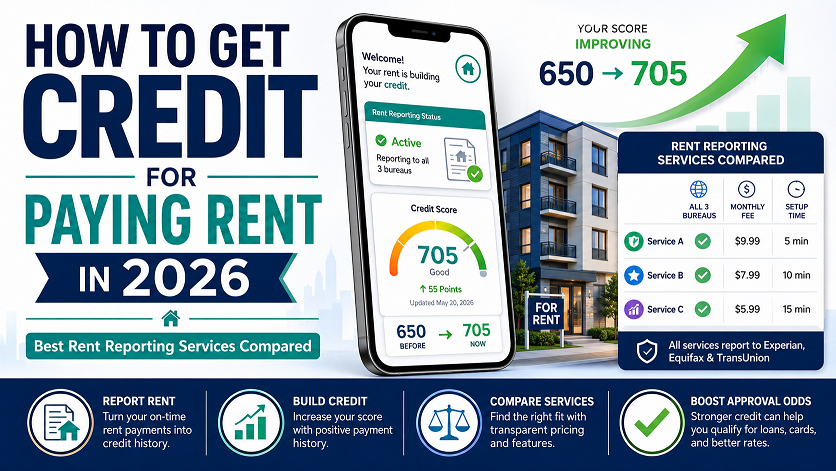
Rent does not usually build credit automatically. To get credit for paying rent, first ask whether your landlord already reports through a property program. If not, you may be able to enroll in a consumer rent-reporting service or add eligible online rent payments to your Experian file through Experian Boost. Compare bureau coverage, fees, past-payment reporting, landlord verification, cancellation rules and whether late payments are reported. Adding rent can help some credit files, but no service can guarantee a score increase or lender approval.
Rent is often a household’s largest monthly payment, yet many landlords do not furnish it to the nationwide credit bureaus. That leaves responsible renters searching for a way to make years of on-time payments visible.
Rent reporting can be useful, particularly for a thin credit file, but the value depends on where the information goes and which scoring model a lender uses. A service reporting to all three bureaus is not automatically “best” if the renter cannot verify payments, the subscription is expensive, or the intended lender does not use a score that considers the tradeline.
A property-sponsored program may already report rent and may cost the renter nothing.
Experian-only reporting is different from furnishing to Equifax, Experian and TransUnion.
Report inclusion, scoring-model use and lender underwriting are three different questions.
How rent reporting works
Landlords, property managers and third-party services can furnish verified rent-payment data to one or more consumer reporting companies. Depending on the program, verification may come from property-management records, a linked bank account, an online rent portal or documents such as the lease and payment history.
The CFPB advises renters who want positive payments reported to ask whether their landlord participates in a rental reporting program and to consider the fees. Freddie Mac gives similar guidance: some landlords already sponsor programs that report on-time payments without charging the renter.
Rent reporting can create two related but different records:
- A rental or tenant-history record used by landlords and tenant-screening companies.
- A tradeline or payment history on a nationwide credit report that may be eligible for certain credit scores.
Experian RentBureau, for example, is a specialty rental-history database. Experian says some positive rent data it receives is also added to the consumer’s standard Experian credit report. The exact product, furnisher and report matter.
Three separate questions
Ask: “Will it appear on my bureau report?”, “Will the lender’s scoring model use it?” and “Will it improve the lender’s decision?” A yes to the first does not guarantee the other two.
Rent-reporting options compared for 2026
The following table uses provider information available on August 29, 2026. Pricing, eligibility and reporting can change, so confirm the enrollment screen before paying.
| Option | Published bureau coverage | Published cost | Best fit and limitations |
|---|---|---|---|
| Landlord or property program | Varies by provider | May be landlord-paid, free to renter or subject to a disclosed fee | Check first; property participation and reporting policy control |
| Experian Boost | Experian credit file only | Free | Eligible rent paid online through a detectable linked account; not all rent or lenders qualify |
| Self Rent & Bills Reporting | Self says rent goes to all three nationwide bureaus | Self currently advertises a free rent-reporting option; confirm current membership terms | Direct consumer enrollment using verified transactions; bill reporting coverage differs from rent |
| Esusu | Esusu says on-time rent can be reported to all three bureaus | May be property-sponsored; direct Core Membership is advertised at $10 monthly | Can include eligible history on the current lease; verify property or app eligibility |
| Boom | Boom says it reports to all three bureaus | Published offer: $60 annually for ongoing reporting; $25 optional past reporting | Direct renter verification; current page says on-time reporting and up to 24 months of history |
This is an editorial comparison, not a paid ranking. CreditScoreMastery did not receive compensation from the listed providers. “All three bureaus” is valuable only when the data is accurate, the renter can afford the cost and the lender’s model considers the reported history.
1. Landlord or property-manager reporting
Start with the leasing office. Ask for the reporting company’s name, bureaus, enrollment cost, whether participation is optional, what happens after moving and whether only positive payments or both positive and negative activity are furnished.
Property-sponsored reporting can be the lowest-cost path. It also reduces the need to prove each payment independently because the management system already holds the lease ledger. Do not enroll in a second service until you know whether rent is already reported; duplicate tradelines can create confusion and require disputes.
2. Experian Boost
Experian Boost is free and can add eligible residential rent paid online to the Experian file after the consumer connects a bank or card account. Experian’s disclosure generally requires enough qualifying payment history and says peer-to-peer transfers and paper checks are not eligible. It also warns that not every lender uses Experian data or a score affected by Boost.
This is a narrow, low-cost option for a detectable rent payment. It is not three-bureau rent reporting, and disconnecting or removing data can alter a score that previously used the added information.
3. Self Rent & Bills Reporting
Self says its rent product reports verified rent payments to Experian, Equifax and TransUnion. Its support material currently describes free rent reporting, while broader Rent & Bills features and optional products may have separate terms. Confirm exactly what is free, what bank access is required and whether an upsell is optional before enrolling.
Self’s support page distinguishes rent coverage from household bills: rent may go to all three bureaus, while certain utility and phone data may be furnished only to TransUnion. Do not assume every connected payment receives identical bureau coverage.
4. Esusu
Esusu commonly works with property owners and operators. It says it reports eligible on-time rent to Equifax, Experian and TransUnion and does not report missed or late payments through its positive reporting program. Some residents receive it through their building; direct app membership is also advertised.
Esusu says eligible renters may connect up to 24 months of history on the current lease. Before paying for direct membership, confirm the lease, payment method and history requirements and ask whether the property already covers the service.
5. Boom
Boom’s consumer page says it reports on-time rent to all three bureaus. A current published offer lists ongoing reporting at $5 per month billed as $60 annually, with optional past reporting for a $25 one-time charge. Older Boom articles show different historic prices, which is why the current enrollment page should control.
Boom also offers property-manager reporting where the manager may choose positive-only or full-file reporting. A renter should confirm which program applies; a consumer marketing page and a landlord’s furnishing policy are not interchangeable.
How to choose a rent-reporting service
| Question to ask | Why it matters | Red flag |
|---|---|---|
| Which bureaus receive my rent? | A lender may pull only one report | “Reports everywhere” without naming bureaus |
| Which payments are reported? | Positive-only and full-file programs carry different risks | No clear late-payment policy |
| Can past rent be added? | Back-reporting may add depth sooner | Guaranteed point increase for buying history |
| How is rent verified? | Checks, cash, peer-to-peer and bank transfers may be treated differently | Asking you to fabricate a lease or receipt |
| What is the total first-year cost? | Enrollment, monthly, annual and history fees can stack | Price hidden until after sensitive data is entered |
| What happens when I cancel or move? | Reporting may stop, close or require reverification | No deletion, cancellation or dispute procedure |
| How do I dispute an error? | Wrong dates, amounts or late status can affect reports | No consumer support or furnisher contact |
Also compare privacy practices. Bank-linked services may analyze transaction data to identify recurring rent. Read what data is collected, how long access continues, which vendors receive it and how to revoke permission.
How to get credit for paying rent
Ask whether rent is already reported
Contact the landlord or property manager and request the provider name, bureaus, reporting type and renter cost.
Check your current reports
Use AnnualCreditReport.com to see whether a rental tradeline already appears and whether its dates and amounts are accurate.
Define the goal
Decide whether you need Experian-only data, all-three-bureau coverage, past history or evidence for future rental screening.
Compare current terms
Review fees, eligible payment methods, landlord involvement, bureau coverage, late-payment policy, back-reporting and cancellation.
Submit accurate documents
Use the real lease, address, rent amount and payment account. Never manufacture receipts or change payment dates.
Verify the first update
After the provider’s stated reporting window, check each promised bureau. Contact the provider if the tradeline is missing or inaccurate.
Review before moving or canceling
Ask whether the tradeline closes, remains, is deleted or needs to be transferred, and save final payment and cancellation records.
Does rent reporting improve every credit score?
No. A bureau may accept rent data while a particular scoring model ignores it. Newer FICO and VantageScore versions can consider eligible rental information when it is present, but lenders choose which bureau and model they use. Traditional mortgage scores may not treat rental data the same way as a free consumer score.
The effect also depends on the rest of the file. A consumer with limited history may see a different outcome from someone with many established accounts. Adding positive rent does not erase late payments, collections or high card utilization. It also does not guarantee that a previously unscorable consumer becomes scoreable under every model.
Avoid score-increase marketing
Provider averages and testimonials do not predict your result. Sample selection, starting scores, bureau coverage and the specific model can materially change the outcome.
For the underlying model differences, see VantageScore 4.0 explained and the credit reports versus scores guide.
Can rent payment history help with a mortgage?
Potentially, but not only through a credit score. Fannie Mae says Desktop Underwriter can identify positive rent history from a credit report or an authorized asset-verification report containing bank transaction data. That means consistent verified rent may supplement automated underwriting even when it does not produce a dramatic consumer-score change.
Fannie Mae’s current process has eligibility and documentation requirements. The lender controls the asset report and application submission; buying a rent-reporting subscription does not guarantee a Desktop Underwriter approval. Freddie Mac also provides methods for lenders to consider documented rent history in Loan Product Advisor under applicable rules.
If a mortgage application is planned soon, ask the loan officer:
- Which credit bureau and scoring model will be used?
- Can the underwriting system consider positive rent from the credit report?
- Will the lender order an eligible asset-verification report?
- How should the monthly rent be entered and documented?
- Could a new subscription or tradeline complicate preapproval timing?
Keep paying rent from a consistent, traceable account when practical and retain the lease. For broader preparation, read the 2026 mortgage credit-score requirements guide.
Costs, late payments, cancellation and other risks
Paying a fee without lender value
A service can report correctly and still have no impact on the particular score a lender pulls. Compare annual cost with the likely time you will use the service. Free landlord-sponsored reporting should generally be checked before a paid duplicate.
Negative rental information
Some programs furnish only eligible positive payments; others may report late payments, outstanding balances or write-offs. Experian RentBureau states that its rental database can contain on-time and negative rental information, although only positive rent history is included in standard Experian credit reports through that channel. Collections for unpaid rent can be reported separately.
Errors and duplicate accounts
Review the landlord, address, start date, payment status and monthly amount. If data is inaccurate, dispute it with the company providing the report and the business furnishing the information. The CFPB’s tenant-screening guidance explains that consumers can dispute inaccurate or outdated data. Our credit-report error guide covers nationwide-bureau disputes.
Cancellation and account removal
Ask before enrolling whether cancellation closes the tradeline, stops future updates or removes added data. A score based on information that later disappears may change. Do not assume a paid reporting service creates a permanent account.
Overspending on “credit building”
Never pay rent late, borrow at high interest or skip essential savings to fund a reporting subscription. Rent reporting is an optional way to make an existing payment visible; it is not more important than housing stability.
Frequently asked questions
Does paying rent build credit automatically?
Usually not. The landlord, property manager or a reporting service must furnish eligible payment data, or the consumer must add qualifying rent through a product such as Experian Boost.
Can I report rent myself to the credit bureaus?
Consumers generally cannot send an informal payment list directly to a bureau. Use a participating landlord or qualified service that verifies and furnishes the data.
What is the best rent-reporting service?
There is no universal best service. Compare current cost, bureau coverage, payment verification, back-reporting, landlord participation, late-payment policy and cancellation rules.
Can rent be reported to all three credit bureaus?
Yes, some services state that they report rent to Equifax, Experian and TransUnion. Experian Boost is different because it adds eligible payments only to the Experian file.
Can past rent payments be reported?
Some providers advertise up to 24 months of eligible history, often for an additional fee or subject to current-lease verification. Confirm the exact terms before paying.
Does rent reporting guarantee a higher score?
No. Report inclusion, scoring-model eligibility and the rest of the credit file determine the result. A lender may use a model or bureau that does not consider the data.
Will late rent hurt my credit?
It depends on the reporting program, but unpaid rent sent to collections can create credit risk even if routine monthly rent was not reported. Read the program’s positive-only or full-file policy.
Does Experian Boost report rent to all three bureaus?
No. Experian Boost adds eligible rent to the Experian credit file. It does not furnish that added data to Equifax or TransUnion.
Do I need my landlord’s permission?
Property programs require landlord participation. Some consumer services can verify rent through bank transactions and lease data without ongoing landlord action, but eligibility varies.
Can roommates report the same rent?
Some services allow each named leaseholder to enroll, but each person must prove their actual obligation and payment. Do not report the full rent amount for multiple people unless the provider’s rules support it accurately.
What happens when I move?
The provider may require a new lease and payment verification. Reporting could stop or the old tradeline may close. Ask before moving and keep final payment records.
Can rent history help mortgage approval?
It may. Fannie Mae’s Desktop Underwriter can consider eligible positive rent from credit or asset reports. This is separate from guaranteeing a score increase or mortgage approval.
Bottom line
The best first step is free: ask the landlord whether rent is already reported and check all three credit reports. If it is not, compare a property-sponsored program, Experian-only Boost and direct-to-consumer all-three-bureau services based on your actual goal.
Choose verified reporting with clear fees, privacy terms and cancellation procedures. Treat rent history as one supporting part of a healthy credit file—not a shortcut that replaces on-time debt payments, low card balances, accurate reports and responsible applications.
Related guides
Official sources and provider terms reviewed
- CFPB: rent payments and credit reporting
- Freddie Mac: how to get rent reported
- Experian RentBureau reporting FAQ
- Experian Boost eligibility and limitations
- Self: free rent reporting
- Esusu: rent reporting
- Boom: renter reporting and current terms
- Fannie Mae: positive rent history in Desktop Underwriter
- AnnualCreditReport.com
4 thoughts on “How to Get Credit for Paying Rent in 2026”