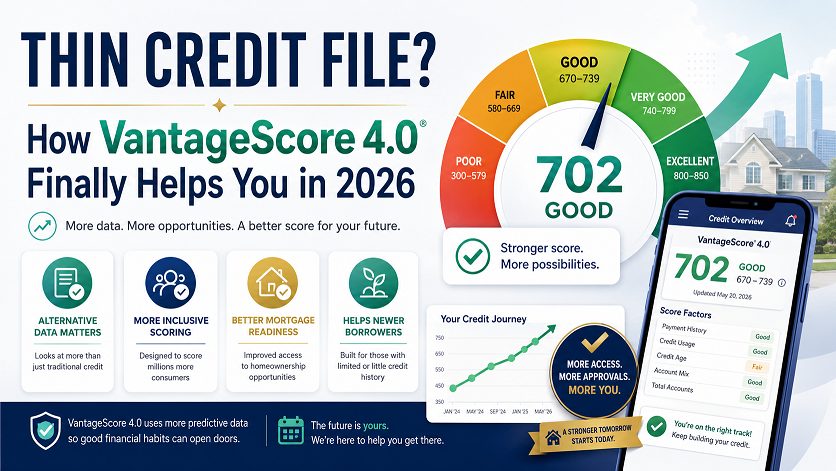
A thin credit file means your nationwide credit reports contain too little current account history for some lenders or scoring models to evaluate confidently. It is not the same as bad credit. VantageScore 4.0 can score some consumers with newer, dormant or limited files that older models may leave unscored, but it cannot use bills that were never reported and it does not guarantee approval. The safest solution is to add one affordable account that reports regularly, pay every obligation on time and let accurate history develop.
People often discover a thin file at an awkward moment: a first apartment, a car loan, a credit-card prequalification or a mortgage conversation. A website may show a score while a lender says there is not enough credit history. Both can be true because the score shown to you and the score used by the lender may come from different bureaus and models.
This guide explains how to identify the actual problem, where VantageScore 4.0 changes scoreability and which credit-building products may add useful reportable history. It does not promise a fast point increase. A thicker file is not automatically a better file; the payment record, balances, age and accuracy of the accounts still matter.
A report exists but contains limited current credit history. A score may or may not be generated.
No credit record exists at a nationwide consumer reporting company.
A record exists, but a particular model lacks enough eligible or recent information to calculate a score.
What does a thin credit file mean?
“Thin file” is an industry description, not a single legal threshold. It generally refers to a credit report with few accounts, a short history or too little recent activity. One lender might evaluate it manually, another might require a score from a particular model and a third might use permitted cash-flow or rental information alongside the report.
The CFPB distinguishes several situations. A credit-invisible consumer has no record at a nationwide credit reporting company. A person can have a record but remain unscored because the information is insufficient or stale. The Bureau’s June 2025 technical correction also cautions that scoreability varies by model; “unscored” under one model does not mean every model is incapable of producing a score.
| Status | What may be in the report | What it does not mean | Useful first move |
|---|---|---|---|
| Credit invisible | No nationwide bureau record | It does not prove poor money management | Open one affordable, reporting credit-building account |
| Thin file | Few or recently opened accounts | It is not automatically a low score | Confirm all three reports, then build slowly |
| Stale or unscored file | Older accounts with little recent reporting | The accounts are not necessarily deleted | Restore legitimate recent activity without overspending |
| Poor credit | Reported late payments, high balances or other risk signals | It is not the same problem as limited history | Address accuracy, payment status and balances |
Do not respond to a thin file by opening several accounts at once. Multiple applications can create hard inquiries, several new accounts can reduce average age and the new required payments may strain a budget. One well-chosen account that reports to the intended bureaus is usually a cleaner starting point than a collection of fee-heavy products.
How VantageScore 4.0 can help a thin credit file
VantageScore 4.0 is a tri-bureau scoring model with a 300-to-850 range. VantageScore says it uses specialized methods to evaluate some consumers with limited, new or dormant histories who may not meet older conventional scoreability rules. That can make a score available sooner or after a period of inactivity, provided useful information actually exists in the bureau file.
This matters because traditional FICO minimum criteria are different. FICO says a report generally needs at least one account opened for six months or more, at least one account reported within the previous six months and no deceased indicator. One account can satisfy both account-related conditions, but each bureau report is separate. An account appearing at Experian may not make the Equifax file scoreable.
What VantageScore 4.0 looks at
The model evaluates information in the credit report, including payment history, balances, available credit, account age and recent credit behavior. It also uses trended credit data, meaning patterns across time can matter rather than only a single snapshot. It may consider eligible rent, utility or telecom information when that data is furnished to the report.
That last qualification is crucial. VantageScore 4.0 does not search your checking account for ordinary bills and does not automatically know that you paid a landlord. The data must reach the relevant credit bureau in a format the model can use. Our separate guides explain the limits and costs of rent reporting and utility-bill reporting.
A score is access to an evaluation—not a promise
Becoming scoreable can help a lender assess the file, but the score may be low, moderate or high depending on the reported information. Lenders can also consider income, debt, collateral, housing costs and their own underwriting rules.
For a deeper discussion of model design, reason codes and adoption, read VantageScore 4.0 explained. Keeping those technical details on the model guide prevents this page from competing for the same search intent.
What VantageScore 4.0 cannot do
- It cannot create history from nothing. A bureau needs reportable information connected to the consumer.
- It cannot make every lender use the same score. A bank may use another VantageScore version, a FICO model or a proprietary risk system.
- It cannot add income or savings. VantageScore states that version 4.0 is based on credit-report information, not the balance in a bank account.
- It cannot repair inaccurate data. Errors must be disputed with the bureau and information furnisher.
- It cannot guarantee an approval or rate. Loan amount, debt-to-income ratio, employment, collateral and lender policy can affect the decision.
- It cannot turn expensive borrowing into a good deal. An available personal loan or “credit-building” subscription may still have an unaffordable total cost.
A free app score can still be useful for education and monitoring, but check its bureau, model and update date. If a mortgage lender uses a different model, the number in the app is not a preview of the underwriting result. Learn more in our guide to how credit scores work.
How to find out whether your file is thin
Request all three nationwide reports
Use AnnualCreditReport.com, the federally authorized source for free reports from Equifax, Experian and TransUnion. Free online reports are currently available weekly.
Inventory each report separately
Record open and closed accounts, opening dates, last reported dates, payment status and whether the same account appears at every bureau.
Identify the score and reason codes
Note the model name, version, bureau and date. If no score is available, read the stated reason rather than assuming the file is “bad.”
Correct factual errors
Dispute accounts that are not yours, wrong balances, duplicate entries or inaccurate payment histories. Do not dispute accurate information merely because it is negative.
Choose one reportable path
Compare cost, bureau coverage, underwriting goal and monthly obligation before applying or subscribing.
If an application was denied, the adverse-action notice can be especially helpful. It should identify important reasons for the decision and provide information about the consumer reporting company involved when a report contributed. Request the named report and compare the lender’s explanation with what is actually listed.
When a report contains errors, follow the documented process in our credit-report dispute guide. A thin file can be unusually sensitive to an error because each account represents a large share of the available history.
Ways to build a thin credit file responsibly
The best credit-building product is not the one with the boldest score promise. It is the least expensive product that you understand, can manage without missing a payment and that reports useful information to the bureau or bureaus relevant to your goal.
| Option | Typical cost or commitment | Potential value | Questions before using it |
|---|---|---|---|
| Secured credit card | Refundable deposit; possible fees and interest | Can establish a revolving tradeline and payment record | Reports to which bureaus? Annual fee? Graduation and deposit-refund terms? |
| Credit-builder loan | Interest and possible fees; scheduled monthly payment | Can add installment history while funds remain secured | Total cost? Reporting coverage? Early-payoff and missed-payment rules? |
| Authorized-user account | Usually no borrowing contract for the user; relationship risk | Issuer may report the established card history | Does issuer report users? Is the primary account old, current and low-balance? |
| Rent reporting | Free through some landlords; otherwise setup or subscription fee | May add verified housing payments to one or more bureaus | Which bureaus and models? Past history? Cancellation treatment? |
| Utility reporting | Free or monthly subscription depending on service | May add eligible bills to a specific bureau | Which bills, bureau and score models qualify? |
| Retail card or unsecured starter card | Potentially high APR or limited use | May create a traditional revolving tradeline | Fees, APR, issuer reporting and temptation to overspend? |
Secured credit cards
A secured card generally requires a cash security deposit, often setting the credit limit. The CFPB lists secured cards as a way to establish or rebuild history, but products differ. Confirm that the issuer reports normal account activity to all three nationwide bureaus. Compare annual fees, foreign-transaction fees, purchase APR, deposit refund and whether the account can graduate to an unsecured card.
Use the card for a small planned purchase, wait for the statement and pay the statement balance by the due date. Carrying interest-bearing debt does not build credit faster. Autopay can reduce missed-payment risk, but keep enough cash in the linked account and review each statement for errors or fraud. Our credit cards for rebuilding credit guide explains how to compare current issuer terms.
Credit-builder loans
With a typical credit-builder loan, the lender places the proceeds in a locked savings account or certificate while you make scheduled payments. You receive the funds after satisfying the agreement. The CFPB notes that these products can build credit and savings together, but the consumer still pays interest or fees and a late payment can undermine the purpose.
Compare the total dollar cost—not just the advertised monthly payment. Ask whether payments reach all three bureaus, when the first report occurs, whether late fees apply and what happens if you need to end early. Do not borrow a large amount merely to improve “credit mix.”
Becoming an authorized user
A family member or trusted person may add you as an authorized user on a credit card. Some issuers report the account to the user’s credit reports. The effect is not guaranteed: reporting practices and scoring treatment vary, and a high balance or late payment on the primary account can be unhelpful.
There should be no need to buy access to a stranger’s account. Commercial tradeline rentals introduce privacy, fraud and account-removal risks. If a genuine household arrangement is appropriate, confirm issuer reporting and agree on whether the user will receive or use a physical card.
Rent, utilities and telecom
Alternative payment reporting can be useful when the payments already fit the household budget. However, the service must verify and furnish the data. Coverage may be one bureau rather than all three, and not every scoring model or lender uses it. Calculate the annual subscription cost and do not assume an app’s point estimate will translate into lower loan pricing.
Never miss a real bill to chase a credit score
Emergency savings, rent, food, insurance and essential utilities take priority over opening a fee-based credit-building product. A new monthly obligation that causes a late payment is counterproductive.
A practical 12-month thin-file plan
Days 1–30: verify before applying
- Download and review all three reports.
- Identify which bureaus have no record, a thin record or an inaccurate record.
- Set a realistic monthly amount that can be paid without carrying debt.
- Compare a secured card, credit-builder loan and any available landlord reporting.
- Use prequalification where offered, understanding that it is not final approval.
Months 2–6: establish a clean pattern
Manage the selected account exactly as agreed. Pay on time every month, keep revolving use modest relative to the limit and avoid unnecessary applications. Check that the account begins reporting as promised, but allow for the provider’s normal cycle before escalating.
Do not obsess over weekly score changes. A balance can vary as statements report, and an educational score may update on a different schedule from a lender score. The goal during this period is accurate, affordable history—not a particular number by a particular date.
Months 7–12: reassess the goal
Review all three reports again. If the first account is accurate and easy to manage, keep it open when the cost remains reasonable. Consider a second product only if it serves a real financial purpose, adds needed bureau coverage or offers materially better terms. Opening debt solely to create account variety is unnecessary.
If you still lack a FICO score after the relevant timing criteria appear satisfied, check whether the account was reported recently to that specific bureau and whether personal information is mismatched. Contact the bureau or score provider for the stated reason. Our credit-improvement timeline explains reporting cycles without promising points.
Can VantageScore 4.0 help a thin-file mortgage borrower?
The mortgage market changed in 2026, but implementation is not universal. FHFA says approved lenders may currently choose Classic FICO or VantageScore 4.0 for loans sold to Fannie Mae and Freddie Mac during the interim process. Lenders not approved for VantageScore delivery continue using Classic FICO. FHFA also says the Enterprises are not initially accepting multiple models on the same delivered loan.
That means a VantageScore 4.0 result may expand options for some borrowers with limited or dormant history, but consumers should not assume every mortgage company can or will use it. Ask the loan officer:
- Which credit score model and bureau-report configuration will be used?
- Is the lender approved to deliver a VantageScore 4.0 loan to the Enterprises?
- Will verified rent history or other nontraditional credit documentation be considered?
- Can the lender perform an initial review without a hard inquiry?
- Which income, reserve, debt and down-payment requirements apply?
A mortgage decision is much broader than a score. Avoid opening accounts, closing old cards or financing large purchases shortly before underwriting unless the loan officer explains the effect. See our dedicated guide to the credit score needed for a mortgage.
Thin-file shortcuts and scams to avoid
- Credit Privacy Numbers or CPNs: A seller may be offering a stolen Social Security number or encouraging false statements on an application.
- Purchased tradelines: Paying a stranger for temporary authorized-user placement is expensive, unstable and may trigger lender scrutiny.
- Guaranteed score packages: No company controls bureau reporting, score calculations and lender decisions well enough to promise a fixed increase.
- Fake identity-theft disputes: Claiming a real account is fraudulent can create legal and financial consequences.
- High-fee loans disguised as credit building: A tradeline is not worth triple-digit costs or unaffordable payments.
- “Primary tradeline” sales: Never provide identity documents or banking access to an unverified seller promising instant account age.
Legitimate credit building is slow and rather ordinary: accurate reports, on-time payments, controlled balances and limited applications. Review our credit-repair scam warnings before paying anyone who claims to manufacture a file.
Frequently asked questions
How many accounts make a credit file “thin”?
There is no universal number. Lenders and scoring models define sufficiency differently. A file can be considered thin because it has few accounts, only recent accounts or little current activity.
Is a thin credit file the same as bad credit?
No. Thin credit describes limited information; bad credit generally describes reported risk signals such as missed payments or high balances. A thin file can have positive, negative or no score.
Can VantageScore 4.0 score someone with less than six months of history?
VantageScore says version 4.0 can score some limited or new-to-credit consumers who do not meet conventional six-month requirements. A report still needs usable information, and lenders are not required to use the model.
Why do I have a VantageScore but no FICO score?
The models have different minimum scoring criteria. FICO generally requires an account at least six months old and a recent account update, while VantageScore may score a newer or dormant file.
How long does it take to build a credit score?
It depends on the model, bureau reporting and account history. FICO’s published minimum rules include a six-month-old account; VantageScore may score certain files sooner. Neither timeline guarantees a strong score.
What is the fastest safe way to build a thin file?
Choose one affordable account that reports regularly—often a secured card or credit-builder loan—and pay exactly as agreed. “Fast” should not override fees, affordability or application risk.
Does becoming an authorized user help?
It can if the issuer reports the account and the primary card has responsible history. Results vary, and a late payment or high balance on the primary account can be harmful.
Can rent payments build a thin file?
They may when a landlord or service reports verified payments to a bureau and the relevant model uses the data. Bureau coverage, fees and lender use vary.
Do utility payments count in VantageScore 4.0?
Eligible utility or telecom data may be considered when it appears in the credit report. Paying a bill does not automatically place it on all three reports.
Should I open several accounts to thicken my file?
Usually not at once. Each application and new obligation adds risk. Start with one manageable reporting account, build history and reassess based on a genuine financial need.
Can I get a mortgage with a thin file?
Possibly. Underwriting depends on the program, lender, score model, income, debts, reserves and documentation. In 2026, approved GSE lenders may have VantageScore 4.0 options, but adoption is not universal.
Will a credit-builder product guarantee approval?
No. Reporting can add history, but no product can guarantee a score, lender approval, APR or savings. Compare the full cost and use only payments you can afford.
Bottom line
A thin credit file is an information problem, not a character judgment. VantageScore 4.0 can produce scores for some limited, newer or dormant records that older models may not score, but its reach has limits. The relevant bureau must have usable data, and the intended lender must use that model.
Begin by checking all three reports and identifying the exact gap. Then choose one low-cost product that reports reliably, make every payment on time and allow the history to age. Responsible repetition is more valuable than expensive shortcuts, multiple applications or a promised score jump.
Related guides
Official sources reviewed
- CFPB: credit reports and scores key terms
- CFPB: 2025 technical correction and updated credit-invisible estimates
- CFPB: ways to start or rebuild credit
- AnnualCreditReport.com: official free credit reports
- FICO: minimum requirements for a FICO Score
- VantageScore: lender FAQs and limited-file scoreability
- VantageScore: report data used by VantageScore 4.0
- FHFA: current mortgage credit-score implementation