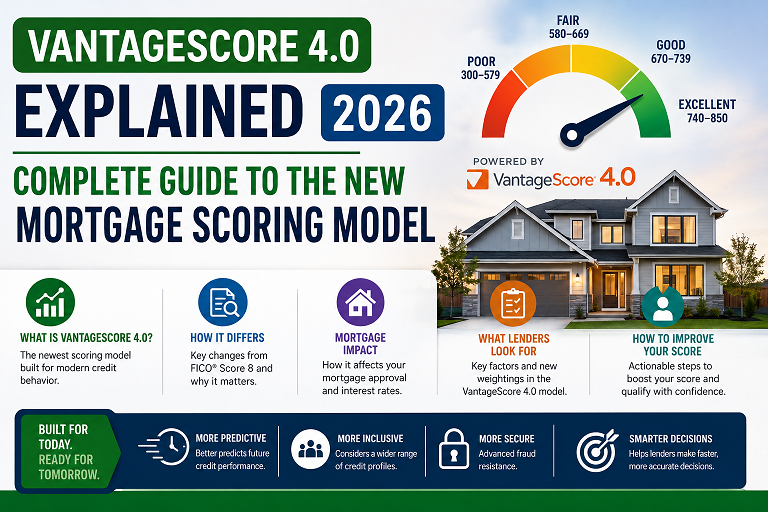
VantageScore 4.0 is a 300–850 credit-risk score developed for use with credit-file data from Equifax, Experian and TransUnion. It uses trended credit attributes, can score some consumers with limited or inactive credit histories, and can consider rent, utility or telecom data when that information is actually reported. For mortgages, VantageScore 4.0 is available in 2026 through a limited Fannie Mae and Freddie Mac rollout to approved lenders. It has not replaced Classic FICO across every mortgage lender.
A score labeled “VantageScore” may appear in a free credit-monitoring app, but that does not mean the lender uses the same version, bureau or date. VantageScore 3.0 remains widely displayed to consumers, while VantageScore 4.0 is a newer model with different design features.
This guide focuses on VantageScore 4.0 itself: its factors, scoreability rules, use of trended and reported alternative data, and current mortgage status. The separate FICO 10T vs. Classic FICO guide covers FICO’s newer mortgage model.
VantageScore 4.0 uses 300–850, where higher scores indicate lower modeled credit risk.
The model can generate scores for some consumers excluded by more restrictive file-history rules.
Approved GSE lenders can use it during the 2026 interim rollout; most lenders have not universally switched.
VantageScore 4.0 mortgage status: August 2026
- FHFA validated and approved VantageScore 4.0 and FICO Score 10T for use by Fannie Mae and Freddie Mac in 2022.
- Fannie Mae and Freddie Mac updated their policies in April 2026 to allow current VantageScore 4.0 use and future FICO 10T use.
- VantageScore 4.0 is available now to a limited number of approved lenders using tri-merge credit reports.
- Participating lenders may choose VantageScore 4.0 or Classic FICO for a particular delivered loan during the interim phase.
- All borrowers on the same loan must use the same selected scoring model.
- Lenders outside the rollout continue using Classic FICO under current GSE guidance.
Practical meaning: ask the mortgage lender which score model it will use. “Approved” and “available to limited approved lenders” do not mean universal adoption.
FHFA’s 2026 interim framework initially preserves tri-merge reporting. The participating lender obtains VantageScore 4.0 from each nationwide credit bureau and follows the current representative loan-level score calculation. Historical VantageScore data published by the GSEs helps investors and industry participants evaluate the transition; it does not convert a consumer’s Classic FICO score into a guaranteed VantageScore result.
Do not use old rollout dates
Earlier materials discussed a fourth-quarter 2025 implementation. That schedule changed. Current Fannie Mae, Freddie Mac and FHFA pages should control any statement about adoption.
What is VantageScore 4.0?
VantageScore Solutions is independently managed and was founded by the three nationwide consumer reporting agencies: Equifax, Experian and TransUnion. The scoring model is applied to credit-report data held by each bureau. A lender, bureau or consumer service can obtain a VantageScore based on one bureau’s file.
The score estimates relative credit risk over a defined performance period; it is not a measurement of income, wealth or personal character. VantageScore 4.0 uses the familiar 300–850 range:
| VantageScore 4.0 range | Common model label | Responsible interpretation |
|---|---|---|
| 781–850 | Superprime | Lower modeled credit risk; approval and best pricing are not guaranteed. |
| 661–780 | Prime | Generally stronger profile, but lender, product and full application still matter. |
| 601–660 | Near prime | Credit may be available at different prices or conditions. |
| 300–600 | Subprime | Fewer or higher-cost options may be offered; avoid guaranteed-approval claims. |
These are analytical bands, not universal mortgage cutoffs. A “VantageScore 620” cannot be assumed to receive the same underwriting outcome as a Classic FICO 620, because the models and lender rules differ. Do not use an unofficial conversion chart to predict approval.
VantageScore 4.0 factors and weights
VantageScore’s consumer guidance describes the relative composition of VantageScore 4.0 as follows:
| Factor | Published weight | What it generally evaluates |
|---|---|---|
| Payment history | 41% | Whether accounts are paid as agreed, including severity and recency of delinquencies |
| Depth of credit | 20% | Age and mix of credit accounts |
| Credit utilization | 20% | Revolving balances relative to available limits |
| Recent credit | 11% | Recent inquiries and newly opened accounts |
| Balances | 6% | Total balances and outstanding debt information |
| Available credit | 2% | Remaining access to credit |
The percentages are educational categories, not a calculator. A late payment does not automatically subtract a fixed number of points, and paying a balance does not guarantee a specific increase. The result depends on the entire bureau file.
Payment history
Paying every account on time is the most durable action. More severe, recent or repeated delinquencies can be more harmful than an older isolated event. An account generally must be reported to affect the score.
Utilization and balances
Revolving utilization compares reported card balances with limits. Lower balances are generally safer than near-maxed-out accounts, but no universal utilization percentage guarantees a score. Paying interest is not required to build credit.
Depth and recent credit
Older responsibly managed accounts can provide more history. Opening unnecessary accounts merely to improve “mix” can add inquiries and reduce average age. Apply only when the product serves a genuine financial need.
How trended credit and alternative payment data work
Traditional snapshot data shows the current reported balance and status. Trended data can show changes in balances and payments over time. VantageScore 4.0 uses trended attributes to add context about whether revolving debt is growing, stable or declining.
Two consumers can each show a $2,000 card balance today. One may have paid down from $5,000, while the other increased from $300. A trend can provide information that the current balance alone cannot. This example does not predict which score is higher or by how much.
Rent, utilities and telecom payments
VantageScore 4.0 can consider eligible rent, utility and telecom information when it appears in the credit file. Paying a landlord or phone company does not automatically send positive history to all three bureaus. Reporting coverage, fees, cancellation terms and data accuracy vary.
Before paying a rent-reporting service, ask:
- Which bureaus receive the data?
- Will prior payments be reported or only future payments?
- Which VantageScore or lender models can use the information?
- What setup and monthly fees apply?
- How are disputes and cancellation handled?
Alternative data in a credit report is different from bank-account cash-flow underwriting. A lender may use cash-flow information separately from VantageScore 4.0, subject to authorization and product rules.
Limited, new and inactive credit histories
VantageScore 4.0 was designed to score a broader population than models requiring longer or more recent traditional credit activity. Its validation materials describe groups such as new entrants, infrequent users, rare credit users and consumers with limited tradelines.
This broader scoreability can produce a numerical score where another model produces none. It does not guarantee that a lender offers a product, accepts that model, or approves the application. Mortgage underwriting still evaluates income, debts, down payment, reserves, property and program requirements.
A newly scoreable consumer should not open multiple accounts quickly to create history. One affordable, properly reported account managed over time is generally safer. A secured credit card may be useful when its annual fee, deposit and bureau reporting are reasonable; compare options in credit cards for rebuilding credit.
VantageScore 4.0 vs. Classic FICO and FICO 10T
| Feature | VantageScore 4.0 | Classic FICO mortgage models | FICO Score 10T |
|---|---|---|---|
| Range | 300–850 | 300–850 | 300–850 |
| Model era | Modern VantageScore model | Older bureau-specific mortgage models | Modern FICO model |
| Trended data | Yes | Not incorporated in the same model design | Yes |
| Broader scoreability | Designed to score certain limited or inactive files | More restrictive conventional scoreability criteria | Model and file requirements differ from VantageScore |
| GSE status in August 2026 | Limited rollout for approved lenders | Still permitted and widely used | Approved; future availability announced |
None of these models is a simple rescaling of another. A VantageScore can be higher or lower than a FICO score from the same general period because the model, bureau data and update date differ. The lender’s chosen model is the relevant one for that application.
For the detailed FICO comparison and rollout history, use FICO 10T vs. Classic FICO. For bureau-versus-model distinctions, see the Equifax FICO score guide.
What VantageScore 4.0 means for mortgage applicants
During the limited GSE rollout, approved participating lenders can choose Classic FICO or VantageScore 4.0 on a loan-by-loan basis. The choice belongs to the participating lender under enterprise rules—not to a consumer who wants the highest displayed score.
A score alone does not approve a mortgage. The lender and automated underwriting system consider income, debts, employment, assets, loan-to-value ratio, occupancy, property, loan type and other requirements. A newly scoreable applicant may still need extensive documentation or may not meet a program rule.
Does VantageScore 4.0 change minimum mortgage scores?
Do not substitute a VantageScore number into a Classic FICO cutoff table. Current Fannie Mae and Freddie Mac automated-underwriting policies are more nuanced than one universal minimum, and FHA, VA, USDA, jumbo and portfolio loans have distinct rules. The canonical mortgage score requirements guide explains those loan types.
Will VantageScore 4.0 lower a mortgage rate?
No individual rate reduction can be promised. Mortgage pricing depends on score, model, loan program, LTV, property, down payment, points, market conditions and lender. Compare written Loan Estimates using the same assumptions rather than relying on model marketing claims.
Ask one precise question
“Which bureau data and credit-scoring model will you use for this loan, and is that model used for both underwriting and pricing?” The answer is more useful than asking whether the lender generally “accepts VantageScore.”
Why your VantageScore numbers differ
Differences usually come from one or more of the following:
- Different bureau: an account or balance may appear at one bureau but not another.
- Different version: VantageScore 3.0 and 4.0 are not identical.
- Different date: creditors report on their own schedules.
- Different purpose: a lender may use another model or proprietary risk score.
- Data error: incorrect limits, balances or account ownership can affect results.
Check the report behind the score. If an account is wrong, follow a documented credit-report dispute. A legitimate difference between scoring models is not itself a reporting error.
How to build a healthier VantageScore 4.0 profile
Pay every account on time
Use reminders or carefully funded automatic payments. Payment history is the largest published factor.
Reduce revolving debt steadily
Lower balances improve cash flow and utilization. Avoid shifting debt without reducing the total.
Keep older useful accounts stable
Do not close a no-fee account solely to chase a score. Consider fraud monitoring and spending risk.
Apply only when needed
New inquiries and accounts can affect recent-credit and depth categories. Rate shopping rules vary by loan and model.
Check all three reports
Use AnnualCreditReport.com to confirm ownership, status, limits and balances. Checking your own report does not hurt scores.
Evaluate reporting services by cost
Rent or utility reporting may help only when accepted data reaches the relevant bureau and model. Do not pay based on guaranteed-score claims.
No company can promise a particular VantageScore increase, mortgage approval or rate. Avoid credit sweeps, false identity-theft claims and purchased tradelines. Read the warning signs in credit-repair scams to avoid.
Frequently asked questions
What is VantageScore 4.0?
It is a 300–850 credit-risk score that uses credit-bureau data, trended attributes and broader scoreability rules than some older models.
Is VantageScore 4.0 used for mortgages in 2026?
Yes, but only through a limited rollout to approved Fannie Mae and Freddie Mac lenders. Nonparticipating lenders continue using Classic FICO under current GSE guidance.
Did VantageScore 4.0 replace FICO?
No. Classic FICO remains approved and widely used. FICO 10T is also approved for future GSE availability.
Is a VantageScore 4.0 score the same as VantageScore 3.0?
No. They share the 300–850 range but use different model designs and factor treatment. Many free services still display VantageScore 3.0.
Can VantageScore 4.0 use rent payments?
Yes, when eligible rental information is actually reported to the relevant credit bureau. Paying rent alone does not guarantee that it appears.
Does VantageScore 4.0 use bank transactions?
The model uses eligible bureau-file data. Separate cash-flow underwriting or open-banking scores can use authorized bank information, but that is not automatically VantageScore 4.0.
Why is my VantageScore different from my FICO score?
The models weigh information differently. Bureau, version and update date can also differ. Neither number is necessarily an error.
Can I ask a mortgage lender to use my VantageScore?
You can ask which models are available, but the lender follows program and rollout rules. During the interim phase, participating lenders choose the model at the loan level.
Does a 620 VantageScore qualify for a mortgage?
No score guarantees qualification. Do not substitute a VantageScore number into a Classic FICO table. The full underwriting result and loan program control.
How often does VantageScore 4.0 update?
A new score can be calculated when requested using the bureau data available at that time. Creditors report on different schedules, so scores may change as files update.
The bottom line
VantageScore 4.0 is a modern 300–850 model with trended-data analysis and broader scoreability. It can consider eligible rent, utility and telecom information when that data reaches a credit report. Its mortgage role is real but limited: as of August 28, 2026, only approved lenders in the Fannie Mae and Freddie Mac rollout can use it for eligible delivered loans.
Consumers do not need to predict the proprietary algorithm. Pay on time, reduce revolving debt, limit unnecessary applications, monitor all three reports and ask lenders which exact model they use. Approval and pricing always depend on more than one score.
Related guides
Official model and mortgage sources
- FHFA: Credit-score models and 2026 interim framework
- Fannie Mae: Credit Score Models and Reports Initiative
- Freddie Mac: Credit Score Models and Reports Initiative
- GSE Credit Report and Credit Score Model Playbook, July 2026
- VantageScore: VantageScore 4.0 consumer guide and factors
- VantageScore: VantageScore 4.0 validation study
- VantageScore: Consumer mortgage questions
- AnnualCreditReport.com: Federally authorized credit-report access
8 thoughts on “VantageScore 4.0 Explained: Mortgage Use and Score Factors”