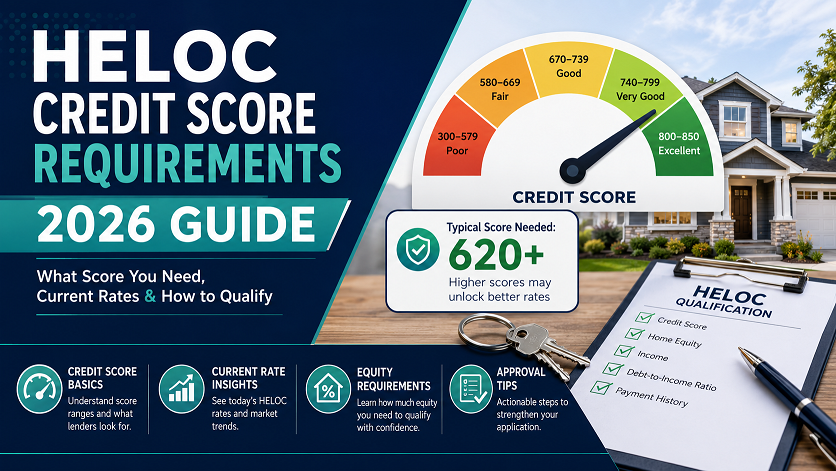
There is no universal credit score required for a HELOC. Bank of America and U.S. Bank currently publish a minimum score of 660 for their standard HELOC products, while other lenders may accept a different score or apply additional restrictions. A score alone is not enough: lenders also review available home equity, combined loan-to-value ratio, debt-to-income ratio, income, payment history, occupancy and property eligibility. Stronger credit and more equity may improve available limits and pricing, but approval and rates are never guaranteed.
A home equity line of credit can provide flexible access to money for renovations, major expenses or debt consolidation. It also converts part of your home equity into secured debt. If payments become unaffordable, your home is collateral and foreclosure is possible.
This guide explains the credit-score benchmarks lenders actually publish, how to calculate available equity and CLTV, what documents underwriters request, and how to compare a HELOC with a home equity loan, personal loan or cash-out refinance. It does not treat a lender’s advertised minimum as a promise that every applicant with that score will qualify.
What credit score do you need for a HELOC?
A practical starting point is the mid-600s, but the precise minimum belongs to the lender and product. As of the review date, Bank of America and U.S. Bank each state that applicants need a minimum score of 660 to get started or qualify. Navy Federal’s educational guidance describes a mid-600s baseline while emphasizing that every lender sets its own rules.
These numbers are lender disclosures, not an industry-wide law. A local credit union may publish 680, another lender may consider a lower score with substantial equity, and a premium offer may require a much stronger profile. Property type, lien position, state, requested limit and occupancy can change eligibility.
Published starting minimum at two reviewed national-bank HELOC programs.
Common starting point when a lender limits combined borrowing to about 85% of value.
Many HELOC rates move with an index plus a lender margin, so payments can change.
Can you get a HELOC with a 620 credit score?
Possibly, but options may be narrower and more expensive. Some lenders describe 620 as a possible general threshold, while the reviewed Bank of America and U.S. Bank products publish 660. An applicant near 620 may need more equity, lower debts, stable documented income and a strong recent payment record. Do not pay an application or appraisal fee until the lender explains its minimum and refund policy.
What about a 680, 700 or 740 score?
A higher score can strengthen the application, but it does not override high CLTV or unaffordable debt. U.S. Bank’s current rate disclosure notes that pricing can vary for scores below 730, among other factors. Navy Federal’s advertised low-rate example assumes a 750 FICO score along with a primary residence and low 70% maximum loan-to-value. Those assumptions illustrate premium pricing conditions; they are not general qualification rules.
Published HELOC requirements from current lender pages
The table is informational, not a ranking or endorsement. Terms were checked August 29, 2026 and can change by state, property, membership, line size and market conditions. Confirm the current official application disclosures before relying on them.
| Provider | Published score guidance | Published equity/CLTV guidance | Important limitation |
|---|---|---|---|
| Bank of America | Minimum credit score of 660+ | At least 15% equity; generally borrow up to 85% of value minus mortgage balance | Getting started does not guarantee approval, limit or APR |
| U.S. Bank | FICO score of 660 or higher | Reviews available equity; rate can vary with LTV and other factors | Also evaluates DTI, credit history and income history |
| Navy Federal | Educational baseline in the mid-600s; product pricing example assumes 750 | Product page advertises borrowing up to 95% for eligible members | Membership, occupancy, property and underwriting rules apply |
Do not copy a lender’s lowest advertised APR into a long-term budget. HELOC rates are commonly variable and can change after the page is published. Request a personalized offer showing the index, margin, introductory period, rate floor, lifetime cap, fees and payment formula.
How much equity do you need?
Equity equals current property value minus loans secured by the home. Underwriters usually calculate combined loan-to-value, or CLTV, by adding the existing mortgage balance and requested HELOC limit, then dividing by the appraised value.
HELOC CLTV example
Suppose a home is appraised at $400,000, the first-mortgage balance is $240,000 and the requested HELOC limit is $60,000. Combined secured debt would be $300,000. Dividing $300,000 by $400,000 produces a 75% CLTV.
If a lender’s maximum were 85%, the theoretical combined debt ceiling would be $340,000. After subtracting the $240,000 mortgage, up to $100,000 might appear available. That is not an approval estimate: the lender may reduce the line based on credit, income, property, minimum/maximum line sizes or its valuation.
Bank of America says most lenders require CLTV of 85% or less, though cutoffs vary. Some credit unions advertise higher maximums for eligible borrowers. Higher leverage can increase pricing and risk because less equity remains if home values decline.
Credit limit versus amount used
Some underwriting and pricing decisions consider the full approved line, not only what you plan to draw immediately. Ask how the requested limit affects CLTV, fees and the minimum initial advance.
Debt-to-income ratio and income requirements
Debt-to-income ratio compares required monthly debt payments with gross monthly income. Include the first mortgage, estimated HELOC payment, auto loans, minimum card payments, student loans and other obligations the lender specifies.
For example, $2,400 in counted monthly debts divided by $7,000 gross monthly income equals approximately 34.3% DTI. Lenders calculate obligations under their own policies; a HELOC payment based only on today’s interest may not be the qualifying payment used in underwriting.
Navy Federal’s educational guidance describes below 50% as a baseline, but that is not a universal maximum. A lender can require less depending on credit, CLTV, reserves or risk. More importantly, an approved DTI is not proof that the payment fits your household budget after taxes, insurance, utilities, childcare and irregular expenses.
Income documents
Applicants may need recent pay stubs, W-2s, tax returns, bank statements or documentation of retirement, rental or self-employment income. The lender may also request a mortgage statement, property-tax bill, homeowners-insurance evidence, identity details and information about outstanding debts. Self-employed borrowers may face additional documentation or income adjustments.
How your credit score affects HELOC rates and costs
A HELOC APR commonly equals a published index—often the prime rate—plus or minus a lender margin. Credit score, CLTV, line size, property type, occupancy, relationship discounts and location can affect the margin or available offer. An introductory APR may expire quickly.
Compare these items in writing:
- Current index and lender margin
- Introductory rate and exact expiration date
- Rate floor, periodic adjustment limit and lifetime cap
- Annual, inactivity, early-closure and transaction fees
- Appraisal, title, recording and closing costs
- Minimum initial draw and ongoing minimum draws
- Interest-only versus principal-and-interest payments
- Draw-period and repayment-period lengths
- Fixed-rate conversion options and conversion fees
A low initial payment can be misleading when it covers only interest. The CFPB warns that payments can change with a variable rate even when no additional money is borrowed. After the draw period, borrowing stops and repayment payments can rise significantly.
A simple stress test
Ask the lender to show the payment at the current rate, two percentage points higher and the contract maximum. Then calculate the repayment-period payment using the expected outstanding balance. If the higher payment would displace essential expenses or emergency savings, reduce the line or choose another option.
How to prepare and apply for a HELOC
Review all three credit reports
Use AnnualCreditReport.com and dispute specific factual errors before applying. Do not file false disputes against accurate accounts.
Estimate equity conservatively
Use a realistic property value, current mortgage payoff and requested line to estimate CLTV.
Calculate household affordability
Test variable-rate and repayment-period payments, not only the introductory minimum.
Compare at least three written offers
Compare index, margin, caps, fees, draw rules, repayment term and closing-cost reimbursement conditions.
Read disclosures before opening
Confirm lien position, property requirements, cancellation rights and circumstances allowing the lender to freeze or reduce the line.
A prequalification may use a soft inquiry, but confirm before submitting. A full application typically requires credit authorization, income verification and property valuation. Rate shopping can be worthwhile, yet consumers should not assume every scoring model groups HELOC inquiries exactly like first-mortgage inquiries.
HELOC versus home equity loan, personal loan and cash-out refinance
| Option | Rate structure | Collateral | Best suited to | Main risk |
|---|---|---|---|---|
| HELOC | Usually variable; borrow repeatedly during draw | Home | Staged or uncertain expenses | Payment increases and foreclosure risk |
| Home equity loan | Often fixed with lump-sum proceeds | Home | Known one-time cost | Borrowing full amount immediately |
| Personal loan | Often fixed; typically higher APR than secured debt | Usually unsecured | Smaller fixed expense without home lien | Higher payment or origination fee |
| Cash-out refinance | Replaces first mortgage, often fixed | Home | Large need when replacing the entire mortgage makes sense | Losing a favorable first-mortgage rate and paying closing costs |
A HELOC may preserve an existing low-rate first mortgage because it creates a separate lien. A cash-out refinance replaces that mortgage, so compare interest on the entire new balance—not only the cash received. Use our HELOC versus cash-out refinance guide for the detailed cost comparison.
Using home equity to consolidate credit-card debt can reduce the stated APR, but it transfers unsecured debt to debt secured by the home. It can also extend repayment and free card limits for new borrowing. Compare total repayment and address the cause of the balances before proceeding.
HELOC risks, tax rules and consumer rights
Your home secures the debt
The CFPB emphasizes that falling behind can lead to loss of the home. Keep property taxes, homeowners insurance and the first mortgage current, because problems with other property obligations may also affect the line or foreclosure risk.
The lender may freeze or reduce access
HELOC agreements may permit the lender to suspend additional advances or reduce the limit under specified circumstances, such as a significant property-value decline or a material change in ability to repay. Do not treat an unused line as guaranteed emergency savings.
Repayment shock
During the draw period, some plans permit interest-only payments. When repayment begins, further borrowing stops and principal must be repaid. The CFPB says payments are often significantly higher; some agreements can require a large balance payment. Read the schedule and plan before drawing.
Interest is not automatically tax-deductible
IRS guidance says interest on home equity debt may be deductible, subject to limits, when proceeds are used to buy, build or substantially improve the qualified home securing the loan. Interest used for personal expenses such as credit-card consolidation is generally not deductible under the post-2017 rules. Tax circumstances vary, so review the current Publication 936 or consult a qualified tax professional.
Three-business-day cancellation right
When the principal dwelling secures the HELOC, federal rescission rules generally provide three business days after the last required event to cancel in writing. The CFPB explains that the timing depends on opening the account and receiving required disclosures and notice. Do not assume the rule applies identically to every property or transaction.
Advertising disclosure
No lender paid for inclusion. Published requirements are examples, not personalized offers. Rates and programs can change after the review date.
Frequently asked questions
What is the minimum credit score for a HELOC?
There is no universal minimum. Bank of America and U.S. Bank currently publish 660 for their reviewed products. Other lenders may set higher or lower thresholds and separate underwriting requirements.
Can I get a HELOC with a 600 credit score?
Options are likely limited. A lender willing to consider the file may require substantial equity, low debts and compensating strengths, with less favorable pricing. Approval is not guaranteed.
Is 700 a good score for a HELOC?
It may satisfy many published minimums, but available equity, CLTV, DTI, income, property and recent credit history still determine eligibility and terms.
How much equity is usually required?
Many lenders limit CLTV to about 85%, leaving roughly 15% equity, but programs vary. Some credit unions advertise higher leverage for eligible members.
What DTI is needed?
There is no single maximum. Some educational guidance uses below 50% as a baseline, while individual lenders may require less depending on the complete risk profile.
Does a HELOC have a fixed interest rate?
Most HELOCs have a variable rate based on an index plus a margin. Some allow part of the balance to convert to a fixed-rate installment, potentially with separate terms or fees.
Will applying hurt my credit?
A full application commonly involves a hard inquiry, while some prequalification tools use a soft inquiry. Confirm the lender’s process before submitting.
Can a HELOC be used for debt consolidation?
Yes, but doing so secures previously unsecured debt with the home. Compare total cost, variable-rate risk and the danger of building new card balances.
Is HELOC interest tax-deductible?
It may be when proceeds buy, build or substantially improve the qualified home securing the debt, subject to IRS limits. Personal uses such as card payoff generally do not qualify.
How long is a HELOC draw period?
Ten years is common, but contracts vary. After the draw period, borrowing stops and repayment begins, often with a higher required payment.
Can a lender reduce my HELOC limit?
Under specified circumstances, yes. Agreements may permit freezes or reductions following a significant property-value decline or material change in repayment ability.
Is a HELOC better than a home equity loan?
Neither is universally better. A HELOC fits staged borrowing but often has variable rates; a home equity loan provides a lump sum and often a fixed payment.
Bottom line
A 660 score is a useful published benchmark at two major lenders, not a universal HELOC rule. The strongest application combines acceptable credit with documented income, manageable DTI and enough equity to meet the lender’s CLTV limit.
Because the home secures the line and payments can rise, compare personalized offers using the index, margin, caps, fees and repayment-period payment. Borrow only what the household can repay under a realistic higher-rate scenario.
6 thoughts on “HELOC Credit Score Requirements: What Lenders Look For”