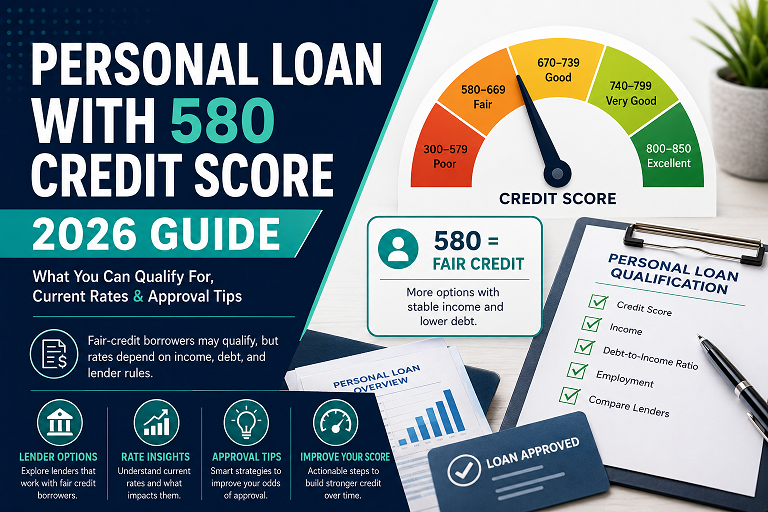
A 580 credit score does not automatically prevent you from getting a personal loan, but approval and affordable pricing are not guaranteed. Lenders may also evaluate income, existing monthly debts, recent payment history, requested amount and state. Start with soft-credit-check prequalification where available, compare APR and origination fees—not just monthly payments—and consider a credit union or lower-cost alternative before accepting an APR near the top of a lender’s range.
When an unexpected expense arrives, a search for “personal loan with a 580 credit score” can quickly produce lists promising easy approval and instant funding. Those lists often create the wrong expectation. An advertised minimum score is not the same as approval, and a lender’s lowest advertised annual percentage rate is usually reserved for stronger applicants.
At a score near 580, the question is not simply whether someone will lend you money. The more important question is whether the loan improves your financial position after interest, origination fees and the monthly payment are included.
This guide uses official provider disclosures checked on August 26, 2026. The advertised ranges may change, may not be available in every state and do not show the terms you personally will receive. No lender paid for placement, and the order below is not a “best lender” ranking.
Where offered, soft-pull prequalification can show potential terms before a formal application.
An origination fee may be deducted before you receive the money, even though you repay the full loan.
A loan is unaffordable if its payment forces you to borrow again for ordinary expenses.
Can you get a personal loan with a 580 credit score?
Possibly. FICO generally places scores from 580 through 669 in its fair range, but personal-loan lenders do not all use the same score, model or underwriting rules. Some do not publish a universal minimum score at all.
A lender may consider:
- Gross income and whether it can be documented
- Housing expense and required monthly debt payments
- Recent late payments, collections, charge-offs or bankruptcy
- Credit-card utilization and current outstanding balances
- Employment or other recurring income information
- Loan purpose, requested amount and repayment term
- State availability and lender-specific eligibility rules
- A co-borrower’s profile, when joint applications are permitted
That is why two people with the same score can receive very different results. One may qualify with a manageable APR; the other may receive only a high-cost offer or no offer at all.
580 is not a lender category
A lender could receive a score different from the one shown in your app because it uses another bureau, scoring model, version or calculation date. Treat your consumer score as a planning signal, not an approval certificate.
Personal-loan providers that may consider a range of credit profiles
Our comparison method
We included providers whose official pages displayed public personal-loan pricing on August 26, 2026 and whose rate-check process or product description could be verified directly. We compared advertised APR, fees, term, loan amount and rate-check disclosures. We did not infer a minimum score, claim that 580 qualifies, or rank providers by a lowest advertised APR that may be unavailable to most applicants.
| Provider | Official advertised terms checked | Fee point to review | Important limitation |
|---|---|---|---|
| Upgrade | APR 7.74%–35.99%; terms 24–84 months | Origination fee 1.85%–9.99%, deducted from proceeds | Lowest rates require conditions such as autopay and direct payoff; some discounts may require collateral. Offers vary and are not available everywhere. |
| Upstart marketplace | APR 6.3%–35.99%; commonly disclosed 3- or 5-year terms | Any origination fee is shown in the offer and may reduce net proceeds | Upstart is a marketplace, not the lender. Not all applicants are approved; partner and state terms vary. |
| Avant | $2,000–$35,000; APR 9.95%–35.99%; terms 24–60 months | Administration fee up to 9.99% | Actual terms depend on credit determination, state law and other factors; minimum amounts vary by state. |
| Local bank | Varies by institution and relationship | Check origination, documentation, late and optional insurance charges | Your bank may not offer unsecured loans to every profile. Request written disclosures. |
| Credit union | Varies by membership, institution and loan type | Compare APR and required membership costs | Membership eligibility applies; “credit union” does not automatically mean the lowest available cost. |
These are advertised ranges, not 580-score rates. A borrower near 580 may receive a rate toward the high end, different terms, or no offer. Before applying, open the provider’s current official disclosure because pricing can change after this page is reviewed.
Commercial terms naturally include valuable search phrases such as personal loan rates, debt consolidation loans, emergency loans, unsecured personal loans and loan origination fees. They belong here because they help readers evaluate cost—not because repeating them can guarantee ranking or higher-value ads.
How much can a personal loan really cost?
The annual percentage rate is a better starting comparison than the interest rate because APR is designed to reflect interest plus certain fees. You still need to examine the net proceeds, payment amount, term and total of payments.
Illustrative $5,000 personal loan
Assume a $5,000 loan has a 29% interest rate, a 36-month term and a 7% origination fee. The fee equals $350. If it is deducted from the proceeds, the borrower receives about $4,650 while owing payments calculated on the $5,000 principal.
At a 29% interest rate, the scheduled monthly payment is approximately $210, and 36 payments total roughly $7,560. Exact disclosures and APR calculation may differ. This example illustrates why a $5,000 approval may not supply $5,000 in usable cash and why the total repayment matters more than “only $210 per month.”
If you need exactly $5,000 for a repair, a deducted fee creates a shortfall. Borrowing more to cover the fee also raises the amount on which interest accrues. Before signing, write down these five numbers:
- Loan principal
- Cash actually deposited or sent to creditors
- APR
- Monthly payment and number of payments
- Total of payments
Lower payment does not always mean cheaper loan
A longer term can reduce the monthly payment while increasing total interest. Compare identical loan amounts over the complete repayment period rather than choosing the smallest payment.
APR versus interest rate
The interest rate is the price charged on the outstanding principal. APR annualizes the cost and incorporates certain finance charges. Two loans can advertise the same interest rate but have different APRs because one includes a larger origination fee.
Fixed versus variable rate
Many unsecured installment loans have fixed rates, creating scheduled payments that do not change. Never assume this. Confirm whether the rate and payment are fixed for the full term and read what happens after a late or failed payment.
How to strengthen a 580-score loan application
Check all three credit reports
Use AnnualCreditReport.com and look for accounts you do not recognize, incorrect balances, wrong late payments and duplicate information. Dispute only information you believe is inaccurate or incomplete.
Request only what you need
A smaller loan can mean a lower payment and may be easier for your budget to support. Include any deducted origination fee when calculating the usable amount.
Calculate debt-to-income pressure
Add required monthly debt payments and divide by gross monthly income. Lenders calculate this differently, but your own estimate reveals whether another obligation is realistic.
Prepare income documentation
Have accurate pay, benefit, bank or tax documentation appropriate to the lender’s process. Never inflate income or alter documents.
Prequalify before formal applications
Where the provider clearly uses a soft inquiry for rate checking, compare possible offers first. A final application may involve a hard inquiry and additional verification.
Consider a joint application carefully
If permitted, a qualified co-borrower may affect the decision. That person becomes responsible for repayment and can suffer credit damage if payments are missed.
If borrowing is not urgent, lowering reported card balances and building several months of reliable payments may improve the choices available. See our guide to responsible credit improvement and the realistic credit-improvement timeline.
When does a personal loan make financial sense?
Debt consolidation
A personal loan can replace several credit-card payments with one fixed installment. It is useful only when APR and total repayment compare favorably with the debts being replaced and paid-off cards do not fill up again. Use our detailed fair-credit debt consolidation guide before deciding.
Necessary home or vehicle repair
A loan may cover a repair needed for safe housing or transportation to work. Compare the financing cost with contractor, mechanic, insurer, employer, family-assistance or payment-plan options. Do not borrow more because a lender approves a larger amount.
Medical or essential expense
Before financing a medical bill, request an itemized statement, check insurance processing, ask about financial assistance and negotiate a payment plan. Turning a disputed or reducible bill into an interest-bearing loan may remove those options.
Situations where caution is especially important
High-cost borrowing for a vacation, wedding, speculative investment or routine monthly deficit can leave the expense behind while payments continue for years. A loan does not create income or solve a budget that remains negative every month.
Alternatives to a high-APR personal loan
| Alternative | Possible benefit | Main caution |
|---|---|---|
| Credit-union small loan | May offer a different underwriting approach or lower cost | Membership and approval requirements apply; compare full APR and fees. |
| Creditor hardship plan | May lower a payment or provide temporary relief without a new lender | Availability and credit reporting vary; obtain terms directly and in writing. |
| Nonprofit credit counseling | A counselor can review the entire budget and explain a debt management plan | Verify fees and services. A debt management plan is not a new loan or guaranteed debt reduction. |
| Medical or utility assistance | Financial assistance or an interest-free payment plan may reduce borrowing | Eligibility and application deadlines vary. |
| Secured savings loan | Collateral may support approval or a lower APR | Your savings are at risk and may be unavailable until repayment. |
| Wait and save | Avoids interest and gives the credit profile time to improve | Not suitable for every emergency; continue all required existing payments. |
Be very careful about title loans and payday loans. Short repayment schedules, repeated account withdrawals and high costs can turn a temporary cash shortage into a larger problem. A lender’s willingness to approve does not prove affordability.
How to recognize a personal-loan scam
A genuine lender may advertise prequalification, but it will not guarantee approval before evaluating required information. Stop if someone:
- Guarantees approval “regardless of credit” before reviewing an application
- Demands a gift card, wire transfer or cryptocurrency payment before releasing funds
- Calls an upfront payment “insurance,” “tax,” “verification” or a refundable deposit
- Uses a web address or email that imitates a known bank but contains misspellings
- Pressures you to act immediately or prevents you from reading disclosures
- Requests online-banking passwords or one-time security codes
- Sends a check and instructs you to return part of the money
Verify independently
Find the lender’s official website yourself, confirm state licensing where applicable, read privacy and contact information, and compare the written agreement with the offer you expected. Report suspected fraud at ReportFraud.ftc.gov.
Frequently asked questions
Can I get a $5,000 loan with a 580 credit score?
Possibly, but neither the score nor requested amount guarantees approval. Income, existing debt, recent delinquencies, state and lender rules also matter. Compare personalized offers and confirm that deducted fees still leave enough usable cash.
What APR should I expect with a 580 score?
There is no reliable universal APR for one score. Providers may offer terms near the high end of their advertised ranges, different amounts, or no offer. Prequalification can provide a more relevant estimate without relying on a generic rate table.
Does prequalification hurt my credit score?
Many providers use a soft inquiry for an initial rate check, which generally does not affect scores. A complete application may use a hard inquiry. Read the provider’s disclosure before submitting information.
Is a 35.99% APR personal loan worth it?
Such an APR is expensive and can approach the upper end advertised by several online providers. Compare total repayment with credit-union, creditor hardship, assistance and counseling options. Do not accept it merely because approval is available.
Can a personal loan improve my credit?
There is no guaranteed score result. A hard inquiry and new account may affect scores, while on-time payments can build positive history. Missed payments can cause harm. Borrow for a financial need, not solely to chase points.
How quickly can personal-loan funds arrive?
Some providers advertise sending funds as soon as the next business day after approval and verification, but bank processing, weekends, creditor payoff and document review can cause delays. Never make a nonrefundable commitment based on an advertised funding time.
Should I use a co-signer?
Only after both people understand that the co-signer can be legally responsible for the entire debt, may have reduced borrowing capacity and can suffer credit damage after missed payments. Not every lender permits co-signers.
The bottom line
A personal loan with a 580 credit score is possible, but the first approval is not automatically a good offer. Compare rates through soft-pull prequalification where available, then judge the approved APR, fee, net proceeds, monthly payment and total repayment together.
If the cost is high or the payment leaves no room for essentials, pause. A credit union, creditor hardship arrangement, nonprofit counselor or short period of saving and credit improvement may provide a safer route. The right outcome is not simply receiving money—it is repaying the obligation without creating another financial emergency.
Related guides
Sources and official disclosures
- Consumer Financial Protection Bureau: Personal installment loan fees
- Upgrade: Official personal-loan APR, fee and term disclosure
- Upstart: Official personal-loan marketplace disclosures
- Avant: Official loan amount, APR, term and fee disclosure
- AnnualCreditReport.com: Federally authorized credit-report access
- Federal Trade Commission: Advance-fee loan scams
4 thoughts on “Personal Loan With a 580 Credit Score: 2026 Options and Costs”