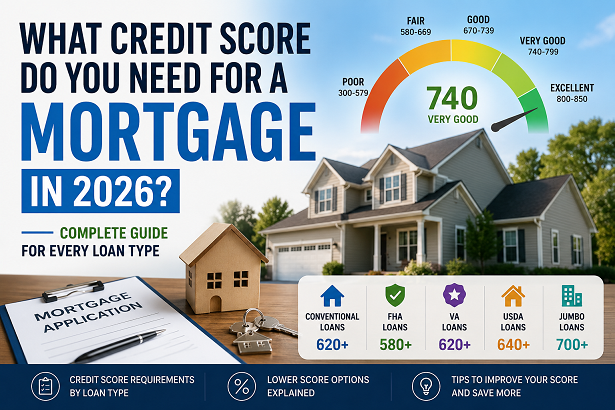
What Credit Score Do You Need for a Mortgage in 2026? — Complete Guide for Every Loan Type
The minimum credit score you need depends on your loan type. Conventional loan: 620. FHA loan: 580 (3.5% down) or 500 (10% down). VA loan: No official minimum — most lenders require 580–620. USDA loan: 640. Jumbo loan: 700–720+. For the best rates in 2026, you need 740 or higher. The difference between a 620 and a 740 score on a $350,000 mortgage can mean $100,000+ in extra interest over 30 years.
Your credit score is the single most important number in a mortgage application. It determines whether you are approved, which loan programs you can access, and — critically — what interest rate you will pay for the next 15 to 30 years. A one-point difference in your rate on a $350,000 mortgage is not a minor detail. It is $200 per month and over $70,000 over the life of the loan.
In 2026, the credit score landscape for mortgages is more complex than it has been in decades. New scoring models — FICO 10T and VantageScore 4.0 — are now approved alongside Classic FICO for loans sold to Fannie Mae, Freddie Mac, and FHA. Fannie Mae has removed its minimum FICO score requirement from its Selling Guide. And average mortgage rates remain elevated, making it more important than ever to maximize your credit score before applying.
This guide covers every mortgage type, every score tier, and gives you a clear action plan to get where you need to be.
Minimum Credit Score by Loan Type — 2026 Quick Reference
| Loan Type | Minimum Score | Down Payment | Best Rate Score | Who It’s For |
|---|---|---|---|---|
| Conventional | 620 | 3%–20% | 740+ | Most buyers with good credit and stable income |
| FHA | 580 (3.5% down) 500 (10% down) |
3.5%–10% | 620+ | First-time buyers, lower credit, limited down payment |
| VA | No official minimum Most lenders: 580–620 |
0% | 620+ | Veterans, active military, eligible surviving spouses |
| USDA | 640 | 0% | 640+ | Rural and suburban buyers within USDA income limits |
| Jumbo | 700–720 | 10%–20% | 760+ | Buyers borrowing above $802,650 conforming limit |
| HELOC | 620–640 | N/A (equity-based) | 720+ | Existing homeowners tapping home equity |
HELOC credit score requirements
See our complete HELOC credit score requirements guide for full rate data, equity calculations, and lender-by-lender requirements.
Program Minimums vs Lender Minimums — They Are Not the Same
The scores above are the official program minimums set by FHA, Fannie Mae, VA, and USDA. Individual lenders almost always set higher requirements called overlays of 20 to 40 points above the program minimum. A lender may require 640 for a loan where the FHA minimum is 580. Always check what your specific lender requires, not just the program minimum.
Conventional Loans — Credit Score Requirements 2026
Conventional loans are the most popular mortgage type in the United States, used for more than half of all home purchases. They are not insured by a government agency — instead, they follow rules set by Fannie Mae and Freddie Mac and are sold on the secondary market.
Conventional Loan — 2026
- Minimum 620 credit score from most lenders
- Fannie Mae removed its formal minimum in November 2025 — but most lenders still enforce 620
- Down payment as low as 3% (with PMI) up to 20% (no PMI)
- PMI required until 80% loan-to-value is reached
- 2026 conforming loan limit: $802,650 in most areas
- Best rates available at 740 or higher
Conventional — What Your Score Gets You
- 760+: Best rates, lowest PMI, widest lender choice
- 740–759: Excellent terms, near-best rates
- 700–739: Good rates, standard approval
- 680–699: Approved but rates noticeably higher
- 620–679: Approved by most lenders but higher rate and PMI cost
- Below 620: Not eligible for conventional — consider FHA
Conventional loans remain the most popular mortgage option. Borrowers will have more than $26,000 of additional borrowing power in 2026 than in the previous year, as conforming loan limits increased. For 2026, the standard conforming loan limit is $802,650 in most U.S. counties, up from prior years due to rising home prices.
Mortgage lenders price rates in credit score tiers, typically moving in 20-point increments. This means a difference of just 20 points — say, 699 vs 720 — can move you into a meaningfully cheaper rate tier. If you are close to a tier boundary, it is worth spending a few extra weeks paying down balances to cross into the better tier before applying.
FHA Loans — Credit Score Requirements 2026
FHA loans are insured by the Federal Housing Administration (FHA), a division of HUD. Their more flexible credit requirements make them the go-to option for first-time buyers, buyers recovering from credit setbacks, and anyone who cannot qualify for a conventional loan.
FHA Loan — 2026
- 580+ score: Qualify with 3.5% down payment
- 500–579 score: Qualify with 10% down payment
- Mandatory mortgage insurance: 1.75% upfront + annual premium paid monthly
- 2026 FHA loan limits: $541,287 (low-cost areas) to $1,249,125 (high-cost areas)
- Requires 2 years of employment and verifiable income
- As of April 2026, FHA now accepts VantageScore 4.0 and FICO 10T alongside Classic FICO
FHA vs Conventional — When FHA Wins
- Your credit score is between 580 and 639
- You have less than 10% for a down payment
- You have past bankruptcy or foreclosure (2–3 year waiting periods vs 4–7 for conventional)
- Your debt-to-income ratio is above 43%
- You are a first-time buyer with a thin credit file
FHA Mortgage Insurance — The Key Trade-Off
FHA loans require mortgage insurance for the life of the loan if you put less than 10% down. This is a significant long-term cost. On a $300,000 FHA loan, you pay roughly $1,750 upfront (1.75%) plus approximately $125–$200 per month in annual MIP. Unlike conventional PMI which drops off at 80% LTV, FHA MIP is permanent unless you refinance into a conventional loan once your equity and score qualify. See our complete FHA loan credit score requirements guide for full MIP costs, DTI limits, and loan limits by county
See FHA Loan Credit Score Requirements 2026 — Complete Guide
See our complete FHA loan credit score requirements guide for full MIP costs, DTI limits, and loan limits by county.
VA Loans — Credit Score Requirements 2026
VA loans are guaranteed by the U.S. Department of Veterans Affairs and available to eligible veterans, active-duty service members, and surviving spouses. They offer the most favorable terms of any mortgage program — zero down payment, no mortgage insurance, and competitive interest rates — making them the best mortgage option available for those who qualify at virtually every credit score level.
VA Loan — 2026
- No official minimum credit score set by the VA — eligibility is lender-dependent
- Most lenders require 580–620 as their own overlay
- Zero down payment required for eligible borrowers with full entitlement
- No monthly mortgage insurance premiums (unlike FHA)
- One-time VA funding fee: 1.25%–3.3% depending on service and down payment (waived for disabled veterans)
- Rates typically 0.15%–0.25% lower than comparable conventional loans
- Average VA borrower credit score in 2024 was 725, per HMDA data
VA Loans Are Almost Always the Best Option for Eligible Borrowers
If you qualify for a VA loan, use it. Even with a 740+ credit score that would qualify you for excellent conventional terms, the VA loan usually wins — no PMI, competitive rates, and zero down payment. The only scenario where conventional beats VA is when the funding fee is not waived and a large down payment is being made, in which case a conventional loan with 20% down may cost less overall.
USDA Loans — Credit Score Requirements 2026
USDA Loan — 2026
- Minimum 640 credit score for automated underwriting approval
- Scores below 640 may still qualify through manual underwriting — but fewer lenders offer this
- Zero down payment for eligible borrowers
- Household income must be at or below 115% of Area Median Income for the county
- Property must be in a USDA-eligible rural or suburban area
- 1% upfront guarantee fee + 0.35% annual fee (lower than FHA MIP)
- Mortgage insurance is cheaper than FHA — making USDA very cost-effective for eligible buyers
USDA loans are significantly underused by eligible buyers. Many suburban areas qualify — not just rural farmland. If your household income is below the local limit and the property is in a USDA-eligible zone, this program offers zero down payment with lower insurance costs than FHA. Check eligibility at the USDA’s eligibility map at eligibility.sc.egov.usda.gov before assuming you do not qualify.
Jumbo Loans — Credit Score Requirements 2026
Jumbo Loan — 2026
- Applies to loans above the 2026 conforming limit of $802,650 (standard areas)
- Most lenders require 700 minimum — many require 720 or 740
- Larger down payment typically required: 10%–20%
- Lower DTI requirements — usually 43% or less, sometimes 38%
- Rates typically 0.25%–0.5% higher than conforming conventional loans
- Significant cash reserves often required (6–12 months of payments)
How Your Credit Score Affects Your Mortgage Rate and Total Cost in 2026
The average mortgage rate in the U.S. is 6.71% for a conventional 30-year fixed-rate mortgage as of May 2026, according to data from Curinos LLC. But that average masks enormous variation by credit score tier. Here is what borrowers at different score levels are actually seeing:
| Credit Score | Rating | Est. APR (30-yr Fixed) | Monthly Payment* | Total Interest* | vs Best Rate |
|---|---|---|---|---|---|
| 760–850 | Exceptional | 6.41% | $2,196 | $440,560 | Best rate ✓ |
| 740–759 | Very Good | 6.55% | $2,226 | $451,360 | +$10,800 |
| 720–739 | Very Good | 6.76% | $2,272 | $467,920 | +$27,360 |
| 700–719 | Good | 6.96% | $2,317 | $484,120 | +$43,560 |
| 680–699 | Good | 7.14% | $2,357 | $498,520 | +$57,960 |
| 660–679 | Fair | 7.27% | $2,386 | $508,960 | +$68,400 |
| 640–659 | Fair | 7.68% | $2,477 | $541,720 | +$101,160 |
| 620–639 | Low | 8.10% | $2,568 | $574,480 | +$133,920 |
*Based on a $350,000 30-year fixed-rate conventional mortgage. Rate estimates from Curinos/Experian data, May 2026. Actual rates vary by lender, location, and individual profile.
The Most Important Number in This Table
The difference between a 620–639 score and a 760+ score on a $350,000 mortgage is $133,920 in extra interest over 30 years — and $372 more per month. Spending 6 to 12 months improving your score before applying is one of the highest-return financial decisions you can make. Even moving from 680 to 720 saves nearly $27,000 over the life of the loan.
See What Loan You Qualify For at Your Credit Score
Use our free Loan Affordability Calculator — enter your income, debts, and credit score to see estimated loan amount, rate range, and monthly payment instantly.
Lender Overlays — Why the Program Minimum Is Not the Real Minimum
One of the most common points of confusion for mortgage applicants is the gap between the official program minimum and what lenders actually require. The program minimum is set by FHA, Fannie Mae, VA, or USDA. A lender overlay is a stricter requirement that an individual lender adds on top.
Individual lenders often set overlay requirements 20 to 40 points above program minimums. The score your lender actually requires may be 20 to 40 points above the program minimum.
Real examples of common lender overlays:
- FHA program minimum is 580 — but many bank lenders require 620 for FHA loans
- VA has no official minimum — but most lenders set 620 as their floor
- Conventional minimum is 620 — but lenders in high-risk markets may require 640 or 660
- USDA minimum is 640 — some lenders require 660 for streamlined processing
This is why shopping multiple lenders — especially smaller credit unions and non-bank mortgage lenders — matters enormously if your score is near a program minimum. A borrower with a 600 score may be declined by a large bank offering FHA loans but approved by a community lender or online lender that operates closer to the FHA program minimum.
Credit Score vs Debt-to-Income Ratio — Both Determine Your Approval
Your credit score is critical, but it is one half of the mortgage approval equation. The other half is your debt-to-income ratio (DTI) — the percentage of your gross monthly income that goes toward debt payments. Even a 780 credit score will not save a mortgage application if DTI is too high.
| Loan Type | Maximum DTI (Program) | Preferred DTI | Notes |
|---|---|---|---|
| Conventional | 45%–50% (with compensating factors) | 36%–43% | Higher score allows higher DTI |
| FHA | Up to 57% with strong compensating factors | 43%–50% | Most flexible DTI of any program |
| VA | No hard cap — uses residual income method | 41% | Residual income calculation may allow higher DTI |
| USDA | 41% standard — 44% with compensating factors | Under 41% | Strict income and location limits apply |
| Jumbo | 43% maximum — often 38% | Under 38% | Strictest DTI requirements of any loan type |
Lenders pull reports from all three major credit bureaus and use your middle score. If you are buying with someone else, they take both middle scores and use the lower one. This means if you are applying jointly, the person with the lower score determines your rate — making it worth delaying an application if one co-borrower can quickly improve their score.
The 2026 Scoring Change — What FICO 10T and VantageScore 4.0 Mean for Your Application
As we covered in detail in our FICO 10T vs Classic FICO guide, the mortgage industry underwent its most significant scoring model change in 30 years in 2026. Here is the condensed version of what it means for your mortgage application specifically:
- Lenders now have a choice between Classic FICO, VantageScore 4.0, and the phasing-in of FICO 10T. This is the first time in mortgage history that lenders could use a non-FICO model for loans sold to Fannie Mae and Freddie Mac.
- The lender you choose now matters more than before. The practical takeaway is that 2026 is a transition year. Some lenders are using the new models, some are sticking with Classic FICO, and many will support both. The lender you work with can affect which scores get evaluated.
- VantageScore 4.0 completely ignores paid collections. If you have paid-off collection accounts on your report, a lender using VantageScore 4.0 may approve you or give you a better rate than a lender using Classic FICO, where paid collections still carry weight.
We cover VantageScore 4.0 in full detail in our dedicated VantageScore 4.0 explained guide — including the rent reporting strategy and who benefits most.
- FICO 10T rewards declining balances. If your credit card balances have been trending down over the past 24 months, FICO 10T will score you higher than Classic FICO would for the same current snapshot.
- VantageScore estimates that approximately 5 million prospective buyers will benefit from the new credit modeling — primarily thin-file borrowers, renters, and those with resolved past credit issues.
How to Improve Your Credit Score Before Applying for a Mortgage
The best time to start improving your credit for a mortgage is 6 to 12 months before you plan to apply. Here is the fastest and most impactful sequence of actions:
Pull Your Credit Reports From All Three Bureaus — Free
Get your free reports at AnnualCreditReport.com. Look for errors, outdated negative items, collections that should have been removed under 2026 medical debt rules, and accounts you do not recognize. Dispute anything inaccurate — a successful dispute can improve your score within 30 to 60 days. Under FCRA, bureaus must investigate disputes within 30 days.
Pay Down Credit Card Balances to Under 30% — Then Under 10%
Paying down credit card balances below 30% utilization can raise your score in as little as 30 days. This is the single fastest-acting improvement available. Target overall utilization under 30% first, then push toward 10% for maximum benefit. Every dollar you pay down in the months before applying translates directly into a better rate.
Make Every Single Payment on Time for 12+ Months Before Applying
Payment history is 35% of your FICO score. A single late payment in the 12 months before a mortgage application will raise red flags with underwriters even if it does not catastrophically drop your score. Set up autopay for the minimum on every account. Never miss a payment in your mortgage preparation period.
Do Not Open Any New Credit in the 6 Months Before Applying
New accounts trigger hard inquiries, lower your average account age, and signal instability to lenders. No new credit cards, no car loans, no store cards, no personal loans. The only exception is if a new account would dramatically improve your utilization ratio — and even then, wait at least 6 months after opening before applying for a mortgage.
Do Not Close Old Credit Card Accounts
Closing old cards reduces your available credit (raising utilization) and shortens your average account age — both negative factors. Even if you do not use an old card, keep it open and use it for a small recurring charge each month. This maintains the account as active without creating significant debt.
Pay Off or Settle Old Collections — Especially if Applying in 2026
Under Classic FICO, paying a collection did not always help because the account still appeared. Under VantageScore 4.0 — now accepted for mortgage underwriting — paid collections are ignored entirely. If a lender is using VantageScore 4.0, clearing old collections before applying could meaningfully improve your qualifying score. Ask your lender which model they use before deciding whether to pay old collections.
Shop Multiple Lenders Before Applying
Request a Loan Estimate from multiple lenders to compare the true cost. This document shows your actual APR, including fees, to help you make an accurate comparison beyond advertised rates. Rate shopping within a 14 to 45-day window counts as a single inquiry under FICO’s mortgage rate shopping protection — so get multiple quotes without worrying about multiple score drops.
What to Do Based on Your Current Score
FHA with 10% down is your only conforming option. Focus on 12 months of on-time payments and paying collections before applying.
FHA with 3.5% down or VA if eligible. Pay down balances to push toward 620 for conventional access within 6 months.
Conventional or FHA available. Rates are high — 6 months of credit work to reach 680–700 saves significant money.
Good approval odds. Pushing to 740 unlocks significantly better rates. 3–6 months of utilization paydown can get you there.
Excellent terms on all loan types. Apply now — you are in the second-best rate tier. Pushing to 760+ gains a small additional benefit.
Best rates available on all loan types. Shop multiple lenders to ensure you are getting the best deal your score earns.
Not Sure Where Your Score Stands?
Use our free Credit Score Estimator — answer 5 questions and get your estimated FICO range in 30 seconds. No sign-up, nothing stored.
Frequently Asked Questions
What credit score do you need to buy a house in 2026?
The minimum depends on your loan type. For a conventional loan you need at least 620. For an FHA loan you need 580 with 3.5% down, or 500 with 10% down. VA loans have no official minimum but most lenders require 580 to 620. USDA loans typically require 640. Jumbo loans generally require 700 to 720 or higher. For the best interest rates on any loan type, aim for 740 or higher.
Can I get a mortgage with a 580 credit score in 2026?
Yes. With a 580 credit score you qualify for an FHA loan with 3.5% down and for most VA loans if you are a veteran or active service member. You will not qualify for a conventional loan (minimum 620) or a USDA loan (minimum 640) at 580. Expect higher rates and mandatory FHA mortgage insurance. If improving your score to 620 is feasible within 6 months, the conventional option may save you enough in reduced MIP costs to justify the wait.
What credit score do I need for the best mortgage rate in 2026?
You generally need a credit score of at least 580 to qualify for a mortgage, and a score of 760 or higher to get the best interest rate. According to Curinos data from May 2026, a borrower at 760+ qualifies for approximately 6.41% APR versus 6.76% for a 700-score borrower on a 30-year conventional — a difference that compounds to tens of thousands of dollars over the life of the loan.
How much does credit score affect mortgage rate in 2026?
Significantly. Improving your credit score from 680 to 760 can save you roughly $83 per month and more than $29,000 in total interest over a 30-year loan, according to myFICO. Based on current 2026 rates on a $350,000 mortgage, the difference between a 620 score and a 760 score is approximately $372 per month and over $133,000 in total interest.
Does my credit score affect FHA mortgage rates?
Yes, but less dramatically than conventional loans. FHA rates vary by score tier but the spread is narrower because FHA’s government backing absorbs more risk. However, all FHA borrowers pay mandatory mortgage insurance — 1.75% upfront and an annual premium — regardless of credit score. For borrowers below 620, FHA loans often offer better overall monthly costs than conventional loans even accounting for MIP.
What is the minimum credit score for a VA loan in 2026?
The VA does not set a minimum credit score requirement. However, most individual lenders require 580 to 620 as their own overlay. The VA does not have a minimum credit score requirement, but most lenders require at least a 620 credit score to qualify. VA loans offer zero down payment and no mortgage insurance — making them the best available option for eligible veterans at nearly every credit score level.
How quickly can I improve my credit score before buying a house?
Paying down credit card balances below 30% utilization can improve your score within 30 to 45 days — as soon as the updated balance is reported to the bureaus. Removing an inaccurate item through dispute can take 30 to 60 days. Building a clean 12-month payment history after a negative event takes longer. Most experts recommend allowing 6 to 12 months of deliberate credit improvement before applying. Use our free Credit Score Impact Simulator to see which actions will help most for your specific profile.
Related Free Tools
Related Guides
- Experian/Curinos — Average Mortgage Rates by Credit Score, May 2026
- UQUAL — Credit Score Requirements for Every Mortgage Type, 2026
- Compass Mortgage — FHA Loan Requirements 2026
- Veterans United — VA Loan Credit Score Minimums
- The Mortgage Reports — Mortgage Rates by Credit Score, 2026
- ConsumerAffairs — Mortgage Rates by Credit Score 2026
- CFPB — Explore Mortgage Interest Rates Tool
- Fannie Mae Selling Guide — Credit Score Requirements
- FHA Handbook — Credit Score and Down Payment Requirements