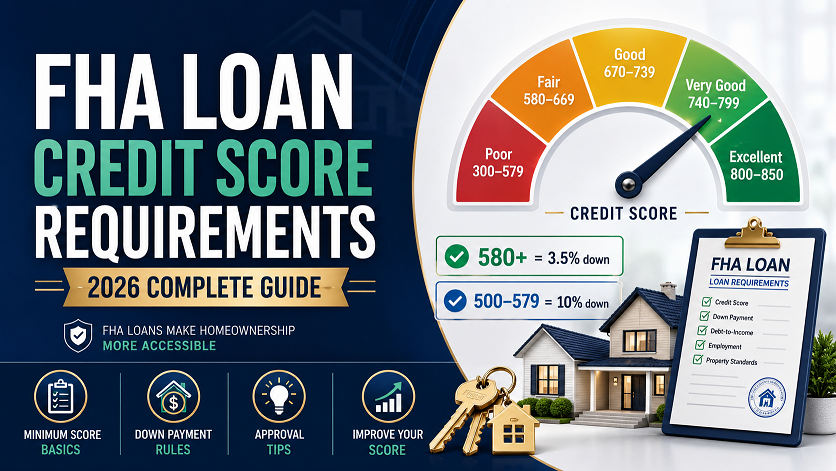
HUD’s FHA rules set a minimum decision credit score of 500. Scores from 500 through 579 generally require at least 10% down because maximum loan-to-value is 90%. A score of 580 or higher may qualify for FHA maximum financing, which can allow a 3.5% minimum down payment. These are FHA insurance rules—not guaranteed-approval thresholds. FHA-approved lenders may require a higher score and must review the borrower’s income, debts, payment history, assets and property.
FHA financing can make homeownership possible for borrowers with a smaller down payment or imperfect credit history. It can also be misunderstood. A 580 score does not produce automatic approval, a 620 score does not guarantee the lowest FHA mortgage rate, and a borrower below one lender’s cutoff is not necessarily below HUD’s program floor.
This guide focuses specifically on FHA purchase-loan credit requirements and costs. For a concise comparison with conventional, VA, USDA and jumbo financing, use the broader mortgage credit score requirements guide.
- Official 500 and 580 score tiers
- FHA rules versus lender overlays
- Automated and manual underwriting
- Debt-to-income ratios and compensating factors
- Mortgage insurance and real loan costs
- 2026 FHA loan limits
- Collections, late payments and bankruptcy
- How to prepare an FHA application
- Frequently asked questions
Not eligible for FHA-insured financing under the minimum decision credit score rule.
Maximum 90% LTV generally means at least 10% down on a purchase.
May qualify for maximum financing and a down payment as low as 3.5%.
FHA credit score and down-payment tiers
| Minimum decision credit score | HUD financing rule | Purchase down-payment implication | What it does not mean |
|---|---|---|---|
| Below 500 | Not eligible for FHA-insured financing | FHA purchase financing unavailable under the score rule | A larger down payment does not override the FHA floor. |
| 500–579 | Maximum 90% loan-to-value | Generally at least 10% down | HUD does not require every lender to approve at 500. |
| 580+ | Eligible for maximum FHA financing, subject to the complete file | As little as 3.5% down may be available | A 580 score does not guarantee approval, rate or affordability. |
HUD uses the term Minimum Decision Credit Score (MDCS). When more than one score or borrower is involved, the lender applies FHA’s current score-selection rules. A score displayed by a credit-card app may not be the score used in the FHA mortgage file because bureau, model and report date can differ.
The down payment is calculated from the home price or adjusted value under FHA rules. Closing costs, prepaid taxes, homeowners insurance, appraisal costs and reserves are separate from the down payment, so a buyer may need more cash than 3.5%.
Do not confuse HUD eligibility with lender approval
HUD insures qualifying FHA mortgages but private FHA-approved lenders originate and underwrite them. A lender may decline a file that meets the program score tier because of its overlay or other risk factors.
Why an FHA lender may require 600, 620 or more
A lender overlay is an additional requirement imposed above FHA’s minimum insurance standard. A company may choose not to originate FHA loans below 600 or 620, may limit manual underwriting, or may require stronger reserves when the applicant has recent delinquencies.
Overlays can reflect risk management, investor rules, servicing capacity or operational policy. They are not proof that HUD changed its 500/580 tiers. Ask the loan officer:
- Is this cutoff an FHA rule or your company’s overlay?
- Do you allow manual underwriting when the automated result is “Refer”?
- Does the policy differ for manufactured homes or multi-unit properties?
- Are there extra reserve or debt-ratio requirements at my score?
- Can you provide the adverse-action reasons in writing?
Shopping among legitimate FHA-approved lenders can uncover different overlays and pricing. It does not mean a borrower should keep applying blindly. First address factual report errors, documentation problems and unaffordable debt.
TOTAL Scorecard and manual FHA underwriting
FHA loans are commonly evaluated through an automated underwriting system using FHA’s TOTAL Mortgage Scorecard. An “Accept” response indicates that FHA may insure the loan without a manual underwriting review unless a manual downgrade is required. A “Refer” response means a Direct Endorsement underwriter must review the file under manual rules.
HUD also states that a lender may not approve or deny a mortgage solely because of the TOTAL assessment. The complete FHA Handbook applies. The underwriter considers income stability, assets, recurring obligations, housing history and credit events.
Manual underwriting is not an exception to affordability
Manual review can provide a path for an applicant whose file needs human evaluation, but it can add stricter debt-ratio and reserve requirements. The underwriter evaluates whether compensating factors genuinely offset risk. A letter explaining a hardship may provide context, but it does not erase accurate missed payments.
FHA debt-to-income ratios and compensating factors
Debt-to-income ratio (DTI) compares qualifying monthly obligations with gross monthly income. The front-end ratio focuses on the proposed housing payment; the back-end ratio includes housing plus recurring debts such as car loans, student loans, credit-card minimums and certain support obligations.
There is no responsible way to promise approval based on one DTI number. Automated underwriting can evaluate the full application, while manual underwriting applies HUD matrices and compensating-factor rules. Lenders may set tighter limits.
Potential compensating factors under applicable guidance can include verified cash reserves, limited increases in housing expense, residual income and other documented strengths. They are not points that a borrower can simply add together. The lender must determine whether the factor is allowed and properly documented.
Calculate a planning estimate
Add the estimated principal, interest, property taxes, homeowners insurance, FHA annual mortgage insurance, homeowners-association dues and required secondary financing. Then add recurring credit obligations. Divide by gross monthly income. Use the result only for planning; underwriting treatment can differ for student loans, disputed debts, collections, self-employment income and variable income.
Approval and affordability are different
An automated system may approve a payment that leaves too little room for repairs, utilities, transportation, childcare or emergencies. Build a homeowner budget rather than borrowing the maximum available.
FHA mortgage insurance and total borrowing cost
FHA insurance protects the lender against qualifying losses; it is not homeowners insurance and does not protect the borrower from foreclosure. Most FHA forward mortgages include an upfront mortgage insurance premium and an annual mortgage insurance premium paid through the monthly payment.
The upfront premium is generally 1.75% of the base loan amount under the standard FHA schedule and can usually be financed into the loan. Financing it reduces cash due at closing but increases the starting balance and interest paid. Annual MIP depends on the loan amount, term and loan-to-value category under HUD’s current premium table.
For many standard longer-term FHA purchase loans, the annual premium rate is commonly 0.55%, but borrowers must verify the exact category. The duration also matters: for many loans above 90% LTV, annual MIP continues for the mortgage term; at 90% LTV or below, it may apply for 11 years. Refinances and older FHA endorsements can follow different schedules.
Example of upfront MIP
For a hypothetical $250,000 base FHA loan, a 1.75% upfront premium equals $4,375. If financed, the initial loan balance would become $254,375 before any other permitted adjustments. This example is arithmetic, not a quote; interest rate, annual MIP and closing charges require a Loan Estimate.
Compare FHA with conventional financing
FHA may offer a competitive path for a smaller down payment or weaker credit profile. Conventional financing may have cancellable private mortgage insurance under certain conditions and different pricing. Compare rate, APR, points, insurance duration, lender fees, monthly payment and cash to close using the same property and lock date.
2026 FHA loan limits
FHA loan limits are maximum insurable base mortgage amounts, not purchase-price guarantees or amounts every borrower can afford. The applicable limit depends on county, number of units and case-number assignment date.
| Property size | 2026 low-cost-area floor | 2026 high-cost-area ceiling |
|---|---|---|
| One unit | $541,287 | $1,249,125 |
| Two units | $693,050 | $1,599,375 |
| Three units | $837,700 | $1,933,200 |
| Four units | $1,041,125 | $2,402,625 |
These calendar-year 2026 figures apply to relevant case numbers assigned from January 1 through December 31, 2026. Areas between the floor and ceiling have county-specific limits. Alaska, Hawaii, Guam and the U.S. Virgin Islands may have special exception limits. Use HUD’s official FHA Mortgage Limits Search for the property address.
FHA property and occupancy rules
An ordinary FHA purchase mortgage is for a principal residence, not a vacation home or pure investment property. The borrower generally must occupy the home as the principal residence under the applicable timeline and certification requirements.
Eligible properties can include one-to-four-unit homes, approved condominiums and qualifying manufactured homes. Multi-unit financing has additional self-sufficiency, reserve or underwriting considerations in some cases. The property must meet FHA appraisal and minimum property requirements. An appraisal is not a home inspection, so buyers should consider an independent inspection.
FHA 203(k) financing can combine acquisition or refinance with eligible rehabilitation costs. That program has additional contractor, draw, consultant and property requirements and should not be confused with a standard FHA purchase loan.
Down-payment gifts, assistance and seller contributions
FHA permits eligible gift funds when the donor, transfer and gift letter satisfy Handbook requirements. A gift is not a hidden loan. The lender must document the donor and transfer of funds, and unacceptable interested-party funding can make the transaction ineligible.
State or local down-payment assistance may be available, but it can have income, occupancy, education, repayment or resale restrictions. Compare the first mortgage and assistance together. A “free” assistance program may be a repayable second mortgage or may affect the first-mortgage rate.
Interested parties can pay certain closing costs, prepaid items and discount points within FHA limits and documentation rules. Contributions cannot be used to disguise cash back to the borrower or inflate the price. Ask the lender and settlement professional how a seller credit appears on the Loan Estimate and Closing Disclosure.
Collections, late payments, disputes and major credit events
Collections
FHA does not require every collection account to be paid off as a universal condition. Depending on aggregate balances and underwriting type, the lender may include a calculated payment, use a documented payment arrangement or require further analysis. Judgments and federal debts can follow different rules.
Late payments
Recent housing or installment delinquencies can cause more concern than an older isolated event. The underwriter evaluates cause, severity, frequency and whether responsible payment behavior has been re-established. No “seasoning trick” guarantees approval.
Disputed accounts
A legitimate factual error should be disputed with evidence. But disputing accurate negative accounts solely to hide them during underwriting can delay or jeopardize the mortgage. Follow the process in how to fix credit-report errors.
Bankruptcy, foreclosure and short sale
FHA applies waiting-period and extenuating-circumstance rules that vary by event and transaction. Dates such as discharge, dismissal, sale or claim can matter. Do not rely on one generalized waiting-period chart; have the lender document which Handbook rule applies to the file.
Federal debt and CAIVRS
Delinquent federal obligations or a federal credit alert can affect FHA eligibility. Tax repayment agreements, student-loan defaults and prior government-insured loan claims require program-specific review. A credit score alone cannot overcome an unresolved federal eligibility issue.
How to strengthen an FHA mortgage application
Check all three reports
Use AnnualCreditReport.com and review account ownership, limits, balances, payment status and collections well before making an offer.
Protect payment history
Keep every account current. A new late payment during preapproval or before closing can change the score and underwriting decision.
Reduce high revolving balances
Lower card debt can improve utilization and monthly cash flow. Do not spend the entire down-payment or emergency fund to chase a score.
Document income consistently
Gather pay statements, W-2s, tax records and self-employment documents requested by the lender. Deposits and income must be supportable.
Source down-payment funds
Keep a clear paper trail for savings, gifts, asset sales and assistance. Avoid unexplained cash deposits before underwriting.
Compare FHA-approved lenders
Ask about score overlays, manual underwriting, rate, APR, points, lender fees and estimated cash to close using matching assumptions.
Avoid new obligations
Do not finance a car, furniture or another major purchase before closing without discussing the effect with the lender.
Build a post-closing budget
Include repairs, utilities, taxes, insurance, HOA dues and emergency savings—not only the mortgage payment shown in qualification.
For broader score-building steps, read how to improve your credit responsibly. Avoid companies promising a specific score increase or guaranteed FHA approval.
Frequently asked questions
What is the minimum credit score for an FHA loan in 2026?
HUD’s minimum decision credit score is 500. Scores from 500 through 579 are limited to 90% LTV, while 580 or higher may qualify for maximum FHA financing. Lender overlays can be higher.
Can I get an FHA loan with a 580 score?
A 580 score meets HUD’s score tier for maximum financing, but approval still depends on automated or manual underwriting, income, debts, assets, payment history and property eligibility.
Can I get an FHA loan with a 500 score?
Potentially, with at least 10% down under HUD’s 90% LTV limit, but many lenders do not lend at the program floor. Meeting the score tier does not guarantee approval.
Does FHA require a 620 score?
No. FHA’s official floor is 500, with the maximum-financing tier beginning at 580. A 620 requirement usually reflects a lender overlay or a particular product policy.
How much is the FHA down payment?
It can be as low as 3.5% for an eligible borrower with an MDCS of at least 580. Scores from 500 through 579 generally require at least 10%. Closing costs are additional.
Can closing costs be included in the FHA loan?
The base mortgage calculation does not simply finance every closing charge. Seller contributions, lender credits, gifts and assistance may cover eligible costs under applicable limits. Upfront MIP can generally be financed.
Do FHA loans always have mortgage insurance?
Most FHA forward mortgages carry upfront and annual MIP. The rate and duration depend on the applicable HUD schedule, loan term, amount and LTV.
Can I use an FHA loan for a duplex?
An eligible two-to-four-unit property may qualify when it is the borrower’s principal residence and meets FHA property, loan-limit and underwriting rules. Additional requirements can apply.
Is an FHA loan only for first-time buyers?
No. Repeat buyers can use FHA financing if they meet occupancy, underwriting and other program requirements.
Is FHA always cheaper than conventional financing?
No. Compare interest rate, APR, points, mortgage insurance, loan term, monthly payment and cash to close. The less expensive option depends on the complete transaction.
The bottom line
FHA’s official score structure is straightforward: below 500 is ineligible, 500 through 579 generally requires at least 10% down, and 580 or higher can access maximum financing with as little as 3.5% down. The actual approval process is broader. Lender overlays, TOTAL or manual underwriting, debt ratios, reserves, payment history, federal debts, property condition and documented funds all matter.
Compare several FHA-approved lenders, but compare complete Loan Estimates rather than score cutoffs alone. The best FHA mortgage is one with affordable payments, transparent fees, adequate post-closing savings and terms the borrower can sustain.
Related guides
Official FHA and consumer sources
- HUD: Current FHA Single Family Housing Policy Handbook 4000.1
- HUD FHA FAQ: Minimum decision credit score
- HUD: FHA TOTAL Mortgage Scorecard
- HUD: 2026 FHA mortgage limits and lender resources
- HUD: 2026 FHA forward mortgage loan limits
- HUD FHA FAQ: Mortgage insurance premium structure
- HUD FHA FAQ: Collection-account treatment
- CFPB: Loan Estimate explainer
- AnnualCreditReport.com: Federally authorized credit-report access
1 thought on “FHA Loan Credit Score Requirements 2026: Complete Guide”