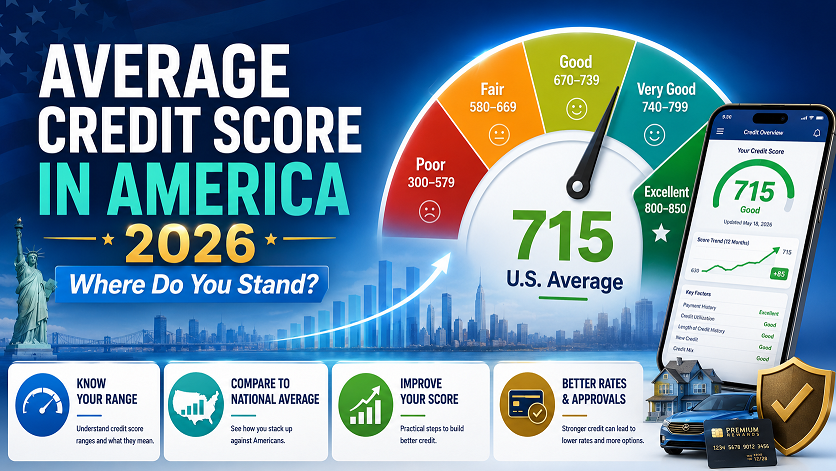
The latest annual U.S. average FICO Score 8 is 713, based on Experian data from September 2025 and published in March 2026. The latest available monthly VantageScore 4.0 national average was 702 for June 2026. These figures are not contradictory: they use different scoring models, datasets and measurement periods. Compare your score only with a benchmark using the same model and bureau context.
“What is the average credit score in America in 2026?” sounds like a one-number question. It is not. The United States has several credit bureaus, multiple FICO and VantageScore versions and lender-specific scores. A national statistic is meaningful only when the publisher identifies the model and the date of the underlying data.
This report does exactly that. It separates the latest annual FICO Score 8 data from the newer monthly VantageScore 4.0 reading, provides sourced state and age tables, and explains what averages can—and cannot—tell you about credit cards, personal loans, auto financing and mortgage applications.
Average credit score in America: the 2026 headline numbers
Average FICO Score 8 in September 2025. Experian annual dataset, published March 30, 2026.
Average VantageScore 4.0 in June 2026. VantageScore CreditGauge monthly dataset.
Share of scored consumers with a FICO Score 8 of 670 or higher in Experian’s September 2025 data.
The 713 figure is the appropriate headline for an annual “average credit score” comparison because Experian identifies both the FICO Score 8 model and a consistent September measurement period. However, it is 2025 data published in 2026—not a measurement of every consumer’s score on today’s date.
VantageScore’s CreditGauge is more current and monthly. Its June 2026 average of 702 is useful for tracking recent movement within VantageScore 4.0. It should not be subtracted from 713 to claim that scores fell 11 points. That would compare different models and samples.
Use like-for-like comparisons
Match model, version, bureau context and data date. A FICO Score 8 from Experian is not directly interchangeable with a VantageScore 4.0 from TransUnion, even though both usually use a 300-to-850 range.
Methodology: what the tables actually measure
Editorial data rules
- Annual FICO tables: Experian’s anonymized consumer-credit data measured in September 2024 and September 2025; score model is FICO Score 8.
- Monthly benchmark: VantageScore CreditGauge using VantageScore 4.0; latest national average available for this review is June 2026.
- State figures: published Experian values only. No estimates were created for missing states.
- Age groups: Experian’s generation definitions and ages as of 2025; these are group averages, not targets.
- Rounding: figures are reproduced as published. Percentages may not total exactly 100 because of rounding.
- Checked: August 29, 2026. Later monthly releases may supersede the VantageScore figure.
An average is a mean, not a minimum approval score, a median or a promise about loan pricing. Consumers without a score under the measured model may not be represented. Data providers also have different files and scoreability rules. This is why a single national number cannot describe every adult.
The state table is also descriptive rather than causal. It cannot prove that climate, income, housing costs or any one policy caused a state’s average. Differences can reflect the age and composition of credit files, payment behavior, balances, local economic conditions and the sampled population.
How the national FICO average changed
| Measurement | 2024 | 2025 | Change | Model/source |
|---|---|---|---|---|
| U.S. average credit score | 715 | 713 | -2 | FICO Score 8; Experian, September each year |
| Average revolving utilization | 29% | 29% | 0 | Experian, September each year |
The average FICO Score 8 fell two points to 713 in 2025. Experian describes this as the first annual decline since 2013, ending a long period without a national drop. Two points is a modest aggregate change, but the distribution shows that movement was not uniform.
Average utilization remained 29%, so it would be too simplistic to blame the decline entirely on card balances. Experian also reported growing shares at both ends of the score range. Broader affordability pressure, delinquency patterns and changes in individual files can matter, but the dataset does not establish one cause for every consumer.
If your own score dropped, a national trend does not diagnose the reason. Review recent report changes—new balances, late payments, inquiries, account closures or corrections—using our guide to why a credit score dropped.
How Americans are distributed across FICO Score ranges
| FICO Score 8 range | Rating | September 2024 | September 2025 | Change |
|---|---|---|---|---|
| 300–579 | Poor | 13.2% | 14.7% | +1.5 points |
| 580–669 | Fair | 15.5% | 14.9% | -0.6 |
| 670–739 | Good | 21.0% | 20.1% | -0.9 |
| 740–799 | Very good | 27.8% | 27.5% | -0.3 |
| 800–850 | Exceptional | 22.5% | 22.8% | +0.3 |
About 70.4% of scored consumers were at 670 or above in September 2025. That does not mean 670 guarantees a competitive credit-card APR, mortgage rate or auto-loan approval. Lenders use different score versions and combine scores with income, debt, collateral, loan-to-value ratio and internal policy.
The range labels are educational categories for FICO Score 8. Industry-specific FICO Auto and Bankcard Scores may use a 250-to-900 range, while many base FICO and recent VantageScore models use 300 to 850. See what counts as a good credit score for model-specific interpretation rather than repeating that guide here.
Average FICO Score by age group
| Generation (age in 2025) | 2024 | 2025 | Change |
|---|---|---|---|
| Generation Z (18–28) | 681 | 678 | -3 |
| Millennials (29–44) | 691 | 689 | -2 |
| Generation X (45–60) | 709 | 709 | 0 |
| Baby boomers (61–79) | 746 | 747 | +1 |
| Silent Generation (80+) | 760 | 760 | 0 |
Source: Experian data from September of each year; FICO Score 8; ages as of 2025.
Older groups have higher averages in this dataset, but age itself is not a FICO scoring factor. Older consumers are more likely to have longer account histories. Their group averages can also reflect different debt mixes and the fact that consumers must have a scoreable file to appear in a score dataset.
A 25-year-old should not treat 747 as a required target, and a 65-year-old is not guaranteed a high score. Compare the factors in your own reports: payment history, utilization, account age, new credit and account mix. Never open an unnecessary loan solely to resemble an older group.
Average credit score by state
The following table reproduces Experian’s published September 2025 FICO Score 8 averages and year-over-year changes. Minnesota led at 741; Mississippi was lowest at 677. No state recorded an increase. Illinois, Maine and Vermont were unchanged.
Download the state data (CSV)| State | 2024 | 2025 | Change | State | 2024 | 2025 | Change |
|---|---|---|---|---|---|---|---|
| Alabama | 692 | 689 | -3 | Alaska | 722 | 720 | -2 |
| Arizona | 712 | 709 | -3 | Arkansas | 695 | 693 | -2 |
| California | 722 | 721 | -1 | Colorado | 731 | 729 | -2 |
| Connecticut | 726 | 724 | -2 | Delaware | 714 | 713 | -1 |
| District of Columbia | 715 | 711 | -4 | Florida | 707 | 704 | -3 |
| Georgia | 695 | 692 | -3 | Hawaii | 732 | 730 | -2 |
| Idaho | 730 | 729 | -1 | Illinois | 720 | 720 | 0 |
| Indiana | 712 | 710 | -2 | Iowa | 730 | 728 | -2 |
| Kansas | 722 | 720 | -2 | Kentucky | 705 | 704 | -1 |
| Louisiana | 690 | 686 | -4 | Maine | 731 | 731 | 0 |
| Maryland | 715 | 714 | -1 | Massachusetts | 732 | 731 | -1 |
| Michigan | 719 | 717 | -2 | Minnesota | 742 | 741 | -1 |
| Mississippi | 680 | 677 | -3 | Missouri | 714 | 712 | -2 |
| Montana | 732 | 730 | -2 | Nebraska | 731 | 728 | -3 |
| Nevada | 701 | 699 | -2 | New Hampshire | 736 | 735 | -1 |
| New Jersey | 724 | 722 | -2 | New Mexico | 702 | 701 | -1 |
| New York | 721 | 719 | -2 | North Carolina | 709 | 707 | -2 |
| North Dakota | 733 | 730 | -3 | Ohio | 716 | 713 | -3 |
| Oklahoma | 696 | 693 | -3 | Oregon | 732 | 730 | -2 |
| Pennsylvania | 722 | 720 | -2 | Rhode Island | 721 | 719 | -2 |
| South Carolina | 700 | 699 | -1 | South Dakota | 734 | 731 | -3 |
| Tennessee | 706 | 703 | -3 | Texas | 695 | 692 | -3 |
| Utah | 730 | 728 | -2 | Vermont | 737 | 737 | 0 |
| Virginia | 723 | 721 | -2 | Washington | 735 | 734 | -1 |
| West Virginia | 702 | 699 | -3 | Wisconsin | 738 | 737 | -1 |
| Wyoming | 725 | 722 | -3 | United States | 715 | 713 | -2 |
A lender does not adjust your score because your state average is high or low. Your score comes from information in your credit report and the model applied to it. Geography may correlate with economic and demographic differences, but the table is not a ranking of financial responsibility.
Where do you stand compared with the average?
If your FICO Score 8 is 713, you match the latest annual national mean. If your VantageScore 4.0 is 713, you are above the June 2026 VantageScore average of 702—but that does not make it equivalent to the FICO benchmark.
- Below average: This does not automatically mean denial. Some products serve fair or limited-credit applicants, often with higher APRs, deposits or fees.
- Near average: Your full profile and lender cutoff may matter more than a few points around 713.
- Above average: A higher score can improve options, but it does not override income, debt-to-income ratio, collateral or recent derogatory information.
Use the score’s reason codes, not the national rank, to decide what to improve. Paying reported obligations on time, correcting factual errors and reducing revolving balances may help depending on the file. No action guarantees a particular increase.
How an average score affects loans and credit cards
Credit cards
A score around the national FICO average may qualify for many products, but rewards cards, balance-transfer cards and low-APR offers have issuer-specific standards. Compare annual fee, purchase APR, balance-transfer fee, rewards value and prequalification—not just the welcome bonus. Approval is never assured.
Personal loans and debt consolidation
Personal-loan pricing depends on score, income, debt, loan amount, term and origination fees. A lower monthly payment can still cost more when the term is longer. Compare APR and total repayment using real prequalified offers. Our debt-consolidation loan guide explains the cost test.
Auto financing
Auto lenders may use an industry-specific FICO Auto Score rather than the base FICO Score 8 in this report. Vehicle price, down payment, term and dealer markup can materially change total cost. Shop multiple lenders within a focused period and compare the amount financed and total interest.
Mortgages
Mortgage underwriting can use different score models and a tri-bureau process. The 713 national average is not a mortgage cutoff. Down payment, loan program, reserves, debt-to-income ratio and property factors also matter. See credit scores for mortgages for the current model transition.
Do not buy a score increase
Credit-repair companies cannot guarantee that you will reach the national average, qualify for a loan or receive a lower APR. Accurate negative information generally cannot be removed simply because it lowers a score.
Frequently asked questions
What is the average credit score in America in 2026?
The latest annual average is 713 for FICO Score 8, measured by Experian in September 2025 and published in March 2026. The monthly VantageScore 4.0 average was 702 in June 2026.
Why are there two national averages?
They use different models, datasets and dates. FICO Score 8 and VantageScore 4.0 can produce different numbers from the same or different bureau files.
Is 713 a good credit score?
Under standard FICO Score 8 ranges, 713 falls in the good category of 670–739. Lenders may use another model and their own approval criteria.
Did the average credit score fall?
Experian’s average FICO Score 8 fell from 715 in September 2024 to 713 in September 2025. This two-point national change does not explain any one person’s score movement.
Which state has the highest average credit score?
Minnesota had the highest published 2025 state average at 741, using Experian’s September FICO Score 8 data.
Which state has the lowest average?
Mississippi had the lowest published 2025 state average at 677. The figure is descriptive and should not be used to stereotype residents.
What is the average score for Generation Z?
Experian reported 678 for adults ages 18–28 in 2025, down three points from 2024. The model was FICO Score 8.
Does age directly affect a credit score?
No. Age is not a FICO score factor. Older groups often have longer credit histories, which can contribute to higher group averages.
Is an average score enough for a mortgage?
There is no universal answer. Mortgage programs and lenders use specific models and also evaluate income, debts, down payment, reserves and property information.
Can I compare a free app score with 713?
Only if the app identifies it as FICO Score 8 and the comparison context is appropriate. A VantageScore should be compared with a VantageScore benchmark.
Does checking my score lower it?
Checking your own score or report is generally a soft inquiry and does not lower scores. A lender’s application inquiry may be treated differently.
How can I move toward a stronger score?
Pay reported accounts on time, review all three reports, dispute factual errors, manage card balances and avoid unnecessary applications. Results and timing vary.
Bottom line
The best-supported annual answer for 2026 readers is a 713 average FICO Score 8, based on September 2025 Experian data. The more current VantageScore 4.0 monthly benchmark was 702 in June 2026. Keep the model and date attached to every number.
Your personal borrowing outcome will not be decided by whether you beat a state or age average. Focus on the score model a prospective lender uses, the accuracy of your reports, affordable debt management and the total cost of the financial product.
Related guides
Sources and data notes
- Experian: Average FICO Score in the U.S., states, ages and distribution — FICO Score 8; September 2024 and 2025 data; published March 30, 2026.
- Experian 2025 Consumer Credit Review — anonymized data through September 2025.
- VantageScore CreditGauge, June 2026 — VantageScore 4.0 national average.
- CFPB: credit-report and credit-score terminology.
- AnnualCreditReport.com — federally authorized access to free nationwide credit reports.
1 thought on “Average Credit Score in America 2026: National, Age & State Data”
Comments are closed.