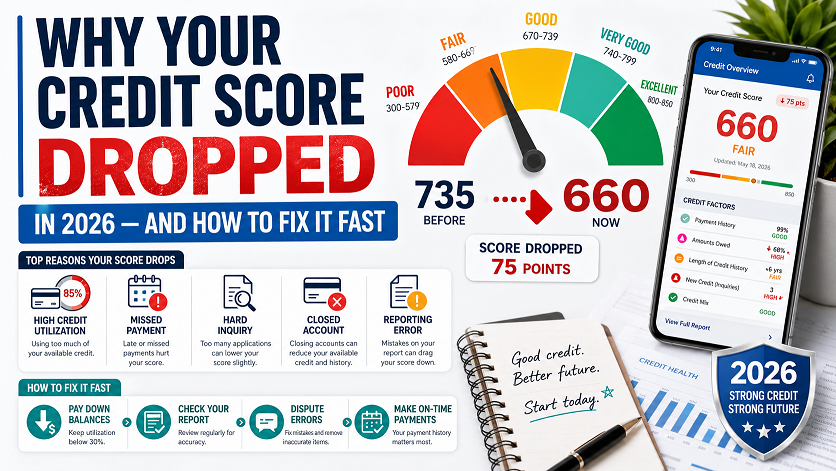
A credit score usually drops because the underlying credit-report data changed—or because you compared different scores. First confirm the bureau, scoring model, version and calculation date. Then compare the new credit report with the earlier one and read the score’s key reason codes. Common causes include a newly reported late payment, higher card utilization, a lower credit limit, a new hard inquiry or account, a collection, an account closure, or an error. No legitimate service can identify the cause from the point change alone.
Opening an app and seeing a lower number can be alarming, especially before a mortgage, auto loan or credit-card application. The fastest useful response is not to guess how many points an event “should” cost. It is to identify exactly which score changed and which report information was different when that score was calculated.
This guide is a diagnostic process. It does not repeat the general steps in our credit-score improvement guide, and it does not promise a fixed recovery date. Scores react differently because every credit file is different.
The same bureau, model, version and date are required for a meaningful comparison.
A score is calculated from eligible report data; inspect recent balance, status and account changes.
The listed key factors are more useful than generic online point-loss charts.
Before diagnosing a drop, verify the score
You do not have one universal credit score. A score shown by a free app may be a VantageScore calculated from one bureau, while a lender may obtain a FICO score from another bureau using a different version. Even two FICO scores can differ because the lender selected a different model or the reports were updated on different dates.
Write down these four details for the old and new number:
- Credit bureau: Equifax, Experian or TransUnion.
- Scoring brand and model: for example, VantageScore 3.0, VantageScore 4.0 or a named FICO version.
- Calculation date: a score is a snapshot of the report data available on that date.
- Data source: consumer app, bank benefit, bureau service or lender disclosure.
If any of these differs, the lower number may not represent a sudden decline in the same score. The credit reports versus credit scores guide explains why models and bureaus produce different results.
Checking your own report is safe
Reviewing your own credit information is a soft inquiry and does not lower your score. Use the federally authorized source at AnnualCreditReport.com to inspect the underlying reports.
Get all three credit reports
A lender may furnish information to one, two or all three nationwide bureaus, and update dates can vary. Retrieve each report through AnnualCreditReport.com. Compare account status, balance, credit limit, payment history, inquiries, collections and personal-information sections.
If an application was denied or offered less favorable terms because of a credit report, read the adverse-action notice. The CFPB explains that the notice should identify the score used, key factors that affected it and the reporting company that supplied the report. It also describes the right to request a free report from that company within 60 days.
Ten common reasons a credit score drops
| Possible cause | What to look for | Responsible next step |
|---|---|---|
| Late or missed payment | A new 30-, 60- or 90-day delinquency or an account reported past due | Verify accuracy, bring the account current if possible and prevent another missed payment |
| Higher utilization | Higher reported card balance, even if the purchase is not yet due | Pay down revolving balances and monitor the next issuer reporting cycle |
| Lower credit limit | Issuer reduced a limit, increasing utilization without new spending | Confirm the limit, reduce balances and avoid spending to the former limit |
| New hard inquiry | An inquiry connected to a recent credit application | Confirm it was authorized; limit unnecessary applications |
| New account | New tradeline plus possible changes to average account age | Manage it on time; do not open more accounts to chase points |
| Closed credit card | Available revolving credit disappeared, increasing utilization | Recalculate overall utilization and pay down remaining cards |
| Paid-off installment loan | Loan changed from open to closed; account mix and active-loan data changed | Do not reopen debt solely for scoring; continue responsible management |
| Collection or charge-off | New collection, charged-off balance or updated delinquent status | Verify ownership, dates and amount before disputing or negotiating |
| Authorized-user change | Primary user’s balance rose, payment was late or account stopped reporting | Ask to be removed if the account is harmful and confirm bureau updates |
| Incorrect or fraudulent data | Account, inquiry, balance, limit or payment status you do not recognize | Document and dispute the factual error; use IdentityTheft.gov for identity theft |
1. A payment became 30 days late
Payment history is the largest general category in a FICO score. A bill that is only a few days late can trigger a creditor fee, but creditors typically report account delinquency by 30-day increments. Verify the statement due date, payment posting date and exact status on each report.
If the late mark is accurate, bring the account current and build a new on-time record. If the creditor received the payment on time but reported it late, collect bank confirmation and statements before submitting a targeted dispute. Do not file a false dispute merely because accurate information is damaging.
2. A card reported a higher balance
Credit-card issuers commonly report around the statement cycle, not every time a payment is made. A large purchase can therefore increase utilization before its payment due date. The score can respond to both per-card and overall revolving utilization.
There is no universal “magic” utilization percentage that guarantees points. Lower reported revolving balances are generally safer than cards near their limits. Paying interest is not necessary to build credit. If cash flow allows, paying before the statement closes can reduce the balance that may be reported.
3. A lender lowered a credit limit
Suppose total card balances remain $2,000 but available limits fall from $10,000 to $5,000. Overall utilization rises from 20% to 40% even though the consumer did not spend more. Review each account’s current limit rather than looking only at balances.
4. You applied for or opened credit
A hard inquiry may influence a score, and a new account can change average age and other file characteristics. The impact is not a fixed number. Legitimate rate shopping for certain loan types may be treated differently by scoring models when inquiries occur within the model’s shopping window, but credit-card applications are not grouped the same way.
5. An account closed
Closing a card removes its available limit from utilization calculations. A closed account in good standing can remain on reports for years, so closure does not necessarily erase its age immediately. The more immediate issue is often utilization across the remaining open cards.
Before closing a no-fee card, consider whether it supports available credit and account history. Do not keep an unsuitable or costly account solely for a score, especially when it creates fees, fraud risk or overspending.
6. A collection or charge-off appeared
Compare the original creditor, collection company, balance and date of first delinquency. A sold or transferred debt can produce entries for both the original creditor and collector without necessarily being an improper duplicate, but balances and statuses must be accurate.
Collection treatment varies by scoring model and debt type. Do not rely on a promised point increase from paying or settling. The legal negative-item guide explains disputes, validation and settlement without guaranteeing deletion.
Use score reason codes instead of guessing
Credit scores are usually accompanied by key factors—often called reason codes—that identify characteristics having the greatest negative influence on that particular score. Examples may refer to revolving balances, recent delinquency, short account history or recent inquiries.
A reason code does not say that fixing one factor guarantees a particular increase. It identifies what was limiting the score at that moment relative to the model. When one major factor improves, another factor may become the next listed reason.
For a meaningful comparison:
- Save the old score, date and reason codes before the service refreshes.
- Record the new score using the same bureau and model.
- Compare the reason-code order and wording.
- Match each changed code to a report change.
- Prioritize factual errors and high-risk behaviors, not cosmetic point chasing.
Best evidence after a lender decision
An adverse-action or risk-based-pricing notice can be more useful than a generic monitoring alert because it identifies the score and key factors used in the actual decision.
Why a score may fall when “nothing changed”
Usually something did change, but it may not be obvious from recent spending. Common explanations include:
- An issuer reported a statement balance on a different day.
- A dormant card was closed or its limit was reduced.
- An old account aged off the report.
- A loan servicer transferred or updated an account.
- An authorized-user account changed.
- A dispute notation or corrected account status changed.
- The app switched bureau data, model version or update date.
- A fraudulent account or inquiry appeared.
Score fluctuations are not proof of identity theft, but unfamiliar accounts, addresses or inquiries deserve prompt attention. Place appropriate fraud alerts or security freezes and report identity theft through IdentityTheft.gov. A freeze does not repair existing errors; it helps restrict new-credit access.
Did a scoring model change?
Consumer services can update the score version they display. Lenders also use different models for mortgages, auto loans and credit cards. Before concluding that a new national model reduced everyone’s score, check the provider’s score label and terms. The rollout of newer models does not automatically replace every lender’s existing model.
Why a credit score can drop after paying off debt
Paying debt is financially positive even when the next score moves down. A paid-off installment loan changes from open to closed, which can alter the mix of active accounts and other model variables. A small temporary movement does not mean taking another loan and paying interest would improve the consumer’s financial position.
Paying off a credit card is different from closing it. Paying the balance generally reduces utilization; closing the card removes its limit. If the issuer reports the payoff after the scoring date, the lower balance may not appear until a later update.
A score can also fall after debt payoff because an unrelated event arrived at the same time—such as a new late payment, lower limit or collection. Compare reports before assigning the decline to the payoff.
What to do after your credit score drops
Verify the score comparison
Confirm bureau, brand, model, version and date. Do not compare a consumer VantageScore with a lender’s FICO score as if they were the same measurement.
Review all three reports
Mark every recent change in payment status, balances, limits, accounts, inquiries and collections. Keep dated copies for comparison.
Read the key factors
Use the score’s reason codes and any lender notice to prioritize the report changes most relevant to that model.
Correct factual errors
Dispute with the bureau showing the problem and the company furnishing it. Explain the exact error and attach supporting documents.
Stabilize current accounts
Bring overdue accounts current when possible, set reminders or autopay safeguards, and reduce revolving balances without taking unaffordable new debt.
Monitor the next reporting cycle
Allow furnishers time to send ordinary updates. Escalate unresolved inaccurate information through the CFPB only after first disputing with the reporting company.
How to dispute an error correctly
The CFPB advises disputing inaccurate information with both the credit reporting company and the business that supplied it. State what is wrong, why it is wrong and what correction is requested. Include copies—not originals—of supporting records. The detailed credit-report dispute guide covers the ordinary 30- to 45-day investigation framework and escalation steps.
Do not pay a credit-repair company to blanket-dispute every negative item. Accurate unfavorable information generally cannot be removed merely because a template demands it. Review the credit-repair scam warning signs before sharing identity documents or bank information.
How long does it take a dropped score to recover?
There is no dependable points-per-month schedule. Recovery depends on the cause, severity, recency, model and rest of the file.
| Cause | When the report can change | What controls score recovery |
|---|---|---|
| High reported card balance | After the issuer reports a lower balance | New utilization, other balances, bureau timing and model |
| Incorrect information | After correction or deletion following investigation | Whether the corrected data was score-relevant and what remains |
| Hard inquiry or new account | Effects generally lessen with time | Model, subsequent applications and overall file stability |
| Late payment or collection | Accurate negative history may remain reportable for years | Severity, recency, later positive history and scoring version |
| Closed card or reduced limit | After remaining balances or available credit change | Overall and per-card utilization plus account history |
For realistic scenarios and a twelve-month rebuilding framework, see how long credit-score improvement takes. Avoid companies promising an exact score by a specific date.
Frequently asked questions
Why did my credit score drop 20 points?
The number of points does not identify the cause. Compare the same bureau and model, then inspect new balances, limits, late payments, inquiries, accounts and reason codes. The same event can affect two consumers differently.
Why did my score drop when I paid on time?
On-time payment is only one factor. Higher utilization, a lower limit, a new account, a closed account, an old account aging off, different bureau data or a different model can coincide with perfect payments.
Can checking my credit lower my score?
Checking your own credit is a soft inquiry and does not lower the score. A lender’s hard inquiry connected with a credit application may affect a score.
Why did my score fall after paying off a loan?
The installment account changed from open to closed, which can alter active-account and mix characteristics. Do not borrow again solely to reverse a small score movement.
Does closing a credit card hurt credit?
It can increase utilization by removing available credit. A positive closed account may remain on reports for years, so loss of account age is not necessarily immediate.
How quickly can utilization update?
It updates after the card issuer furnishes a new balance and the bureau processes it. Timing varies by issuer, bureau and statement cycle; paying today does not guarantee a score refresh tomorrow.
Can one late payment cause a major drop?
A recent reported delinquency can be influential, but no universal point loss applies. Severity, recency, prior score and the entire file determine the result.
Why are my three bureau scores different?
The reports may contain different accounts, balances and update dates. The scores may also use different models. Compare report contents and labels rather than expecting identical numbers.
Will disputing an item raise my score?
Only an actual correction of score-relevant information might change a score, and the direction or size is not guaranteed. A dispute itself is not a scoring trick.
Can a credit limit decrease lower my score?
Yes, if the lower limit increases revolving utilization. Review balances against the new limits and reduce balances where affordable.
What if I do not recognize an inquiry or account?
Contact the listed company, review all reports, and use IdentityTheft.gov if identity theft is suspected. Consider security freezes to restrict new-credit access.
Should I pay for rapid credit repair?
No company can guarantee a fast score increase or legally remove accurate information on demand. Correct errors free through the bureau dispute process and treat guaranteed outcomes as warning signs.
Bottom line
A lower score is a signal to investigate, not proof of financial failure. Verify that you are comparing the same score, inspect the underlying reports, read the key reason codes and respond to the actual cause. Balance updates may resolve quickly after reporting; serious accurate delinquencies require time and consistent positive behavior.
Focus on financial health rather than daily point movement: pay every obligation on time, control revolving balances, apply only when needed, protect personal information and correct genuine errors. Those actions remain useful across FICO and VantageScore versions.
3 thoughts on “Why Your Credit Score Dropped in 2026—and What to Do”