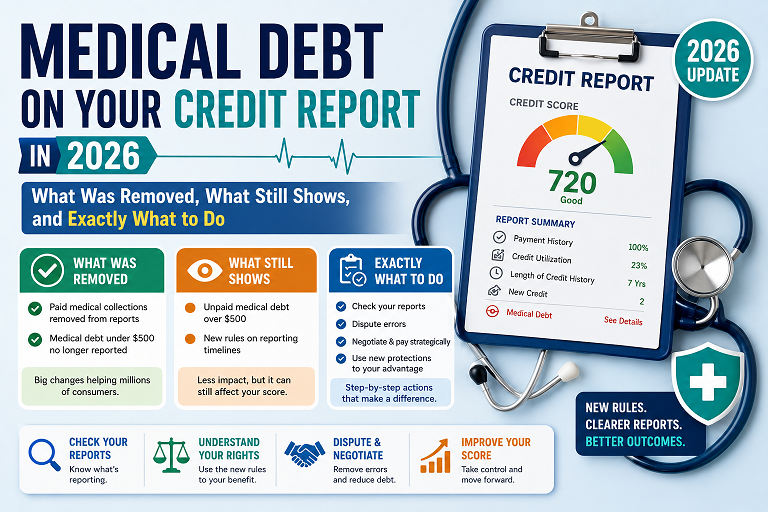
As of August 26, 2026, there is no nationwide federal rule removing every medical debt from credit reports. A federal court vacated the CFPB’s broad 2025 rule on July 11, 2025. However, the three nationwide credit bureaus continue voluntary policies that generally exclude paid medical collections, medical collections with an initial reported balance under $500, and unpaid medical collections less than one year old. Unpaid medical collections over $500 and more than 365 days delinquent may still appear.
Medical bills are unusually difficult to evaluate. A balance can change after insurance processes a claim, a provider may bill the wrong code, and several facilities may send separate bills for one visit. By the time a collection appears, the consumer may still be trying to understand whether the amount is correct.
The legal picture also changed quickly. Many older articles still say a new federal rule banned medical debt from credit reports. That statement is no longer accurate. This guide explains what the court decision changed, which bureau policies remain, and what to do before paying, disputing or financing a medical bill.
The nationwide bureaus’ voluntary policy generally removes paid medical collections.
Medical collections with an initial reported balance under $500 are generally excluded.
An unpaid medical collection generally is not reported until it is more than 365 days delinquent.
What happened to the CFPB medical-debt rule?
Current federal status
The CFPB issued a final rule on January 7, 2025 that would have broadly restricted medical-debt information in consumer reports used by creditors. On July 11, 2025, the U.S. District Court for the Eastern District of Texas vacated the rule in Cornerstone Credit Union League v. CFPB. The CFPB now labels the rule materials as reference only. Therefore, the vacated rule is not a nationwide ban in force.
This does not mean every medical collection suddenly returned to reports. The nationwide credit reporting companies had adopted separate voluntary changes before the CFPB rule. Those company policies continue to provide substantial—but incomplete—protection.
Federal bills introduced in Congress are not law merely because they have names such as “Medical Debt Relief Act.” Always check whether a proposal passed both chambers and became law before treating it as a consumer right.
State law may provide additional protection
Some states restrict medical-debt reporting or collection more strongly. State rules differ by residence, provider, service date and transaction. Check your state attorney general, insurance department or consumer-assistance program rather than relying on a copied nationwide state list.
What medical debt can appear on a credit report in 2026?
| Medical-debt situation | General nationwide-bureau policy | Important detail |
|---|---|---|
| Provider bill that has not gone to collection | Normally not reported as a collection account | The provider may later assign or sell an unpaid balance to a collector. |
| Collection less than one year old | Generally excluded during the one-year waiting period | Use this time to resolve insurance, billing errors, assistance and payment arrangements. |
| Paid medical collection | Generally removed | Check all three reports after payment and dispute an account that should have been removed. |
| Initial reported balance under $500 | Generally excluded | The policy refers to the initial reported balance; do not assume paying a larger collection below $500 forces deletion. |
| Unpaid collection over $500 and more than 365 days delinquent | May appear | Accuracy, dates, ownership and state-law restrictions still matter. |
| Credit-card debt used for medical care | Treated as credit-card debt, not a medical collection | Paying a provider with a general-purpose card can remove the special medical-debt context. |
| Medical financing account | Depends on the account and reporting agreement | Read the financing contract, deferred-interest terms and bureau reporting disclosures. |
The $500 policy is commonly misunderstood. It does not erase the debt, prevent collection activity, or necessarily apply after a consumer pays a larger collection down below $500. It addresses whether qualifying medical collections appear on the nationwide bureaus’ consumer credit reports.
Likewise, deletion from a credit report does not establish that the provider’s bill was invalid. Credit reporting, debt validity, insurance appeals and the legal time for a lawsuit are different questions.
How does medical debt affect credit scores?
A medical collection can affect some scores if it appears in the report used to calculate them. The result depends on the scoring company, model version, bureau data and the rest of the credit file.
Newer score models may treat medical collections differently from older models, and some models disregard them. However, lenders do not all use the newest model. A score shown in a consumer app may therefore respond differently from a mortgage or other lending score.
No responsible article can promise that removing a medical collection will add a fixed number of points. CFPB research found an average score increase in a studied population after the last medical collection was removed, but an average is not an individual prediction. Some files will change more, less or not at all.
Removal and payment are not the same event
Paying a qualifying medical collection may lead to its removal under bureau policy. The score can change only after the report is updated and a score is recalculated from that updated data.
How to check a medical collection and dispute errors
Get all three credit reports
Use AnnualCreditReport.com, the federally authorized source. A collection may appear on one bureau’s report and not another.
Identify the account precisely
Record the collector, original creditor, balance, account status and dates. Do not post a complete account number or medical details publicly.
Compare the bureau policy
Check whether the collection is paid, under the qualifying $500 threshold or within the one-year waiting period. These policies do not apply to ordinary card debt used for treatment.
Review the underlying records
Compare provider bills, explanation-of-benefits documents, insurance decisions, payments, financial-assistance applications and correspondence.
Dispute inaccurate or incomplete information
Send a specific dispute to the credit reporting company and the information furnisher, with copies of supporting documents. Keep originals and proof of submission.
Review the result
A bureau generally investigates a dispute within 30 days, with up to 45 days in some circumstances. Verify the result on every report where the item appeared.
Dispute only when you genuinely believe information is inaccurate, incomplete or inconsistent with the bureau policy. Filing a dispute does not guarantee deletion, and accurate debt should not be described as identity theft.
Our broader guide explains how to fix credit-report errors. If a collection involves information you do not recognize, follow identity-theft procedures rather than using a generic template.
Check the medical bill before paying or financing it
A collection notice is not a substitute for an itemized bill. Contact the provider and insurer to understand what produced the balance.
- Request an itemized statement showing services, dates, codes, insurance adjustments and payments.
- Compare it with your explanation of benefits; an EOB is normally not itself a bill.
- Ask whether the claim was submitted correctly and whether an appeal or corrected claim remains possible.
- Look for duplicate charges, services you did not receive and amounts already paid.
- Ask whether the provider will recall the account from collection while an error, appeal or assistance application is reviewed.
- Document names, dates, confirmation numbers and any promised hold or correction.
No Surprises Act protections
The federal No Surprises Act protects many insured consumers from certain unexpected out-of-network bills involving emergency services, non-emergency services at participating facilities and air ambulance services. The exact protection depends on the service and coverage.
People who did not have or did not use insurance can often receive a good faith estimate for scheduled care. CMS states that a qualifying consumer may use the patient-provider dispute process when the final bill is at least $400 more than the estimate. The dispute generally must begin within 120 calendar days of the initial bill, and eligibility conditions apply.
Official medical-bill help
The CMS No Surprises Help Desk can explain federal protections and complaints at 1-800-985-3059. It does not provide legal advice or financial assistance.
Financial assistance, payment plans and financing
Apply for hospital financial assistance first
Nonprofit hospitals must maintain financial-assistance policies for eligible patients. Ask the billing office for the written policy, application, income limits and documents required. Other providers may also offer charity care, uninsured discounts or hardship reductions.
Apply before converting the balance into a credit card or personal loan. Once a provider is paid with borrowed money, the remaining obligation may be ordinary consumer debt and special medical-collection policies may no longer help.
Ask for an affordable provider payment plan
A hospital payment plan may be interest-free or lower cost than medical financing or a personal loan, but terms vary. Confirm the payment, interest, fees, collection status and what happens after a missed payment in writing.
Compare medical financing carefully
Medical credit cards and financing plans may advertise promotional interest. Some use deferred interest, which can charge interest from the purchase date if the promotional balance is not fully paid by the deadline. Review APR, deferred-interest language, minimum payments and total payoff schedule.
Use a personal loan only after comparison
A medical personal loan can create fixed payments, but origination fees and high APRs can make care much more expensive. Compare net proceeds, APR, term and total repayment with provider assistance and payment plans. Our fair-credit personal-loan guide explains these costs.
Do not drain essential resources blindly
Before using retirement funds, home equity or high-cost debt, consider the tax, foreclosure, penalty and long-term consequences with qualified professionals. Medical-debt urgency does not eliminate those risks.
What if a debt collector contacts you?
Debt collectors covered by federal law must provide validation information that helps identify the debt, creditor and amount. If you dispute in writing within the stated 30-day validation period, federal collection rules generally require the collector to pause collection of the disputed amount until it provides verification.
Before paying:
- Confirm the collector is legitimate using independently located contact information.
- Request and review validation information.
- Do not provide medical records beyond what is reasonably necessary without understanding privacy implications.
- Check whether insurance, financial assistance or a billing dispute is unresolved.
- Get any settlement, payment plan or deletion-related representation in writing.
- Understand that making a payment can affect legal limitation questions in some states; obtain state-specific advice when the debt is old.
Credit-reporting period, lawsuit limitation and debt ownership are separate issues. A debt can be too old to report yet still raise another legal question, or disappear from a report without being forgiven.
Frequently asked questions
Are all medical bills removed from credit reports in 2026?
No. The CFPB’s broad rule was vacated on July 11, 2025. Under current nationwide-bureau policies, unpaid medical collections over $500 and more than 365 days delinquent may still appear.
Do paid medical collections appear on credit reports?
The three nationwide credit bureaus generally remove paid medical collections under their voluntary policy. Check every report after payment and dispute a qualifying account that remains.
Does the $500 rule mean I do not owe the bill?
No. The reporting policy does not forgive debt or prevent lawful collection. It concerns whether qualifying medical collections appear on nationwide credit reports.
Can I pay a $700 collection down to $499 to remove it?
Do not assume so. The bureau policy is commonly described using the initial reported balance. Ask for written terms, verify the current bureau policy and check reports after resolution.
How long before unpaid medical debt can be reported?
Under the nationwide bureaus’ policy, unpaid medical collections generally have a one-year waiting period. The CFPB says debt over $500 and more than 365 days delinquent could appear.
Will paying medical debt raise my credit score?
Payment may lead to removal of a reported medical collection, but no particular point gain is guaranteed. The result depends on the updated report, scoring model and complete credit file.
Should I pay a medical bill with a credit card?
Only after checking accuracy, insurance, financial assistance and provider payment plans. Card debt is generally treated as card debt, even when the purchase paid for medical care, and may carry high interest.
The bottom line
Medical-debt credit reporting in 2026 is governed by a mixture of federal law, a court decision, voluntary bureau policies and state protections. The broad CFPB rule is not in force, but paid medical collections, qualifying balances under $500 and collections less than one year old are generally excluded by the nationwide bureaus.
Start with the underlying bill, not the score. Check insurance, request an itemized statement, apply for financial assistance, understand No Surprises Act rights and verify collector information. Then review all three credit reports and dispute specific inaccuracies or policy violations with documents. That sequence can protect both your finances and your credit more effectively than paying an unclear bill with expensive borrowed money.