What Is a Good Credit Score in 2026?
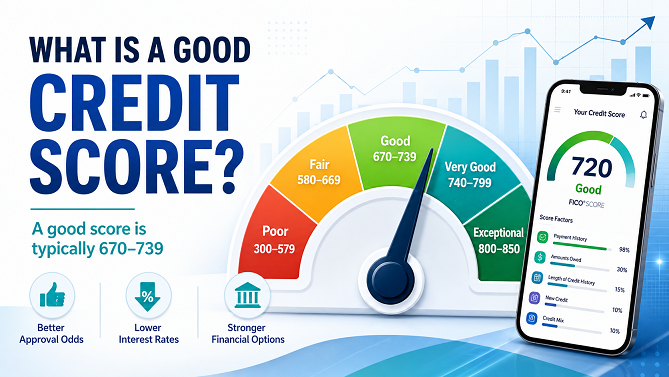
A good FICO Score is generally 670 to 739. FICO describes 740 to 799 as very good and 800 or higher as exceptional. VantageScore uses different labels: it generally places scores from 661 to 780 in its prime range. A score in either range can improve your chances of qualifying for competitive credit cards, mortgage rates, auto loan rates and personal loan offers—but no score guarantees approval or a particular annual percentage rate.
People often ask for one magic number: the score that unlocks every loan, the lowest mortgage rate and the best credit-card offer. Real lending does not work quite that neatly.
Your score matters, but lenders also look at your income, existing monthly debts, payment history, loan amount, down payment and the information in your credit reports. One lender may consider a 700 score strong for a particular product while another may price the same applicant differently.
That is why the most useful question is not simply “Is my score good?” It is: Is my score—and the rest of my financial profile—strong enough for the product I want?
Generally considered a good FICO Score range.
Generally described by FICO as a very good range.
An exceptional FICO Score range, though 850 is not required for strong offers.
FICO Score ranges: where does “good” begin?
Most consumer FICO Scores use a 300-to-850 scale. FICO groups that scale into five broad ranges. These categories are useful for orientation, but they are not universal approval rules. A lender may use a different FICO version, an industry-specific score or its own underwriting system.
| FICO Score | General rating | What it may mean |
|---|---|---|
| 300–579 | Poor | Approval may be more difficult, and available borrowing can carry higher costs or require security or a co-signer. |
| 580–669 | Fair | Some credit products may be available, but rates, fees and limits can be less favorable than those offered to stronger applicants. |
| 670–739 | Good | You may qualify for a wider selection of products, subject to income, debts and the lender’s full criteria. |
| 740–799 | Very good | This range can support access to competitive offers, although the best available pricing varies by lender and product. |
| 800–850 | Exceptional | A strong credit profile, but a perfect 850 is not necessary to qualify for favorable terms. |
Important: you have more than one credit score
Your score can differ depending on the credit bureau, scoring company, model version, industry and date the score was calculated. The score shown in a free consumer app may not be the same score a mortgage, auto or card lender obtains.
FICO versus VantageScore
FICO and VantageScore both analyze information from consumer credit reports, but they are separate scoring companies with different models. Both commonly use a 300-to-850 scale, yet their labels and calculations are not identical.
| VantageScore range | General category | Plain-English interpretation |
|---|---|---|
| 300–600 | Subprime | A higher-risk range in the VantageScore framework. |
| 601–660 | Near prime | Below the model’s prime range; terms may be less competitive. |
| 661–780 | Prime | A generally stronger range, broadly comparable to the everyday idea of “good credit.” |
| 781–850 | Superprime | The model’s strongest category. |
Do not assume one type of score is always higher than the other. The difference depends on the model version and the information in your reports at that moment. Instead, check the label beside the score: it should identify the scoring company, model and credit bureau used.
Is 650, 700, 740 or 800 a good credit score?
Is 650 a good credit score?
A 650 FICO Score falls in the fair range, not the good range. That does not automatically mean rejection. You may still qualify for certain credit cards, auto financing, personal loans or mortgage programs, but approval and pricing will depend on the complete application.
Is 700 a good credit score?
Yes. A 700 FICO Score sits within the good range. It can make a broader selection of products available, but it does not guarantee the lowest mortgage interest rate, the cheapest auto loan APR or approval for a premium rewards card.
Is 740 a good credit score?
Yes. A 740 FICO Score begins the very good range. Applicants in this area may be well positioned for competitive offers, provided the rest of the application—such as income, debt-to-income ratio and payment history—is also sound.
Is 800 a good credit score?
An 800 FICO Score is exceptional. It provides a valuable cushion if balances change or a new inquiry appears. Still, lenders do not require a perfect score, and an applicant with an 800 score can be declined for reasons unrelated to the score.
How a good credit score can affect your money
A stronger credit profile can reduce borrowing costs, but the potential savings depend on the product, lender and market conditions when you apply.
| Financial product | How credit may affect it | What else matters |
|---|---|---|
| Mortgage loans | Eligibility, interest rate, lender pricing adjustments and mortgage insurance costs may vary with credit. | Loan program, down payment, debt-to-income ratio, reserves, property and income documentation. |
| Auto loans | A stronger profile may qualify for a lower APR and reduce total interest. | New or used vehicle, term, down payment, lender, vehicle value and income. |
| Credit cards | Credit can influence approval, credit limit, APR, promotional financing and rewards-card access. | Income, recent applications, existing limits, issuer relationship and card-specific rules. |
| Personal loans | Credit can affect eligibility, origination fee, loan amount and APR. | Income, employment, debts, repayment term and the lender’s underwriting model. |
| Insurance pricing | Where state law permits, insurers may use a credit-based insurance score as one pricing factor. | State law, claims record, coverage, vehicle, location and insurer methodology. |
A score is not an approval promise
Terms such as “minimum score” and “recommended score” are often oversimplified. Unless a government agency or lender publishes a requirement, treat online score estimates as general guidance rather than a guarantee.
Planning a home purchase? Our detailed guide explains credit-score considerations for different mortgage types. If you are financing a vehicle, see the separate guide to auto loan credit tiers and rates.
What lenders consider beyond your credit score
A good score is helpful, but lenders rarely make a decision from that number alone. Depending on the product, they may review:
- Payment history: recent late payments, collections, charge-offs or bankruptcy.
- Debt-to-income ratio: how much of your monthly income already goes toward required debt payments.
- Credit utilization: the portion of your revolving credit limits currently reported as balances.
- Income and employment information: whether your documented income supports the requested payment.
- Recent applications: multiple new accounts or inquiries can affect risk assessment.
- Loan-to-value ratio: particularly important for mortgage and auto lending.
- Relationship and product rules: each lender can apply its own lawful underwriting criteria.
This explains why two people with the same score can receive different offers—and why improving only the score does not always solve an affordability problem.
How to move toward a good credit score
No legitimate method can promise a specific number of points by a particular date. You can, however, improve the information used to calculate your scores.
Check all three credit reports
Review your reports for accounts you do not recognize, incorrect late payments, wrong balances and mixed-file information. A credit report and a credit score are different: reports contain the underlying account information.
Pay every bill by its due date
Payment history is an important scoring factor. Set reminders or automatic minimum payments where appropriate, while monitoring your bank balance to avoid overdrafts.
Reduce reported card balances
Lower revolving utilization can help, but there is no universal requirement to remain below exactly 10%. Aim to keep balances manageable and avoid using a large share of available limits.
Dispute genuine reporting errors
Dispute information only when you believe it is inaccurate or incomplete. Accurate negative information generally cannot be removed simply because it lowers a score.
Apply for new credit selectively
Open an account because it serves a financial need, not merely to chase points. Fees and interest can cost more than a possible scoring benefit.
Give positive history time to build
Credit recovery is rarely instant. Reporting cycles, account age and the seriousness of prior negative information all affect the timeline.
Check how much of your credit limits you are using
Enter card limits and reported balances to calculate overall and per-card utilization.
For a complete action plan, read how to improve your credit score responsibly. If your score changed unexpectedly, use the diagnostic guide explaining common reasons a credit score drops.
How to check your credit reports and scores
Start with your credit reports. Federal law provides access to reports from Equifax, Experian and TransUnion through AnnualCreditReport.com. The reports do not necessarily include a free credit score, but they let you inspect the data used by scoring models.
You may also receive a score through a bank, credit-card issuer, bureau or monitoring service. Before comparing it with another score, look for three details:
- Is it a FICO Score or VantageScore?
- Which model version is being used?
- Which credit bureau supplied the report data?
A difference between two legitimate scores does not automatically mean either is wrong. They may have been calculated from different reports, models or dates.
Privacy reminder
Use official sites and established financial providers. You should not need to share a password, Social Security number or full credit report with an unverified “credit repair” account on social media.
Frequently asked questions
What is considered a good FICO Score?
FICO generally describes scores from 670 to 739 as good. Scores from 740 to 799 are very good, while scores from 800 to 850 are exceptional.
Is a 700 credit score good?
Yes. A 700 FICO Score is within the good range. It may support access to competitive products, but approval, rate and credit limit depend on the lender’s full review.
What score should I aim for?
Aim first to establish accurate reports, on-time payments and affordable debt. A score of 740 or higher is a useful long-term target for many consumers, but the score needed for a particular offer varies.
Does checking my own credit score lower it?
Checking your own report or score is generally treated as a soft inquiry and does not lower your score. A hard inquiry may occur when a lender reviews credit after an application.
Can I improve a credit score in 30 days?
A score may change after updated information reaches a bureau, but no one can guarantee a particular increase in 30 days. Results depend on what changed and the rest of the credit file.
Why is my FICO Score different from my VantageScore?
The companies use different models and may calculate scores using different bureau data or dates. Check the score label before comparing the numbers.
The bottom line
A good credit score is best understood as a range, not a pass-or-fail number. For FICO, the good range begins at 670. Reaching 740 moves you into the very good range, while 800 begins the exceptional range.
Still, the strongest application is more than a score. Accurate reports, reliable payment history, affordable balances, stable income and a loan that fits your budget matter just as much. Build those fundamentals and the score has a better chance to follow.
9 thoughts on “What Is a Good Credit Score in 2026? — Complete Guide”