What Credit Score Do You Need for a HELOC in 2026?
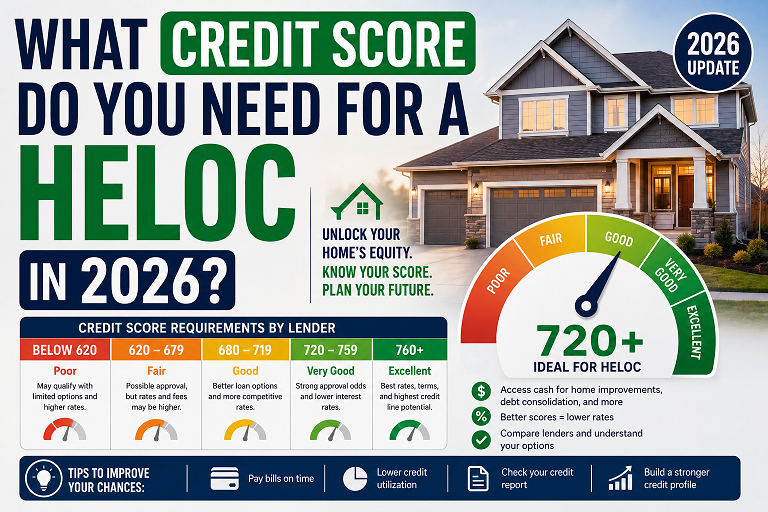
Most lenders require a minimum credit score of 620 to 680 for a HELOC in 2026 — with credit unions often going as low as 620 and traditional banks typically requiring 660 or higher. But the minimum score just gets you in the door. For the best HELOC rates — typically prime rate plus a small margin — you need 740 or above. The difference between a 660 score and a 740 score on a $100,000 HELOC can mean $1,000 to $1,500 more in interest every year. This guide covers exact requirements by lender type, how LTV affects what score you need, and the fastest ways to reach the qualifying threshold.
Mortgage originations rose significantly in April 2026 — the largest monthly increase since April 2021 — as spring homebuying picked up and interest rates declined from their recent peaks. Alongside new purchase mortgages, HELOC demand has surged as homeowners with locked-in low first mortgage rates look for ways to access their equity without refinancing into today’s higher rates.
If you are a homeowner considering a HELOC in 2026, your credit score is the first gating factor — it determines whether you qualify at all, and it determines how much you will pay once you do. This guide gives you the exact numbers you need to know.
What Is a HELOC and How Does It Work in 2026?
A Home Equity Line of Credit (HELOC) is a revolving line of credit secured by your home’s equity — the difference between your home’s current market value and what you still owe on your mortgage. It works like a credit card with your home as collateral: you are approved for a maximum credit limit, you draw from it as needed during the draw period (typically 10 years), pay interest only on what you have drawn, and then repay the principal during the repayment period (typically 10 to 20 years).
Why HELOCs Are Surging in 2026
Many homeowners locked in mortgage rates of 3% to 4% in 2020 and 2021. Refinancing those mortgages at today’s rates — even if lower than the 2023–2024 peaks — would mean replacing a 3.5% rate with a 6.5%+ rate on the entire mortgage balance. A HELOC lets these homeowners access their home equity without touching their existing first mortgage rate. For a homeowner with a $400,000 mortgage at 3.5%, a HELOC to fund a renovation or consolidate debt makes far more financial sense in 2026 than a cash-out refinance that would cost them thousands more per year in first mortgage interest.
Credit Score Requirements by Lender Type in 2026
HELOC credit score requirements are not universal — they vary significantly by lender type. Here is the breakdown of what each type of lender typically requires:
Credit unions are member-owned nonprofits and typically offer the most flexible HELOC requirements. Many will consider the full member relationship — savings history, direct deposits, payment history on other accounts — alongside the credit score. If you are already a credit union member, your HELOC minimum may be lower than what you would find at a bank. Some credit unions allow combined LTV up to 90%, which is higher than most banks allow, meaning you need less equity to qualify.
Community banks often use portfolio lending for HELOCs — meaning they keep the loan on their own books rather than selling it. This gives them more flexibility to consider the full picture rather than rigid score cutoffs. If you bank locally and have a strong relationship, a community bank may approve a HELOC with a 620 to 640 score where a national bank would decline.
National banks have automated underwriting systems with stricter score cutoffs. Most require a minimum of 660 to 680 and will not make exceptions based on relationship history. The benefit of a national bank HELOC is typically lower margins (rates closer to prime) for high-score borrowers, competitive online tools, and faster approval timelines. Below 660, national banks will typically decline without discussion.
Online HELOC lenders have grown significantly in 2025 and 2026. They typically offer faster approvals — sometimes same-day or next-day — and some go up to 90% CLTV. Score minimums vary but generally fall in the 640 to 680 range. Figure is the largest online HELOC lender and typically requires a 640 minimum. Spring EQ focuses on equity-rich borrowers and may be more flexible on score. Rate margins can be higher than traditional lenders for lower-score borrowers.
How Your Credit Score Affects Your HELOC Rate in 2026
The interest rate on a HELOC is variable and tied to the prime rate plus a margin set by the lender. Your credit score directly determines the size of that margin — and the difference between score tiers is significant in dollar terms.
The Real Cost of a Lower Credit Score on a HELOC — In Dollars
On a $100,000 HELOC with a 10-year draw period where you maintain an average balance of $70,000, the difference between a 620-score rate (~9.75%) and a 740-score rate (~8.0%) is approximately $1,225 per year in additional interest — or over $12,000 over the draw period alone. If you are 30 to 50 points below the 740 threshold, spending 3 to 6 months improving your score before applying for a HELOC is one of the highest-ROI financial moves you can make in 2026. See our credit score improvement guide for the fastest strategies.
How LTV Ratio Interacts With Your Credit Score
Your credit score and your loan-to-value (LTV) ratio work together to determine both your approval odds and your rate. Understanding how these two factors interact is critical for HELOC planning in 2026.
The key metric for HELOCs is the Combined Loan-to-Value ratio (CLTV) — your first mortgage balance plus the HELOC amount, divided by your home’s appraised value:
CLTV Formula
CLTV = (First Mortgage Balance + HELOC Amount) ÷ Home Appraised Value × 100
Example: Home value $500,000 / First mortgage balance $300,000 / HELOC requested $75,000
CLTV = ($300,000 + $75,000) ÷ $500,000 = 75% CLTV — within most lenders’ 80% limit ✅
| Credit Score | Max CLTV (Typical) | What This Means |
|---|---|---|
| 740+ | Up to 85%–90% at some lenders | Maximum flexibility — access more of your equity |
| 700–739 | Up to 80%–85% | Standard limit — need at least 15%–20% equity post-HELOC |
| 660–699 | Typically capped at 80% | Stricter equity requirement — lenders want more cushion |
| 620–659 | Often capped at 75%–80% | Need more equity to compensate for credit risk |
| Below 620 | Most mainstream lenders decline | Improve score before applying — see Section 7 |
Other Factors Lenders Check Besides Credit Score
Credit score is the first filter — but it is not the only one. HELOC underwriting in 2026 evaluates five key factors. All five must be satisfactory for approval:
Debt-to-Income Ratio (DTI)
DTI is your total monthly debt payments divided by your gross monthly income. Most HELOC lenders want DTI below 43% — and many prefer below 36%. The HELOC payment (even interest-only during the draw period) is counted in your DTI calculation. If your existing mortgage, car loans, and credit card minimums already push your DTI close to 43%, adding a HELOC payment may push you over the threshold. Calculate your projected DTI before applying: (existing monthly debts + estimated HELOC interest payment) ÷ gross monthly income × 100.
Home Equity and Appraisal
Most HELOC lenders require an appraisal to determine your home’s current market value. The appraisal result, combined with your outstanding mortgage balance, determines your available equity and your maximum HELOC amount. In 2026, home values in most markets remain elevated — but lenders are conservative about LTV limits, especially for borrowers with lower credit scores. Budget $400 to $700 for a full appraisal, or ask if the lender uses an automated valuation model (AVM) that may eliminate the appraisal cost.
Employment and Income Verification
Lenders typically require two years of employment history in the same field and will ask for recent pay stubs, W-2s, and two years of tax returns. Self-employed borrowers typically need to provide two years of business and personal tax returns showing stable or growing income. Income stability matters more than the raw income number — a borrower who recently changed careers or has variable commission income may face additional scrutiny even with a high credit score.
First Mortgage Payment History
HELOC lenders look closely at how you have paid your existing first mortgage — because the HELOC is in second lien position, meaning in a foreclosure scenario the first mortgage lender gets paid before the HELOC lender. Any late payments on your first mortgage in the past 12 to 24 months are a significant red flag, even if your overall credit score is good. Most lenders want to see a perfect or near-perfect mortgage payment history before approving a second lien product.
Credit Report Review — Not Just the Score
Lenders pull your full credit report — not just your score — and review it for specific issues. Recent late payments, collection accounts, judgments, and high revolving utilization all affect approval even if the score number itself meets the minimum. Particular red flags: any mortgage late payments, any recent collections from financial institutions, and any accounts in dispute status. Resolve disputes and pay down revolving balances before applying.
HELOC vs Cash-Out Refinance — Which Is Better in 2026?
This is one of the most common questions homeowners face when accessing equity in 2026. The answer depends almost entirely on your existing mortgage rate:
| Factor | HELOC | Cash-Out Refinance |
|---|---|---|
| Effect on first mortgage | None — your existing rate is untouched | Replaces your entire mortgage at today’s rate |
| Best for borrowers with | Mortgage rates below 5% — keep your rate | Mortgage rates above 6.5% — may improve rate |
| Rate type | Variable — rises with prime rate | Fixed — predictable payment |
| Flexibility | Draw only what you need, when you need it | Lump sum — you pay interest on all of it immediately |
| Closing costs | Lower — typically $500 to $2,000 | Higher — typically 2%–5% of new loan amount |
| Min credit score | 620–680 depending on lender | 620 (FHA), 640–660 (conventional) |
| Approval time | 2–4 weeks (faster with online lenders) | 30–60 days typically |
For Most 2026 Homeowners, a HELOC Makes More Financial Sense
The majority of American homeowners who bought or refinanced in 2020 or 2021 have first mortgage rates between 2.75% and 4.0%. Replacing these rates with a 2026 cash-out refinance at 6.5% to 7% — even if rates have come down from their 2023 peak — would add hundreds of dollars per month in mortgage costs on the full loan balance. A HELOC leaves the first mortgage untouched, costs less to open, and only charges interest on what is actually drawn. For these borrowers, a HELOC is almost always the correct tool for accessing equity in 2026.
How to Improve Your Score to Qualify for a HELOC in 2026
If your score is below the threshold you need — either for approval or for the best rate tier — here are the fastest actions specifically relevant for HELOC preparation:
Pay Down Credit Card Balances — Target Under 10% Utilization
For borrowers preparing for a HELOC, the utilization target is not just 30% — aim for under 10% for maximum score impact. HELOC lenders pull your full credit report and look at revolving utilization carefully as a signal of financial stress. Paying down card balances is the fastest score improvement available and can move your score 20 to 50 points within one billing cycle. Use the funds you are planning to access via the HELOC later — pay off the cards now, get the score boost, qualify at a better rate, then draw from the HELOC if needed.
Dispute Any Errors on All 3 Credit Reports
Pull your free reports from AnnualCreditReport.com and review every account. HELOC lenders pull from all three bureaus — often using the middle score of the three. An error on any one bureau’s report can drag down that bureau’s score and affect which score is used in the middle-score calculation. Dispute any inaccuracy: incorrect payment status, accounts you do not recognize, balances that are wrong, or negative items past their 7-year window. Successful disputes can add 30 to 100+ points within 30 to 45 days.
Do Not Apply for Any New Credit in the 6 Months Before Applying
Every new credit application generates a hard inquiry and opens a new account — both of which can temporarily lower your score. In the 6 months before a HELOC application, freeze all new credit applications. Do not open new credit cards, do not apply for auto loans, do not do rate shopping for personal loans. The only inquiry you want on your report during the HELOC application window is the HELOC inquiry itself.
Pay Your First Mortgage On Time — Every Month Without Exception
As noted above, HELOC lenders scrutinize your first mortgage payment history more than anything else. In the 12 to 24 months before applying for a HELOC, your first mortgage payments must be flawless. Even a single 30-day late on your mortgage can cause a HELOC denial regardless of your overall score. If you are behind on your mortgage for any reason, get current immediately — getting a HELOC while behind on your first mortgage is essentially impossible with any mainstream lender.
Check Your Score Under the Model Your Lender Uses
Most HELOC lenders use Classic FICO scores — often FICO Score 2 (Experian), FICO Score 5 (Equifax), and FICO Score 4 (TransUnion) — and take the middle of the three scores. These are different from the FICO Score 8 you see on Experian’s free account and different from the VantageScore you see on Credit Karma. Ask your lender which score they pull, then check that specific score if possible. Medical collections that hurt Classic FICO but are ignored by VantageScore 4.0 can be a major factor — especially for HELOC applicants near the qualifying threshold.
How to Apply for a HELOC in 2026 — Step by Step
Check Your Credit Score and Reports First
Before approaching any lender, know where your score stands. Pull all three reports at AnnualCreditReport.com. Check your FICO Score 8 via Experian’s free account and your VantageScore via Credit Karma. Note any negative items and address what you can in the 30 to 60 days before applying. Know your score so you can evaluate which lender tier you qualify for and what rate range to expect.
Calculate Your Available Equity and Maximum HELOC Amount
Estimate your home’s current market value (use Zillow or Redfin as a rough guide, understanding a formal appraisal may differ). Subtract your outstanding first mortgage balance. Multiply the home value by 0.80 (for an 80% CLTV limit) and subtract your mortgage balance — this is your approximate maximum HELOC amount. Example: $500K home × 80% = $400K − $300K mortgage = $100K maximum HELOC at 80% CLTV.
Shop Multiple Lenders — Rate Shopping Is Treated as One Inquiry
Apply to multiple lenders within a 14 to 45 day window — multiple HELOC inquiries during this period are typically treated as a single inquiry by scoring models. Compare not just the rate but also: the margin over prime, any rate caps, annual fees, inactivity fees, and closing costs. Credit unions are worth checking first if you are a member. Get at least three quotes before choosing a lender.
Prepare Your Documentation
Gather before you apply: last two years of W-2s and tax returns, last 30 days of pay stubs, last two months of bank statements, your current mortgage statement, proof of homeowners insurance, and a government-issued ID. Self-employed borrowers also need business tax returns and a profit and loss statement. Having these documents ready speeds up the process significantly — most HELOC delays are caused by documentation gaps, not underwriting issues.
Complete the Application and Schedule the Appraisal
Submit your application with your chosen lender. They will order a title search and appraisal (or AVM). Most HELOC approvals take 2 to 6 weeks from application to funding. After approval, there is a federally mandated 3-day rescission period before funds are accessible — you can cancel without penalty during this window. After the rescission period, your HELOC line is open and you can begin drawing.
See How Close You Are to the Best HELOC Rate Tier
Use our free Score Impact Simulator — enter your current credit profile and see exactly how many points you need to reach the 740 threshold for the best HELOC rates.
Frequently Asked Questions
What credit score do you need for a HELOC in 2026?
Most lenders require a minimum of 620 to 680 depending on lender type — credit unions often go as low as 620, while national banks typically require 660 to 680. For the best HELOC rates in 2026, you need a score of 740 or above. Scores between 670 and 739 qualify at most lenders but at higher rates. Below 620, mainstream HELOC approval is very difficult.
Can I get a HELOC with a 620 credit score in 2026?
Yes — some lenders, particularly credit unions and community banks, will approve a HELOC with a 620 credit score. However, you will face a higher interest rate (typically 1 to 2 percentage points above what a 740+ score borrower receives), a stricter LTV cap (usually 80% or less), and closer scrutiny of your DTI and mortgage payment history. If your score is 620, spending 3 to 6 months improving it by 30 to 40 points can save thousands in interest over the life of the HELOC.
What is the minimum credit score for a HELOC?
The practical minimum is 620 for mainstream lenders in 2026. Some credit unions with strong member relationships may go as low as 600, but this is uncommon. Most national banks and online lenders set their floors at 660 to 680. There is no universal minimum — each lender sets its own — but 620 is the practical lower threshold for most borrowers.
How does my credit score affect my HELOC interest rate in 2026?
HELOCs are priced at prime rate plus a margin. Your credit score determines the margin. A 740+ score might get prime + 0.5%, while a 660 score might get prime + 1.75% or 2%. On a $100,000 HELOC, that difference is $1,000 to $1,500 more per year. Over a 10-year draw period with an average $70,000 balance, the cumulative cost of a lower score easily exceeds $10,000 in additional interest.
What else do lenders check besides credit score for a HELOC?
Five key factors: (1) Combined LTV — most lenders cap at 80% to 85% of home value; (2) Debt-to-income ratio — most want DTI below 43%; (3) Home equity and appraisal — sufficient equity must exist post-HELOC; (4) Employment and income stability — typically two years required; (5) First mortgage payment history — any recent lates on your first mortgage are a major red flag for a second lien product.
How fast can I improve my credit score to qualify for a HELOC?
Some improvements are fast: paying credit card balances below 30% — ideally below 10% — can improve your score within 30 days. Disputing and removing inaccurate negative items can add points within 30 to 45 days. For a 30 to 50 point improvement needed to reach the 680 or 740 threshold, a focused 3 to 6 month plan combining utilization reduction and error disputes can realistically get there. Avoid any new credit applications during this window.
Is a HELOC or cash-out refinance better in 2026?
For most homeowners who locked in mortgage rates of 3% to 4% in 2020–2021, a HELOC is almost always better in 2026 — it accesses equity without replacing your low first mortgage rate. A cash-out refinance replaces your entire mortgage balance at today’s higher rates, adding significant cost. HELOCs also have lower closing costs and offer flexible drawdown. Cash-out refis make more sense if your existing mortgage rate is already above 6% or if you need a fixed rate on the borrowed amount.
Related Guides
Related Free Tools
- Equifax — April 2026 Consumer Pulse: Latest Consumer Credit Trends
- CFPB — What Is a Home Equity Line of Credit (HELOC)?
- Bankrate — Current HELOC Rates and Requirements
- NerdWallet — HELOC Requirements: What You Need to Qualify
- Freddie Mac — Primary Mortgage Market Survey
- FICO — Credit Score Ranges and Mortgage Impact
- Figure — Online HELOC Lender Requirements 2026