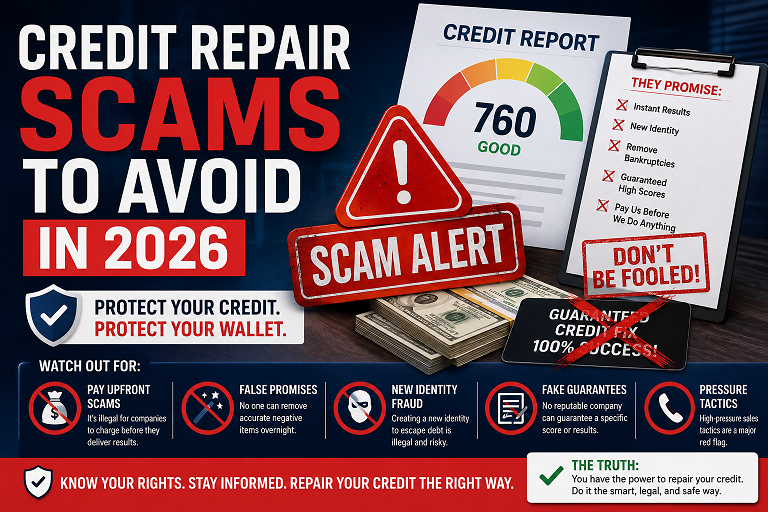
Credit Repair Scams to Avoid in 2026: 12 Red Flags That Cost You Money & Legal Trouble
Updated: June 7, 2026 | Read Time: 13 minutes
If your credit score is under 600, your inbox is probably full of promises: “We’ll delete bankruptcies!” “Guaranteed 700 score in 45 days!” “New credit file overnight!”
In 2025, the FTC logged over 42,000 credit repair complaints and $65 million in reported consumer losses. In 2026, with FICO 10T making scores harder to game, scammers are getting desperate — and more sophisticated.
I’ve spent 9 years covering credit and talked to FTC attorneys, nonprofit counselors, and people who lost $3,000 to fake “repair” companies. This guide shows you the 12 scams blowing up in 2026, how to spot them in 10 seconds, and what actually works to fix your credit legally. No hype. No BS.
Why Credit Repair Scams Exploded in 2026
Three things made 2026 a perfect storm:
- FICO 10T rollout: As of Q1 2026, 60% of mortgage lenders use FICO 10T. It weighs “trended data” — your last 24 months of balances. If your debt is rising, your score drops even with on-time payments. People with 680 scores in 2024 suddenly have 640 scores and are panicking.
- BNPL reporting: Klarna, Affirm, Afterpay, and Apple Pay Later now report to Experian and TransUnion. A $40 missed payment is a 30-day late. Gen Z is getting hit hard and searching “fix credit fast.”
- AI deepfakes: The FTC warned in April 2026 about scam companies using AI voices to impersonate nonprofit counselors from NFCC. If it sounds legit, people pay.
Scammers know you’re stressed. They know you want a house or car. And they know the legal way to fix credit takes 3-6 months. So they sell shortcuts that are illegal, useless, or both.
The Credit Repair Organizations Act: What’s Actually Illegal in 2026
Credit repair itself isn’t illegal. The Credit Repair Organizations Act, or CROA, makes it legal for companies to help you dispute errors. But CROA also bans these practices. If a company does ANY of these, it’s a scam:
| Illegal Tactic | Why It’s Banned | 2026 Penalty |
|---|---|---|
| Charging upfront fees before any work is done | You can dispute for free yourself | Up to $46,517 per violation, FTC enforcement |
| Promising to remove accurate negative info | Only errors can be removed legally | FTC lawsuit + consumer refunds |
| Telling you to lie on credit applications | Wire fraud, mail fraud | Up to 20 years federal prison |
| Not giving you a written contract + 3-day cancel right | CROA requirement | Contract is void, you can sue |
| Suggesting you create a “new credit identity” | Identity theft under 18 U.S.C. § 1028 | Up to 15 years prison |
External Resource: Read the full law at the FTC’s CROA page and file complaints at ReportFraud.ftc.gov.
12 Credit Repair Scams to Avoid in 2026
These are the exact scripts scammers are using right now. If you hear these words, hang up.
1. The “CPN” or “SCN” New Credit File Scam
The pitch: “Bad credit? We’ll sell you a Credit Profile Number or Secondary Credit Number. It’s a 9-digit number you use instead of your SSN. Instant clean slate!” Cost: $800-$3,000.
The reality: CPNs are often stolen SSNs from children or deceased people. Using one on a loan app is federal identity fraud. The FTC prosecuted 14 CPN sellers in 2025. Clients got arrested too.
Red flag phrase: “This is legal because it’s not an SSN.” It’s not. The FBI calls it “synthetic identity fraud.”
2026 twist: Scammers now sell “AI-generated CPNs” claiming they’re government-issued. There is no such program.
2. “Guaranteed 100-Point Increase in 30 Days”
The pitch: “We guarantee we’ll raise your score 100 points in 30 days or your money back.”
The reality: No one can guarantee this unless they’re removing errors. If your negatives are accurate — late payments, collections, bankruptcy — they stay for 7-10 years. Period. “Guarantees” violate CROA.
How they trick you: They dispute everything, even accurate items. Bureaus delete items temporarily during investigation. Your score jumps 40 points for 30 days. They show you the screenshot, take your $1,500, then the items come back. Your money-back guarantee? Read the fine print: it excludes “items that return.”
3. Upfront Fee Scams: “$299 to Start Today”
The pitch: “Pay $299 setup + $99/month. We start disputing today!”
The reality: CROA bans upfront fees. Legal companies only charge after they deliver results. The FTC shut down The Credit Pros and Ovation Credit in 2023-2024 for this. In 2026, new scams use Cash App or Zelle to avoid credit card chargebacks.
Red flag: No written contract, or contract says “fees are for education materials.” That’s how they dodge CROA. It’s still illegal.
4. The “File Segregation” Scam
The pitch: “We’ll help you apply for an EIN from the IRS and use it to build business credit. It won’t link to your bad personal credit.”
The reality: EINs are for businesses. Using an EIN on a personal credit card or auto loan app is lying about your identity. That’s bank fraud. You can go to prison. Real business credit takes 2 years of revenue, not a $1,200 EIN package.
5. “We’ll Remove Bankruptcies, Foreclosures, Repos”
The pitch: “Chapter 7? We delete it. Repo? Gone in 60 days.”
The reality: If the bankruptcy or repo is accurate, it stays 7-10 years. No company can remove it. They’ll dispute it as “not mine” and hope the lender doesn’t respond in 30 days. If it works, it’s temporary. When the lender verifies, it comes back and your score drops harder.
2026 data: Experian says 97% of accurate bankruptcies disputed by credit repair companies are verified and remain.
6. Fake “Nonprofit” Credit Counseling
The pitch: “We’re a nonprofit with HUD approval. Send $50/month and we’ll handle your creditors.”
The reality: Real nonprofits like NFCC members never cold-call. They never ask for money before a free session. Scammers cloned NFCC websites in 2026 and used AI voice calls. Check any counselor at NFCC.org first.
7. The “Tradeline Rental” or “Authorized User” Scam
The pitch: “Pay $500 and we’ll add you as an authorized user on a $50K card with 20 years history. +120 points guaranteed!”
The reality: Real authorized user setups between family are legal. Paying strangers is “tradeline renting.” FICO 10T and lenders now flag it. If the primary cardholder misses a payment, YOU get hit. And many “brokers” take your money and never add you. The FTC sued BoostMyScore LLC in 2024 for this.
Legal way: Ask a parent or spouse with good credit. Don’t pay strangers online.
8. “We Dispute Everything” Bulk Dispute Mills
The pitch: “We’ll dispute every negative item at once. The bureaus can’t handle it and must delete them!”
The reality: Bureaus use AI in 2026 to flag “frivolous” disputes. If you dispute 12 accurate items at once, they label you frivolous and stop investigating. You lose your legal right to dispute real errors later. Plus, you just paid $129/month for them to copy-paste letters you can send free.
9. Fake Credit Privacy Numbers for Renting
The pitch: “Landlord denied you? Use our CPN to rent an apartment. They’ll never know.”
The reality: That’s fraud. If the landlord runs a background check, the SSN/CPN mismatch gets flagged. You lose the apartment and application fee. In 2026, many property managers use AI that catches CPNs in seconds.
10. “We’ll Hack the Bureaus” or “Insider” Scams
The pitch: “We have an insider at Experian who deletes negatives for $2,000.”
The reality: This is fiction. Bureau employees can’t manually delete accurate data. It’s all logged. Anyone claiming this is lying. You’ll send Bitcoin and they’ll ghost you. The FBI’s 2026 alert lists this as a top 5 financial scam.
11. Subscription Trap “Credit Monitoring” Add-Ons
The pitch: “Free credit repair! Just pay $1 for a 7-day trial of our monitoring service.”
The reality: You get billed $39.99/month and they never repair anything. Cancelling requires calling a number that’s always busy. These companies buy your data from free “score check” ads on TikTok. Read the fine print.
12. TikTok & YouTube “Credit Sweep” Gurus
The 2026 version: “Use this Metro 2 compliance dispute letter! The bureaus HATE it!” Video has 2M views. Link in bio sells the letter for $47.
The reality: Metro 2 is the format lenders use to report data. There’s no “magic letter.” Bureaus saw 500,000 copies of that letter in 2025 and auto-reject it as template spam. You paid $47 for something free at the CFPB website.
Red flag: Comments turned off. No real address. Only takes Cash App.
How to Spot a Credit Repair Scam in 10 Seconds
Ask these 4 questions. One “yes” = walk away.
- Do they want money before doing anything? Illegal.
- Do they guarantee specific results? “700 score” or “delete bankruptcy” = illegal.
- Do they tell you NOT to contact bureaus or creditors yourself? Scammers don’t want you learning it’s free.
- Do they suggest lying or using a CPN/EIN? That’s fraud. You go to jail, not them.
What Legal Credit Repair Actually Looks Like in 2026
Legal credit repair companies exist. Lexington Law and Credit Saint operate under CROA. Here’s what they can and can’t do:
| Legal Action | Illegal Promise |
|---|---|
| Dispute errors you identify | “We’ll remove all negatives” |
| Send goodwill letters for late payments | “We guarantee lender will delete lates” |
| Negotiate pay-for-delete on collections | “We’ll delete paid collections 100% of time” |
| Advise you on credit use | “Don’t pay your bills, we’ll fix it” |
| Charge monthly AFTER work is done | “$299 upfront to start” |
2026 Reality: Most legal firms cost $79-$129/month. They cancel anytime. They’ll tell you upfront that accurate negatives stay. If you’re comfortable writing dispute letters, you can do 90% of this free.
How to Fix Your Credit Yourself for Free in 2026
You don’t need to pay anyone. Here’s the legal, FTC-approved process:
Step 1: Get Your Free Reports Weekly
Go to AnnualCreditReport.com. You get free Experian, Equifax, and TransUnion reports every week. Check for errors: accounts not yours, wrong balances, lates you paid on time, paid collections showing unpaid.
Step 2: Dispute Errors Online in 10 Minutes
Each bureau has a dispute portal. Upload proof: bank statement showing on-time payment, letter showing collection was paid. They have 30 days to investigate. If they can’t verify, they must delete it. This is 100% free.
2026 Tip: Dispute one bureau at a time. If Experian deletes it, use that letter to dispute with Equifax and TransUnion. Faster.
Step 3: Attack Credit Utilization
This is 30% of your FICO score and the fastest fix. Pay cards to under 10% of the limit BEFORE the statement closing date. If you have a $1,000 limit and $800 balance, you’re at 80% util. Pay to $50 and you’re at 5%. That can add 60-100 points in one cycle.
Step 4: Use Experian Boost for Free Points
Connect your bank account to Experian Boost. As of 2026, it counts Netflix, Hulu, Disney+, phone, and utility bills. Average user gains 13 points instantly. No credit check. Only helps Experian, but that’s 1/3 of your score.
Step 5: Become an Authorized User — The Right Way
Ask a parent or spouse with a 10+ year old card, 100% on-time payments, and <10% utilization to add you. Don’t pay a stranger. This can add 50-120 points in 30-60 days if their history is clean.
Step 6: Negotiate Pay-for-Delete Yourself
Have collections? Call the agency. Say: “I’ll pay in full today if you delete this from all 3 bureaus. Can you email me that in writing?” Get it in writing before paying. No letter = don’t pay. Many agencies agree because they’d rather have cash than nothing.
Step 7: Wait. Time Heals.
Late payments hurt less after 24 months. Collections fall off after 7 years. Hard inquiries drop after 12 months. If everything on your report is accurate, time + on-time payments + low utilization is the only cure. No company can speed up the calendar.
When to Use a Legit Credit Counselor vs. DIY
DIY if: You have 1-3 errors, you’re organized, and you can wait 30-90 days. Total cost: $0.
Use a nonprofit counselor if: You’re drowning in debt, facing collections, or need a Debt Management Plan. Contact NFCC.org or call 800-388-2227. First session is free. DMPs have small fees but lower your interest rates.
Use a legal credit repair company if: You have 10+ errors, no time, and don’t mind paying $79-$129/month for 4-6 months. Lexington Law, Credit Saint, Sky Blue. Cancel anytime. Make sure they follow CROA.
2026 Scam Trends: AI, TikTok, and “Credit Sweep” Groups
The FTC’s June 2026 alert flagged these new tactics:
- AI Voice Cloning: Scammers call pretending to be your bank’s “credit department.” They spoof caller ID and use AI to sound like your branch manager. They ask for SSN to “verify” and offer “hardship deletion.” Hang up. Call your bank back at the number on your card.
- TikTok “Credit Sweep” Telegram Groups: $97 to join. They sell the same dispute letter to 10,000 people. Bureaus auto-reject it. Then upsell you “the real method” for $497.
- Fake FTC Agents: “The FTC is suing you for credit fraud. Pay $1,000 to clear your name.” The FTC never calls to demand money. Ever.
- Student Loan Forgiveness + Credit Repair Bundles: “We’ll erase your student loans AND fix your credit for $2,500.” Student loan forgiveness is free at StudentAid.gov. This is a double scam.
Frequently Asked Questions
Is credit repair illegal in 2026?
No. Legal credit repair is allowed under the Credit Repair Organizations Act. But charging upfront fees, promising to remove accurate negative items, or telling you to lie is illegal. Only scams do that.
What is the biggest credit repair scam in 2026?
The ‘CPN’ or ‘new credit identity’ scam. Companies sell you a 9-digit number to use instead of your SSN. Using it is federal identity fraud and can lead to jail time. The FTC shut down 14 CPN sellers in 2025 alone.
Can a company really fix my credit in 30 days?
Not if the negative items are accurate. Legitimate errors can be removed in 30 days via disputes you file for free. Any company guaranteeing 30-day fixes for accurate late payments or bankruptcies is scamming you.
How do I report a credit repair scam?
Report to the FTC at ReportFraud.ftc.gov, your state Attorney General, and the CFPB at ConsumerFinance.gov/complaint. If you paid by credit card, dispute the charge as fraud immediately.
The Bottom Line: If It Sounds Too Good, It’s a Scam
In 2026, there are no shortcuts. If someone promises to delete accurate bankruptcy, create a new credit file, or guarantee 100 points in 30 days, they’re lying.
The legal way takes work: dispute errors, pay down cards, wait for time to pass. It’s boring. It’s free. And it works.
If you’re overwhelmed, call a real nonprofit at NFCC.org. First session is free. They’ll tell you what’s possible and what isn’t — without charging $1,500 upfront.
Your credit score is too important to trust to a TikTok guru or Telegram group. Protect it.
Next Read: How to Dispute Credit Report Errors Yourself: 2026 Step-by-Step and Best Secured Credit Cards to Rebuild Credit in 2026
1 thought on “Credit Repair Scams to Avoid in 2026: 12 Red Flags That Cost You Money & Legal Trouble”