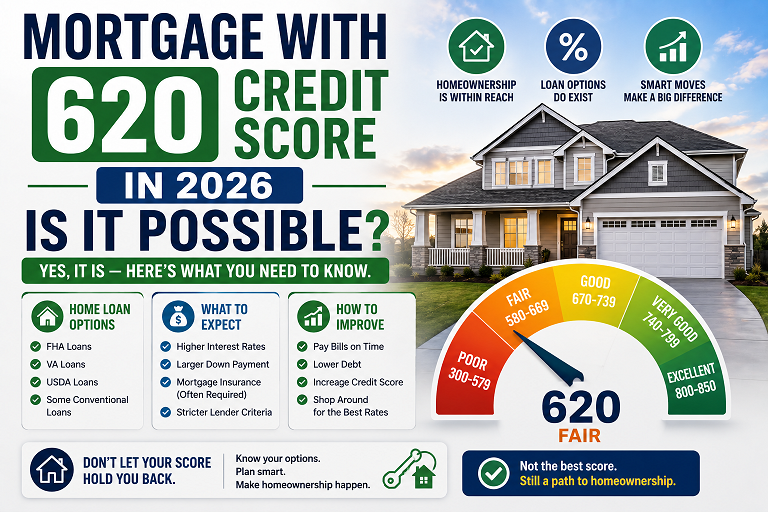
Yes, getting a mortgage with a 620 credit score can be possible in 2026, but 620 does not guarantee approval or a competitive rate. FHA guidelines can permit a 3.5% minimum down payment at scores of 580 or above, although lenders may impose higher score overlays. VA and USDA agencies do not set one universal minimum score, but participating lenders assess credit and may add their own thresholds. Conventional rules changed: Fannie Mae Desktop Underwriter no longer applies a universal third-party minimum score to new casefiles, while manual underwriting and specific Freddie Mac products retain score requirements.
A 620 score sits at an important mortgage-shopping point. It may open several program paths, yet the same applicant can receive an approval from one lender and a denial from another because automated underwriting, debt-to-income ratio, down payment, reserves, property type and recent credit history all matter.
This page focuses only on the decisions unique to a 620 score: which programs may work, why lender overlays matter, what costs may be higher, and whether applying now or waiting could be more sensible. For broader ranges and model explanations, use our mortgage credit-score pillar guide.
Can you buy a house with a 620 credit score?
A 620 score can be sufficient for consideration under several mortgage programs, but it is only one input. Fannie Mae describes automated underwriting as a comprehensive risk assessment that evaluates credit history, equity investment, liquid reserves, reliable income and the combined effect of those factors. Freddie Mac, FHA, VA and USDA programs also have product-specific rules and lender underwriting.
Agency rules determine the broad path, but the lender can apply stricter overlays.
DU or Loan Product Advisor may accept, refer or reject based on the entire file.
Income, debts, down payment, reserves, taxes and insurance shape the final decision.
The score a mortgage lender uses may also differ from the number in a free app. Mortgage credit-model implementation is changing in 2026, and approved lenders may have different model paths. Ask which score model, bureau configuration and underwriting system produced the result.
A 620 score is not an approval certificate
A recent late payment, high card balances, thin reserves, unstable qualifying income or excessive DTI can outweigh meeting a published score threshold. Conversely, a well-documented file may receive a favorable automated result even when a generic website says the score is “too low.”
Mortgage programs that may work with a 620 score
| Program | Official score position | Down-payment context | What can block a 620 applicant |
|---|---|---|---|
| FHA | FHA policy supports maximum financing at 580+; lenders may require more | As low as 3.5% under standard maximum-financing rules | Lender overlay, DTI, recent delinquencies, property or appraisal issues |
| Fannie Mae conventional | No universal third-party minimum for new DU casefiles since Nov. 16, 2025; manual rules differ | Varies by product, occupancy and borrower eligibility | DU risk assessment, pricing, reserves, DTI, LTV or manual minimums |
| Freddie Mac conventional | Automated Accept loans can have no general minimum in some cases; product/manual requirements vary | Varies by product and transaction | LPA result, specific product minimum, LTV, DTI or lender overlay |
| VA | VA does not set a minimum credit score | Potentially no down payment for eligible borrowers, subject to entitlement and lender approval | Lender minimum, residual income, credit history, entitlement or property requirements |
| USDA Guaranteed | USDA says the program has no set credit-score requirement | No down payment may be available for eligible rural property and income-qualified households | Income/property eligibility, repayment ability, lender standard or guarantee underwriting |
FHA at 620
A 620 score is above FHA’s 580 benchmark for maximum financing, but FHA insurance and lender approval are separate. An FHA-approved lender can impose a 620, 640 or other overlay based on its risk policy. The borrower must also satisfy income, debt, occupancy, appraisal and property-condition requirements. Mortgage insurance affects both upfront cash and monthly cost.
This article does not repeat every FHA rule. See the site’s FHA guide for program-wide eligibility, mortgage insurance and property standards.
VA at 620
The Department of Veterans Affairs states that VA itself does not require a minimum score. Lenders still use credit scores and their own standards. Eligible service members and veterans should compare VA lenders rather than treating one lender’s 620 or 640 overlay as a VA rule.
USDA at 620
USDA’s guaranteed-loan page says the program has no credit-score requirement, but applicants must demonstrate willingness and ability to manage debt. The property must be in an eligible rural area, household income must meet limits and a participating lender must approve the loan.
The 2026 conventional-loan change most articles miss
Older mortgage content commonly states that every conventional loan requires at least 620. That is now too broad. Fannie Mae removed the minimum third-party credit-score requirement for new Desktop Underwriter casefiles created on or after November 16, 2025. DU uses its proprietary risk assessment rather than the score as a minimum eligibility gate.
However, the score has not become irrelevant. Fannie Mae still requires credit reports and uses representative scores for pricing and for certain manual or product rules. Its current Selling Guide lists 620 for fixed-rate manually underwritten loans and 640 for manually underwritten adjustable-rate mortgages in the relevant table.
Freddie Mac likewise states that a minimum Indicator Score is not required for certain mortgages receiving an “Accept” risk class from Loan Product Advisor. Yet its Guide and Exhibit 25 retain minimums for manually underwritten loans and specific products or transactions.
Practical meaning at 620
Do not ask only, “Does this lender accept 620?” Ask whether the file is going through Fannie Mae DU, Freddie Mac Loan Product Advisor, manual underwriting or a government program—and whether the lender applies a higher overlay.
What may cost more with a 620 score?
A mortgage at 620 may carry a higher rate, discount points, mortgage insurance or lender charges than an otherwise similar stronger-credit file. Exact pricing changes daily and varies by loan program, LTV, property, occupancy, term and lock period, so this article does not publish a “today’s 620 rate” that will become stale.
- Interest rate and points: Lenders may offer a higher rate or require points to reduce it.
- Conventional mortgage insurance: With less than 20% down, private mortgage-insurance pricing can reflect credit and LTV.
- FHA mortgage insurance: FHA loans generally involve upfront and annual mortgage-insurance premiums under program rules.
- Homeowners insurance and taxes: These are not determined by score but can materially change the housing payment.
- Cash reserves: A stronger reserve position can matter to underwriting even though it is not an interest charge.
Compare Loan Estimates rather than verbal quotes. Review interest rate, APR, points, lender credits, total loan costs, cash to close and the projected five-year cost. A low advertised rate may require points that do not break even before a likely move or refinance.
Apply now or wait? A transparent mortgage comparison
The table is an illustration, not a market-rate forecast or personalized quote. It isolates a half-percentage-point rate difference to show how waiting could affect principal-and-interest cost. Real offers may differ, home prices can change, rates can rise, and improving a score is not guaranteed.
| Illustrative choice | Rate assumption | Monthly principal & interest | 30-year interest if held full term | Important tradeoff |
|---|---|---|---|---|
| Apply now | 7.25% | $2,046.53 | $436,750.38 | Buy sooner, but accept higher illustrative financing cost |
| Wait and qualify for lower pricing | 6.75% | $1,945.79 | $400,485.94 | Saves $100.74 monthly in this example, but rate/price/score outcome is uncertain |
| Illustrative difference | 0.50 percentage point | $100.74 monthly | $36,264.44 | Only valid under the stated assumptions |
When applying now may be reasonable
- The complete payment comfortably fits the budget at a stress-tested amount.
- You have stable qualifying income, emergency reserves and cash to close.
- Multiple Loan Estimates show acceptable terms without risky features.
- The purchase serves a real housing need and you expect to remain long enough to justify transaction costs.
When waiting may be wiser
- Card utilization can be reduced without draining emergency savings.
- Credit reports contain errors that need documented correction.
- A recent late payment, job change or large new debt is weakening underwriting.
- Cash to close would leave no reserve for repairs or income disruption.
- The only available offers have unaffordable payments, excessive points or unclear adjustable terms.
Waiting has costs too: rent continues, home prices or rates may move, and the desired property may sell. Use actual local housing costs and written lender scenarios—not a promise that “20 more points” will produce a specific APR.
How to strengthen a 620 mortgage application
Check all three reports
Use AnnualCreditReport.com. Correct specific factual errors with documents; never dispute accurate accounts simply to manipulate underwriting.
Control revolving balances
Reduce card balances where affordable and avoid new charges before closing. Do not empty emergency savings solely for a score change.
Stabilize applications and debt
Avoid opening cards, personal loans or auto financing shortly before and during mortgage underwriting unless the loan officer approves the plan.
Document funds and income
Keep pay records, bank statements, tax documents and explanations for large deposits. Do not move money repeatedly without a clear paper trail.
Shop program and lender overlays
Ask each lender which agency, automated system, model, score and overlay apply. Compare Loan Estimates on the same loan type and lock timing.
Down payment versus reserves
A larger down payment can lower LTV and possibly improve pricing, but using every available dollar can leave the household exposed to repairs, moving costs and income interruption. Ask lenders to price several down-payment levels and keep an appropriate reserve.
DTI and compensating factors
Underwriters compare qualifying monthly debts with gross income, but program and automated findings determine acceptable ratios. Paying off a small required monthly debt can sometimes help more than reducing an installment balance that does not change its counted payment. Get lender guidance before moving money.
What to do if a lender denies a 620 application
A denial from one company does not establish that every mortgage program is unavailable. Read the adverse-action notice and identify the actual reason: score, recent delinquency, DTI, insufficient income, unverifiable funds, property, appraisal, LTV or lender overlay.
- Request and review the consumer report named in the notice.
- Ask whether the denial came from agency rules, automated findings or the lender’s overlay.
- Correct verifiable report errors using the process in our credit-report error guide.
- Ask a HUD-approved housing counselor to review affordable options.
- Obtain another lender’s assessment only after understanding whether a new hard inquiry is necessary.
Avoid anyone selling guaranteed approval, fake pay stubs, undisclosed debt, a CPN or temporary tradeline access. Misrepresenting income, occupancy, funds or liabilities on a mortgage application can constitute fraud.
Frequently asked questions
Can I get a mortgage with a 620 credit score in 2026?
Yes, it may be possible through FHA, conventional, VA or USDA paths depending on eligibility and the complete file. A score of 620 does not guarantee approval.
Is 620 still the universal conventional minimum?
No. Fannie Mae removed the universal third-party minimum for new DU casefiles in November 2025. Manual underwriting and specific Fannie/Freddie products still have score requirements.
Can I get an FHA loan at 620?
A 620 score is above FHA’s 580 benchmark for maximum financing, but lenders may impose higher overlays and must approve income, debts, credit history and property.
How much down payment is needed at 620?
It depends on the program. FHA can allow 3.5% under qualifying conditions; VA or USDA may offer no-down-payment paths to eligible borrowers; conventional requirements vary.
Does VA require 620?
No. VA says it does not set a minimum score. Individual VA lenders use credit standards and may establish a 620, 640 or other overlay.
Does USDA require 620?
USDA says its guaranteed program has no set credit-score requirement, but the lender evaluates repayment ability and program income and property rules apply.
Will a 620 score mean a higher mortgage rate?
It may produce higher pricing than a stronger otherwise comparable profile, but rate depends on program, LTV, property, term, points, market and lender.
Should I wait until my score is 640 or 680?
Compare real Loan Estimates and a realistic waiting plan. Waiting can help if specific, affordable actions improve the file, but scores, rates and home prices are uncertain.
Can a larger down payment overcome 620?
It can lower LTV and strengthen the file, but it does not erase recent delinquencies, excessive DTI or lender minimums. Keep sufficient emergency reserves.
Which credit score will the mortgage lender use?
It depends on current model implementation, program and lender. Ask for the model, bureau configuration and representative-score method rather than relying on an app score.
Can I use a co-borrower?
Potentially, but the lender evaluates all borrowers and determines the representative score and qualifying income under program rules. A co-borrower can also add debts or a lower applicable score.
How quickly can I improve a 620 score?
No fixed timeline or point gain applies. Report corrections or lower reported balances may update relatively quickly, while recovery from missed payments generally takes longer.
Bottom line
A mortgage with a 620 credit score remains possible in 2026, but the right question is not simply whether 620 “qualifies.” Determine the program, automated-underwriting result, lender overlay, total payment, cash to close and reserve position.
Use actual Loan Estimates to compare applying now with waiting. Never rely on a guaranteed rate, approval or predicted score increase, and do not stretch the household budget merely because an automated system returns an approval.
Related guides
Official sources reviewed
- Fannie Mae: Desktop Underwriter credit-risk updates
- Fannie Mae Selling Guide: credit-score requirements
- Freddie Mac Guide: credit-score and LPA requirements
- HUD: FHA loan overview and 3.5% down payment
- VA Home Loan Buyer’s Guide
- USDA Guaranteed Loan Program
- CFPB: preparing to buy a home
- CFPB: compare mortgage rates and Loan Estimates
- AnnualCreditReport.com
1 thought on “Mortgage With a 620 Credit Score in 2026: Your Options”
Comments are closed.