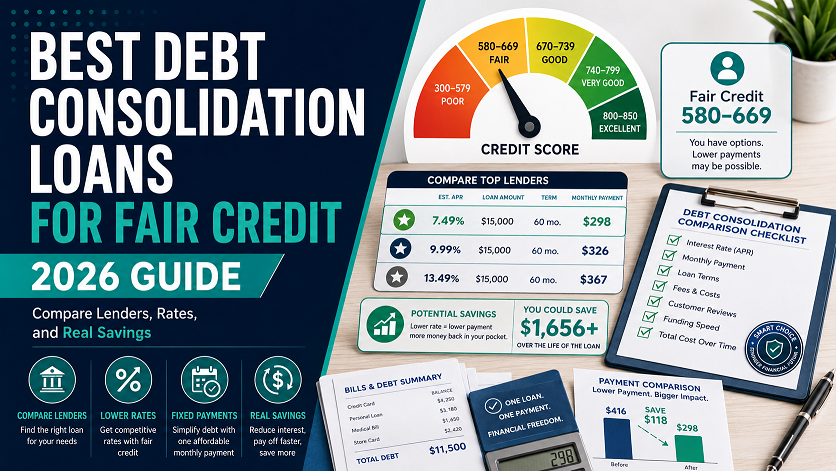
A debt consolidation loan can be useful with fair credit when the new loan’s APR and total repayment cost are lower than the debts being replaced, the payment fits your budget, and you stop adding new card balances. Fair credit does not point to one guaranteed rate or lender. Compare personalized offers—preferably through soft-credit-check prequalification—and account for origination fees before accepting a loan.
Debt consolidation sounds simple: replace several credit-card payments with one personal loan. The part that deserves more attention is whether the new loan actually improves your situation.
With fair credit, you may receive a wider range of prices than a borrower with excellent credit. One offer may reduce your interest cost; another may only make the monthly payment look smaller by stretching repayment over more years. A high origination fee can also reduce the money you receive while leaving you responsible for the full loan balance.
This guide does not rank lenders by an advertised “starting APR” that few applicants receive. Instead, it gives you a practical method for comparing debt consolidation loan offers based on the numbers that apply to you.
APR combines the interest rate with certain loan fees, making it more useful than the interest rate alone.
A lower payment may cost more overall when it comes with a much longer term.
Keep paid-off cards from becoming new debt after consolidation.
What counts as fair credit?
FICO generally labels scores from 580 through 669 as fair. That range is a useful reference, not a universal personal-loan approval standard. A lender may use a different score model or score version and may weigh income, existing debts, recent late payments, loan amount and employment information alongside the score.
This is why two applicants with the same score can receive different decisions. A 640 score with stable income, moderate required payments and a clean recent history may be evaluated differently from a 640 score accompanied by recent delinquencies and a high debt-to-income ratio.
A published minimum is not an approval promise
Some lenders disclose a minimum credit requirement; others do not. Meeting a stated minimum does not guarantee approval, a particular loan amount or the lowest advertised APR.
When is debt consolidation worth considering?
A consolidation loan has the strongest case when it does more than reorganize your bills. Look for measurable improvement in cost, payment structure or payoff certainty.
- The new APR is lower than the weighted average APR on the balances you plan to pay off.
- The total of payments is lower after including the origination fee and any other required charges.
- The payment is affordable without relying on another card for groceries, utilities or emergencies.
- The fixed payoff date helps you replace open-ended revolving debt with a clear repayment schedule.
- You have addressed the cause of the balances and can avoid charging the paid-off cards again.
Consolidation may be a poor fit when the new APR is similar to or higher than your existing costs, the loan is secured by an asset you cannot afford to risk, or the payment leaves no room for ordinary expenses. It also cannot solve a continuing monthly deficit by itself.
Use a weighted average—not a simple average
If your cards carry different balances and APRs, a simple average can mislead you. Multiply each balance by its APR, add those results, and divide by the total debt. That gives a useful approximate weighted APR for comparison.
For example, a $1,000 card at 29% and a $9,000 card at 18% do not have an effective average of 23.5%. Most of the debt is on the lower-rate card, so the weighted APR is about 19.1%.
How to compare debt consolidation loan offers
Do not select an offer from the headline rate or monthly payment alone. Put each offer beside your current debts and compare the following fields.
| Comparison point | Why it matters | What to verify |
|---|---|---|
| Annual percentage rate | APR reflects the annualized borrowing cost and incorporates certain fees. | Use your approved or prequalified APR—not the lender’s lowest advertised rate. |
| Origination fee | The fee may be deducted before funds reach you, yet you may repay the full principal. | Confirm both the dollar fee and the net amount available to pay creditors. |
| Monthly payment | A payment must fit alongside housing, food, insurance, transportation and savings needs. | Check the due date, fixed or variable nature, and consequences of a late payment. |
| Loan term | A longer term can reduce the payment while increasing total interest. | Compare offers using both payment and total repayment—not payment alone. |
| Total of payments | This shows the combined principal and finance charges if paid as scheduled. | Review the federal loan disclosures and loan agreement before signing. |
| Prepayment terms | Paying early can reduce interest on many loans, but the contract controls. | Check for any prepayment penalty and how extra payments are applied. |
| Creditor payoff | Some lenders send funds to creditors; others deposit funds in your account. | Continue monitoring old accounts until every payment posts and balances reach zero. |
| Credit-check type | Prequalification often uses a soft inquiry, while a formal application may use a hard inquiry. | Read the lender’s disclosure before submitting personal information. |
The Consumer Financial Protection Bureau notes that personal installment loans may include origination, documentation, optional insurance, non-filing and late fees. It recommends reviewing disclosures and comparing offers from multiple lenders.
Do not confuse “rate” with APR
The interest rate alone may not show the effect of an origination fee. When comparing loans with the same amount and term, APR is generally the more useful starting measure. Then inspect the actual cash received and total repayment.
Debt consolidation savings example
Assume someone has $12,000 in credit-card debt at a weighted APR of 25% and is comparing a three-year personal loan. The calculation below is illustrative; it is not a quote or prediction.
Illustrative offer: $12,000 for 36 months
Loan interest rate: 18%
Origination fee: 5%, or $600
Approximate scheduled payment: $434 per month
Approximate scheduled payments: $15,616 over 36 months
If the $600 fee is deducted from the proceeds, the borrower receives about $11,400—not enough to pay $12,000 of cards without adding $600 from savings or obtaining a larger loan. That cash-flow detail can change whether the plan works.
The loan’s stated rate is lower than the card APR, but the right comparison still depends on the card payoff plan. Credit cards do not have one fixed repayment schedule: paying only small minimums can take much longer, while paying $434 a month may eliminate the cards sooner than minimum payments. Use the same monthly budget and a realistic payoff timeline when comparing alternatives.
Also ask what happens after the cards are paid off. If $4,000 of new card debt returns during the loan term, consolidation has increased rather than reduced the total debt burden.
Where to look for debt consolidation loans with fair credit
The “best” lender is the one offering the most suitable verified terms for your situation—not necessarily the company with the loudest advertisement. Consider several lender types.
Banks where you already have an account
An existing relationship may make application and payment management convenient. Ask whether the bank offers soft-pull rate checks, relationship discounts or direct creditor payment. Availability and underwriting rules vary.
Credit unions
Federal and state-chartered credit unions may offer personal loans to eligible members. Compare membership requirements, APR, fees and term just as you would with any lender. Do not assume a credit union is automatically cheapest.
Established online lenders
Online lenders can make comparison shopping easier, and some provide prequalification. Verify that the lender operates in your state, review its privacy practices, and read the complete offer. Marketplace websites may share an application with multiple providers, so understand consent language before submitting it.
A qualified co-borrower or co-signer option
A lender that permits a joint applicant or co-signer may evaluate both profiles. This is not a casual favor: the other person can become legally responsible for the debt, missed payments may affect both credit files, and access to future borrowing may be reduced.
A safer shopping sequence
Start with lenders that clearly explain whether checking an estimated rate affects credit. Compare a small group of offers, then submit a full application only after reviewing the likely APR, fee, payment and term.
How to prepare before applying
List every debt accurately
Record each balance, APR, minimum payment and due date. Decide which eligible debts the loan would pay and which would remain outside it.
Review your credit reports
Use AnnualCreditReport.com to obtain federally authorized reports from Equifax, Experian and TransUnion. Look for unfamiliar accounts, incorrect balances and inaccurate late-payment information.
Estimate debt-to-income ratio
Add required monthly debt payments and divide by gross monthly income. Lenders calculate this differently, but the exercise helps you judge whether a new payment is manageable.
Gather documentation
Depending on the lender, you may need identity, address, income, employment and bank information. Submit sensitive data only through a verified lender’s secure application.
Prequalify selectively
Where available, use soft-inquiry prequalification to compare potential terms. Prequalification is not final approval; terms may change after verification and underwriting.
Read before accepting
Confirm the amount financed, APR, finance charge, payment schedule, total of payments, fees, late-payment terms and whether proceeds cover all intended balances.
If your report contains genuine errors, correct them before applying when time permits. Our guide explains how to dispute inaccurate credit-report information. If the offered costs are too high, consider improving your profile before trying again using these responsible credit-improvement steps.
How consolidation may affect your credit
There is no responsible way to promise that consolidation will raise or lower a score by a certain number of points. Several changes can happen at once:
- A formal application may create a hard inquiry.
- A new installment account may reduce the average age of accounts.
- Paying down card balances may reduce revolving utilization after issuers report the new balances.
- Closing cards can affect available revolving credit and account history considerations.
- On-time loan payments can support positive history; late payments can cause significant harm.
Do not close a paid-off card automatically. Consider its annual fee, temptation to overspend, account age and available limit. If you keep it open, monitor it for fraud and set a rule that prevents the balance from returning.
Alternatives when a consolidation loan is too expensive
| Alternative | Potential advantage | Main caution |
|---|---|---|
| Contact creditors directly | You may be able to ask about hardship assistance, a payment plan or a lower rate without a third-party fee. | Options are not guaranteed; obtain terms in writing and understand reporting consequences. |
| Nonprofit credit counseling | A counselor can review the full budget and may discuss a debt management plan. | Verify fees, services and creditor participation. A debt management plan is not a new loan. |
| Balance-transfer card | A promotional APR may reduce interest during a limited window. | Fair-credit approval and limits may be difficult; transfer fees and the post-promotion APR matter. |
| Debt avalanche or snowball | No new account is required. Avalanche targets the highest APR; snowball targets the smallest balance. | Progress requires enough monthly cash flow above minimum payments. |
| Wait and improve the application | Reducing balances, correcting errors or documenting stable income may improve future choices. | Continue required payments; waiting while missing due dates can make the problem worse. |
| Bankruptcy consultation | For severe, unmanageable debt, a qualified attorney can explain legal options and protections. | Bankruptcy has serious legal, financial and credit consequences; obtain individualized advice. |
Debt settlement is different from consolidation. Settlement companies may encourage consumers to stop paying creditors while funds accumulate for negotiations. That can lead to additional interest, fees, collection activity, lawsuits and credit damage. Forgiven debt can also have tax consequences in some circumstances. It should not be presented as a harmless substitute for a loan.
How to avoid debt consolidation and debt-relief scams
Debt stress makes promises of instant approval or guaranteed savings especially persuasive. The Federal Trade Commission warns consumers about companies that demand money before providing debt relief, guarantee that they can eliminate debts, promote supposed government programs, or enroll people without reviewing their finances.
- Do not pay an unexpected caller who promises to erase debt or lower card rates.
- Do not share your Social Security number, bank credentials or card information with an unverified caller or text sender.
- Be skeptical of “guaranteed approval,” “no matter your credit” and pressure to act immediately.
- Verify the lender’s identity and state availability independently—not through a link in an unsolicited message.
- Do not stop paying creditors based only on a salesperson’s instructions.
- Report suspected fraud at ReportFraud.ftc.gov.
A loan fee should not be disguised as an advance payment
Legitimate loan costs must be disclosed. A stranger asking you to send gift cards, cryptocurrency, wire transfers or “insurance” money before releasing a guaranteed loan is a major fraud warning sign.
Frequently asked questions
Can I get a debt consolidation loan with a 600 credit score?
Possibly, but a score alone cannot establish eligibility. Lenders may also consider income, debt-to-income ratio, recent delinquencies, requested amount and other information. Compare actual prequalified offers and do not rely on an unofficial minimum-score list.
What APR is good for a debt consolidation loan?
A useful APR is generally lower than the weighted APR of the debts being replaced and produces a lower total cost after fees. The right threshold depends on your current debts, repayment timeline and the offer available to you.
Does prequalification hurt my credit?
Many lenders use a soft inquiry for prequalification, which generally does not affect credit scores. A formal application may involve a hard inquiry. Read the lender’s disclosure before proceeding because processes vary.
Does debt consolidation close my credit cards?
Not automatically in every case. Some lenders or programs may impose conditions, while a standard personal loan may simply provide funds or pay creditors. Confirm the agreement and decide separately whether keeping each card open is financially safe.
Is direct creditor payment better?
It can reduce the risk of spending loan proceeds elsewhere, but you must still verify that payments arrived, were applied correctly and reduced each balance to zero. Keep making required payments until the creditor confirms payoff.
Can consolidation reduce my monthly payment but cost more?
Yes. Extending repayment over a longer term can lower the required payment while increasing total interest. Compare the total of payments and payoff date as well as the monthly amount.
Should I use a home-equity loan to consolidate cards?
Turning unsecured card debt into debt secured by a home adds foreclosure risk if payments become unaffordable. Compare closing costs, variable-rate risk where applicable, tax questions and alternatives with qualified professionals before putting a home at risk.
The bottom line
A debt consolidation loan can create one payment, a fixed payoff date and meaningful interest savings. Fair credit does not prevent that outcome, but it makes careful comparison especially important.
Begin with the debts you actually owe, calculate their weighted APR, and compare several personalized offers. Give equal attention to APR, origination fee, net proceeds, monthly payment, term and total repayment. If the loan does not lower cost or create a payment you can sustain without new card debt, it is not the right solution—regardless of how appealing the advertisement sounds.
Related guides
Primary consumer sources
- Consumer Financial Protection Bureau: personal installment loan fees
- Federal Trade Commission: how to get out of debt and avoid scams
- Federal Trade Commission: interest-rate reduction scams
- AnnualCreditReport.com: federally authorized credit-report access
- FICO: score information and general score ranges
5 thoughts on “Best Debt Consolidation Loans for Fair Credit in 2026 — Compare Lenders, Rates, and Real Savings”