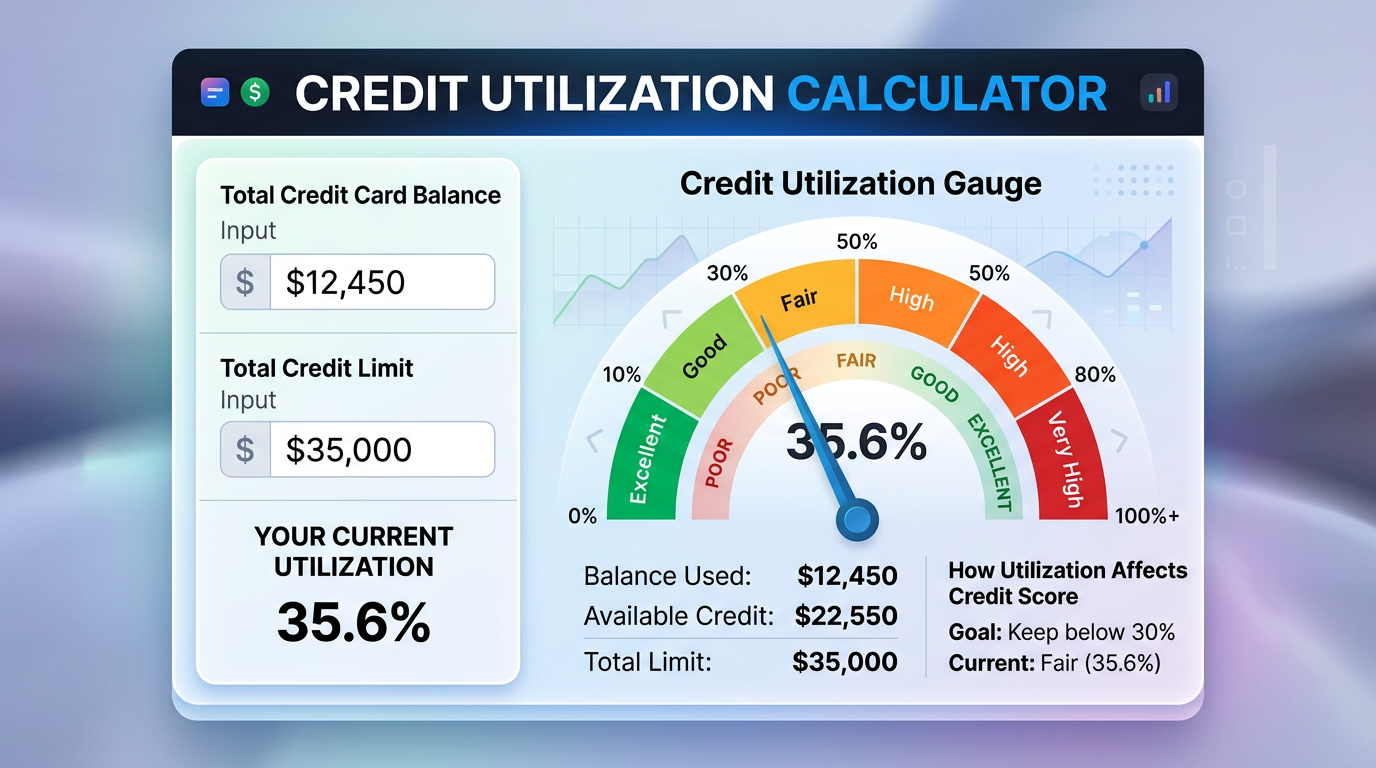
Use this calculator to determine your credit utilization ratio by comparing your total credit card balances to your total credit limits.
Credit Utilization Calculator 2026 — See Your Ratio Instantly and Know Exactly How Much to Pay Down
Credit utilization is the second most important factor in your FICO score, accounting for 30% of your total score. It measures how much of your available revolving credit you are currently using. If you have a $1,000 balance on a card with a $4,000 limit, your utilization on that card is 25%.
Most people know they should keep utilization low — but few know the exact number they need to hit to maximize their score. This calculator does the math for you. It shows your current ratio, color-codes it by impact, and tells you the precise dollar amount to pay off to reach 29% or 9% — the two most important thresholds for credit scoring.
- Enter your balance and credit limit for each credit card you currently have. You can find both numbers on your most recent statement or by logging into your card account online.
- Click “Add another card” to add more cards. The calculator handles up to 10 cards and updates your overall ratio in real time.
- Read the paydown tip — if your utilization is above 30%, the tool tells you exactly how many dollars to pay off to reach the ideal range before your next statement closes.
Credit Utilization Calculator — 2026
What Your Utilization Ratio Means for Your Score
Credit utilization has a direct and fast impact on your FICO score. Unlike payment history (which takes months to recover), utilization changes can reflect in your score within 30 to 45 days — as soon as your creditor reports your updated balance to the bureaus.
| Utilization Rate | Score Impact | What Lenders See |
|---|---|---|
| 0% – 9% | Ideal | Maximum score benefit. Shows you use credit responsibly without relying on it heavily. |
| 10% – 29% | Good | Solid range. Meets most recommendations. Minor improvement available by going lower. |
| 30% – 49% | Caution | Score starts to decline. Lenders may see you as carrying more debt than comfortable. |
| 50% – 74% | High | Noticeable score damage. Likely hurting your chances of approval and rate quality. |
| 75% – 100% | Critical | Significant score damage. This is one of the fastest-fixable problems in your credit profile. |
5 Proven Strategies to Lower Your Utilization Fast
Your creditor reports your balance to the bureaus on your statement closing date — not your due date. If you pay down your balance a few days before the statement closes, the lower balance gets reported. Even if you pay in full every month, a high balance at statement close hurts your score.
If you cannot pay the full balance before the statement closes, make a mid-cycle payment to reduce the balance that gets reported. This is especially effective if you use your card heavily throughout the month for everyday spending.
If your balance stays the same but your limit goes up, your utilization ratio drops automatically. Call your card issuer and request a limit increase — many issuers will approve this with no hard inquiry if you have had the card for 12 or more months and have a good payment history.
Opening a new card increases your total available credit, which can lower your overall utilization ratio. However, this triggers a hard inquiry and lowers your average account age. Only do this if the utilization benefit outweighs the short-term score dip from the inquiry.
Having one card at 80% utilization hurts more than having four cards at 20% each, even with the same total balance. FICO looks at both individual card utilization and overall utilization. Spreading balances across cards can improve your score even without paying anything down.
The new FICO 10T model now used for mortgage underwriting looks at your balance trends over 24 months, not just your current snapshot. If your balances are consistently decreasing month over month, your mortgage score gets a boost — even if your current utilization is not yet ideal.
Individual Card Utilization vs Overall Utilization
FICO looks at your utilization in two ways simultaneously — your overall utilization across all revolving accounts, and the utilization on each individual card. Both matter. Here is what this means practically:
- A card maxed out at 95% hurts your score even if your overall utilization is only 20%
- Paying down your highest-utilization card first gives you the fastest individual card improvement
- Never let any single card exceed 50% utilization if you can avoid it
- Even store cards and retail cards count toward your utilization — include all revolving accounts in this calculator
Does Paying Off a Card Immediately Improve My Score?
Yes — but there is a timing factor. Your score only reflects what has been reported to the credit bureaus. Most creditors report your balance once per month, on your statement closing date. So if you pay off a balance today but your statement closes in 3 weeks, your score will not reflect the improvement for roughly 30 to 45 days. To see the fastest improvement, pay down balances a few days before your statement closing date each month.
What Counts as Revolving Credit for Utilization?
Only revolving credit accounts affect your utilization ratio. These include:
- Credit cards (Visa, Mastercard, Amex, Discover)
- Store cards and retail credit accounts
- Home Equity Lines of Credit (HELOCs)
- Personal lines of credit
Installment loans — auto loans, mortgages, personal loans, student loans — do not count toward your utilization ratio. Only your revolving credit limits and balances are used in the calculation.
Frequently Asked Questions
Does closing a credit card hurt my utilization?
Yes. When you close a credit card, that card’s limit is removed from your total available credit, which increases your utilization ratio. For example, if you have $2,000 in balances across $10,000 in total limits (20% utilization) and you close a card with a $3,000 limit, your utilization jumps to 28% ($2,000 / $7,000). Avoid closing old cards if possible, especially those with high limits.
Is 0% utilization ideal for my credit score?
Not exactly. Having zero balances across all cards can actually work against you slightly, because FICO may interpret no activity as insufficient data to score. The ideal range is 1% to 9% — using your cards lightly but consistently. The difference between 0% and 1-9% is small, but if you want to optimize your score, a small balance is better than zero.
How quickly will my score improve after paying down balances?
Most creditors report balances to the bureaus once per month, on your statement closing date. After the updated balance is reported, the bureaus typically update your score within 2 to 5 days. So from the time you pay down a balance, expect to see score improvement within 30 to 45 days — sometimes faster if your creditor reports mid-cycle.
Should I include my HELOC in this calculator?
Yes. A Home Equity Line of Credit is a revolving account and its balance and limit count toward your utilization ratio just like a credit card. Include your current HELOC balance and credit limit in the calculator for an accurate overall utilization figure.
My utilization is high because I use my card for everything and pay in full. Will this hurt my score?
It can, even if you pay in full every month. The issue is timing — FICO scores your balance as of your statement closing date, not your due date. If you charge $3,000 on a $4,000 limit card during the month and pay in full after the statement closes, your score will briefly reflect 75% utilization until the payment is reported. The fix is to pay down your balance before your statement closing date, not just before your due date.
Know your utilization — now improve your score
See our complete guide on the fastest ways to lower utilization and boost your FICO score this month.
Read the improvement guide →