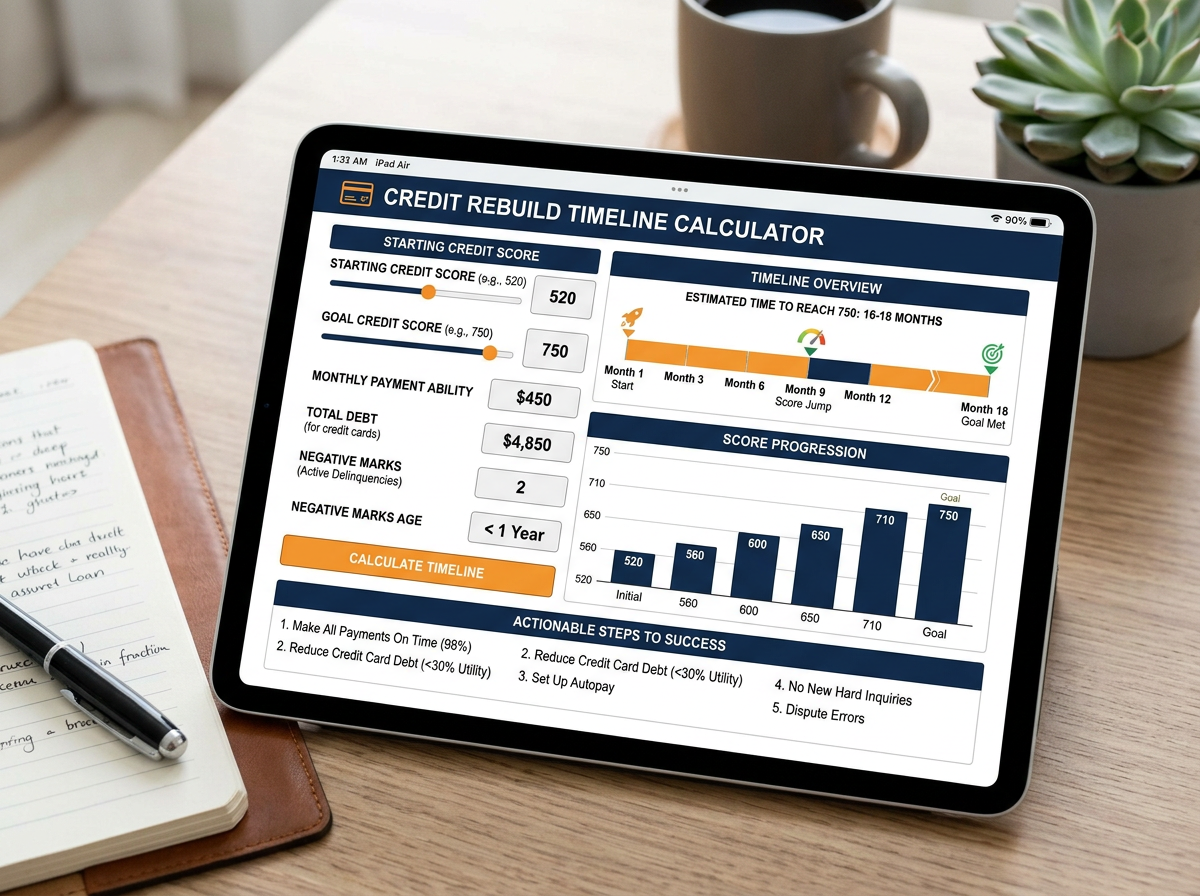
Track your credit improvement over time. This timeline helps you stay on track with your credit rebuilding goals.
Credit Rebuild Timeline Calculator 2026 — See Exactly When Negative Items Fall Off Your Report and When Your Score Will Recover
One of the most common questions people ask about credit repair is simply: how long do I have to wait? Negative items on your credit report do not stay forever — the Fair Credit Reporting Act (FCRA) sets strict limits on how long derogatory information can remain on your report. But the exact timeline depends on the type of negative item and when it occurred.
This calculator turns the complexity into a clear, personal timeline. Enter your specific negative items with their dates, and see exactly when your credit history gets clean — and what your score trajectory looks like between now and then.
- Enter each negative item on your credit report. Select the type (late payment, collection, charge-off, bankruptcy, etc.) and the date it occurred — this is the date of first delinquency, not when it was added to your report.
- Add all negative items for a complete picture. The timeline shows every removal date in chronological order.
- Read the score recovery projection — it shows your estimated score trajectory over time if you maintain positive credit behavior starting today.
Credit Rebuild Timeline Calculator — 2026
How Long Do Negative Items Stay on Your Credit Report?
The Fair Credit Reporting Act (FCRA) sets the maximum time any negative item can remain on your credit report. Here is the complete reference table for 2026:
| Negative Item | How Long It Stays | Clock Starts | 2026 Notes |
|---|---|---|---|
| Late payment (30, 60, or 90 days) | 7 years | Date of late payment | Impact fades significantly after 2 years |
| Collection account | 7 years | Date of original delinquency | Paid collections: ignored by FICO 9, FICO 10T, VantageScore 4.0 |
| Charge-off | 7 years | Date of first delinquency | The debt can still be collected even after removal |
| Medical collection (paid) | Removed immediately | N/A | 2026 rule: paid medical collections removed from all 3 bureaus |
| Medical collection (unpaid, under $500) | Removed immediately | N/A | 2026 rule: removed regardless of payment status |
| Medical collection (unpaid, $500+) | 7 years | Date of delinquency | Still appears — dispute if paid |
| Repossession | 7 years | Date of default | Deficiency balance can still be collected |
| Foreclosure | 7 years | Date of first missed mortgage payment | Major impact for 3–4 years; fades significantly after |
| Chapter 7 Bankruptcy | 10 years | Filing date | Most severe; scores can recover to 650+ within 2–3 years |
| Chapter 13 Bankruptcy | 7 years | Filing date | Slightly less severe than Chapter 7 |
| Hard inquiry | 2 years | Date of inquiry | Only affects score for ~12 months |
How Negative Items Lose Impact Over Time — Even Before They Fall Off
A crucial piece of information that most credit resources miss: negative items do not have the same impact throughout their time on your report. Their impact fades significantly over time, even before the item is removed.
- In the first 12 months — A negative item is at its most damaging. A collection or serious late payment can cost 60 to 100+ points.
- 12 to 24 months later — The item still appears but lenders and scoring models begin to weigh it less heavily, especially if you have added positive payment history since.
- 2 to 4 years later — The item’s impact on your score is significantly reduced. Most people with a single collection from 3 years ago and clean history since can reach scores in the 660 to 720 range.
- 4 to 7 years later — The item is still visible on your report but has minimal scoring impact if outweighed by positive history. Most lenders will overlook a single old negative mark from this period.
2026 Rule Changes — Medical Debt Update
One of the most significant credit reporting changes in 2026 affects medical debt. Under new rules implemented by Equifax, Experian, and TransUnion:
- All paid medical collections have been removed from credit reports
- All unpaid medical collection accounts under $500 have been removed
- Larger unpaid medical debts ($500 and above) may still appear on reports
- Millions of Americans saw their credit scores increase as a result of these removals
If you had medical collections on your report, check your credit report at AnnualCreditReport.com to confirm whether they have been removed. If eligible medical debts are still showing, file a dispute with the bureau immediately.
What to Do While You Wait for Negatives to Fall Off
Waiting for negative items to age off your report does not mean doing nothing. Every positive action you take during the waiting period builds a layer of positive history that increasingly outweighs the negatives in your score calculation. Here is what to focus on:
- Pay every bill on time from this point forward — 35% of your score. Even 12 months of perfect payment history after a serious negative event begins to demonstrate recovery to scoring models.
- Keep utilization under 30% — paying down card balances is the fastest-acting improvement you can make.
- Open a secured credit card — if you have been declined for unsecured cards, a secured card used lightly and paid in full monthly builds positive history without risk.
- Dispute any inaccurate negative items — if an item on your report is incorrect, outdated, or unverifiable, you have the right to dispute it under the FCRA. Successful disputes remove items before their scheduled fall-off date.
- Do not close old accounts — even if you do not use them, keeping old accounts open maintains your average account age and available credit.
Frequently Asked Questions
Does paying a collection account remove it from my report?
Not automatically under FICO 8, which is still widely used by many lenders. A paid collection still appears on your report until the 7-year clock expires. However, under FICO 9, FICO 10T, and VantageScore 4.0 — the newer models now used for mortgage underwriting — paid collections are ignored in score calculations. This means paying a collection may improve your score under newer models even if the item still appears on your report.
Can I dispute an old collection to remove it early?
You can dispute any item you believe is inaccurate, incomplete, or unverifiable. If the collection agency cannot verify the debt within 30 days, the bureau is required to remove it — even if the 7 years have not expired. This is sometimes called a debt validation dispute. However, disputing a debt you genuinely owe is not fraud — it is your legal right under the FCRA. The outcome depends on whether the creditor responds to the verification request.
If a collection is sold to a new agency, does the 7-year clock reset?
No. This is illegal under the FCRA. The 7-year clock starts on the date of original delinquency with the original creditor — it does not reset when the debt is sold to a collection agency. If a collection agency re-ages a debt on your report (extends the clock), you have the right to dispute it and report the agency to the CFPB.
How quickly can my credit score recover after bankruptcy?
Faster than most people expect. With a disciplined approach — secured card, low utilization, on-time payments — many people reach a 640 to 680 score within 18 to 24 months of a Chapter 7 bankruptcy discharge. The key is that the bankruptcy stops the bleeding. You start with a clean slate for new positive behavior, which scoring models begin to reward quickly.
Ready to start rebuilding?
See our step-by-step guide to rebuilding credit after negative events — secured cards, credit builder loans, and the exact actions to take in your first 90 days.
Read the rebuild guide →