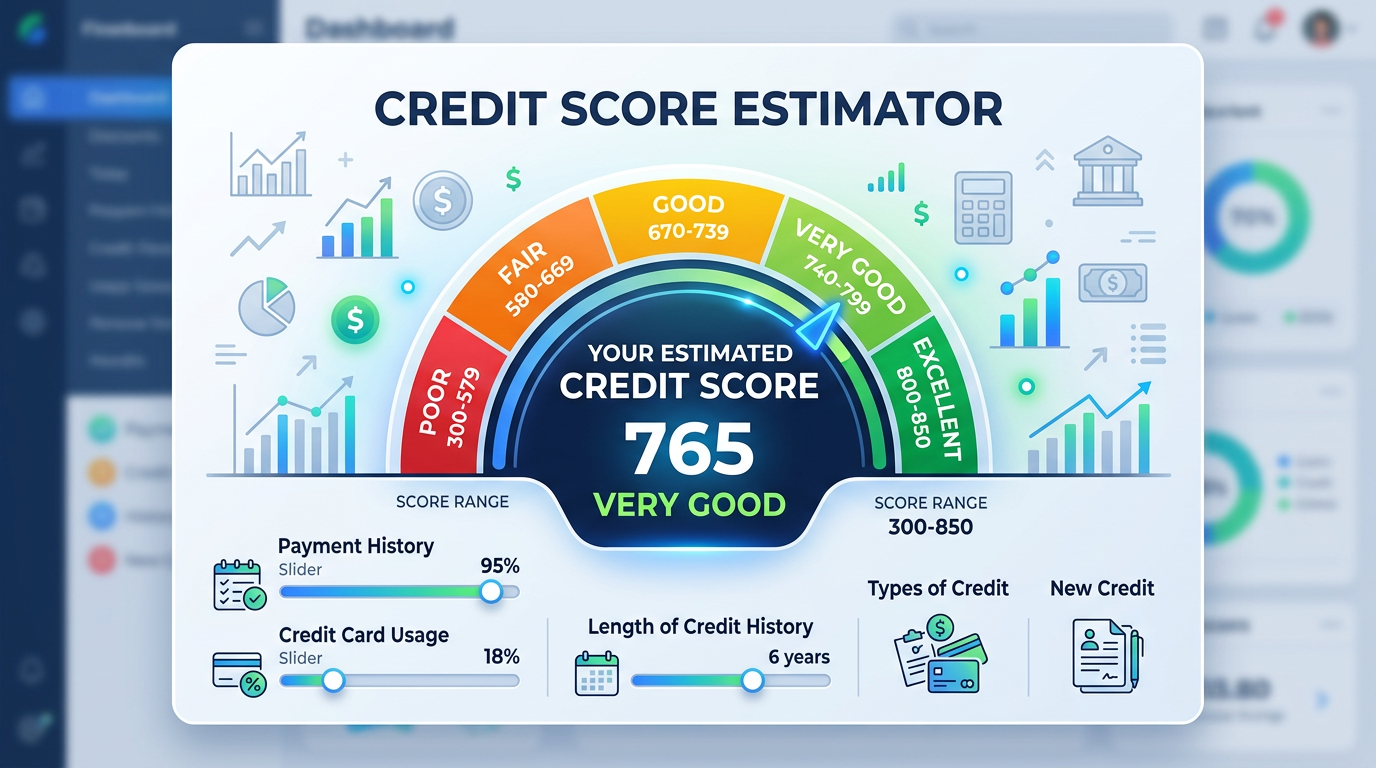
Free Credit Score Estimator 2026 — Get Your Estimated FICO Range in 30 Seconds
Your FICO credit score is a three-digit number between 300 and 850 that lenders use to decide whether to approve your loan, credit card, or mortgage — and at what interest rate. Yet most Americans have no idea where their score stands until they actually apply for credit and face rejection or a high rate.
This free credit score estimator gives you an instant estimate of your score range based on the real factors that drive your FICO score. While it is not a substitute for your actual FICO score (which you can get free from Experian, Credit Karma, or your bank), it is a fast and private way to understand roughly where you stand and which factors are hurting you the most.
- Answer each of the 5 questions honestly based on your current credit situation. Select the option that best describes your history, even if it is not a perfect match.
- Watch your estimated score update instantly as you change your answers. The score meter and badge update in real time so you can see exactly how each factor affects your range.
- Use the improvement tip at the bottom of the result panel — it tells you the single most impactful action you can take right now to push your score higher.
Credit Score Estimator — 2026
Estimated range: 720 – 760
Lower your utilization under 10% to push into the Very Good range faster than any other action.
How to Interpret Your Estimated Score
Your estimated score is based on the five factors FICO uses to calculate real credit scores. The weighting in our estimator mirrors the actual FICO weighting as closely as possible without access to your real credit file. Here is what your result means:
| Score Range | Rating | What It Means for You |
|---|---|---|
| 800 – 850 | Exceptional | Best rates on all products. Instant approvals. Lenders compete for your business. |
| 740 – 799 | Very Good | Near-best rates. Approved for almost all credit products. Mortgage-ready. |
| 670 – 739 | Good | Approved for most products. Rates slightly above the best. Solid position. |
| 580 – 669 | Fair | Approved for some products at higher rates. Limited card choices. Improvement needed. |
| 300 – 579 | Poor | Likely declined for most unsecured credit. Focus entirely on repair before applying. |
The 5 Factors That Determine Your FICO Score
FICO builds your score from exactly five factors. Understanding each one tells you where to focus your energy for the fastest improvement.
Whether you pay on time. A single 30-day late payment can drop a 750 score by 60 to 100 points. This is the single most important factor — and the most recoverable with consistent on-time payments.
How much of your available revolving credit you are using. Keep total utilization below 30% for a good score. Below 10% for an excellent score. Paying down balances is the fastest way to improve your score.
How long you have had credit accounts. FICO looks at the age of your oldest account, your newest account, and the average age of all accounts. Avoid closing old accounts — it shortens your history.
The variety of account types — credit cards, auto loans, mortgages, personal loans. Having a healthy mix shows lenders you can manage different types of credit responsibly.
Recent hard inquiries from credit applications. Each application can drop your score 5 to 10 points. Multiple applications in a short period signal financial stress to lenders. Space applications 6 months apart.
FICO 10T — now required for mortgages — looks at whether your balances are going up or down over 24 months. If your balances are consistently decreasing, your score gets a boost. Increasing balances hurt more.
How Accurate Is This Estimator?
This tool gives you a directionally accurate estimate — it will not match your exact FICO score to the point, but it will reliably tell you which score tier you are likely in and which factor is dragging you down the most. For your actual FICO score, you can get it free from:
- Experian.com — free FICO Score 8 with a free account
- Credit Karma — free VantageScore from TransUnion and Equifax
- Your bank or credit card — most major banks now show your FICO score in your account dashboard for free
- Discover Credit Scorecard — free FICO Score 8 even if you are not a Discover customer
Frequently Asked Questions
Does using this estimator affect my credit score?
No. This tool does not connect to any credit bureau and does not perform a credit check of any kind. It is a calculation based on your self-reported answers. Your score is not affected in any way.
Why is my estimated score different from my actual FICO score?
Your actual FICO score is calculated using the precise details from your credit file — exact balances, exact payment dates, specific account ages, and more. Our estimator uses your answers to 5 broad questions. It is accurate enough to identify your score tier and main problem area, but will not match your exact score to the point.
What is the difference between FICO and VantageScore?
FICO is the most widely used scoring model — used by 90% of top lenders. VantageScore was developed by the three credit bureaus as an alternative. Both use a 300 to 850 range but weigh factors slightly differently. As of 2026, both FICO 10T and VantageScore 4.0 are required for mortgage underwriting by Fannie Mae and Freddie Mac.
How fast can I improve my credit score?
It depends on your starting point. Paying down high balances can improve your score within 30 to 45 days — as soon as the updated balance is reported to the bureaus. Removing a collection can add 50 to 100 points. Building a strong payment history takes 6 to 24 months of consistent on-time payments.
What score do I need for a mortgage in 2026?
For a conventional loan, most lenders require a minimum score of 620 to 640. For an FHA loan, you can qualify with as low as 580 with 3.5% down, or 500 with 10% down. For the best mortgage rates in 2026, aim for 740 or higher under both FICO 10T and VantageScore 4.0.
Ready to improve your score?
Use our step-by-step credit repair guides to fix what is pulling your score down — starting today.
Start the improvement guide →