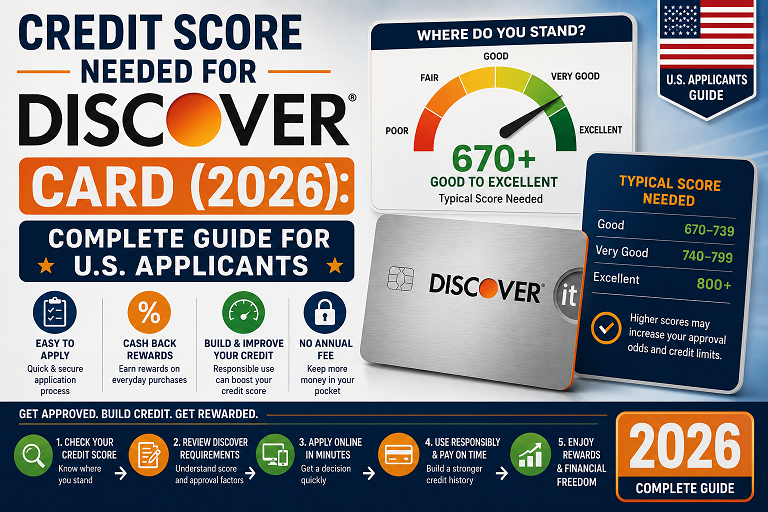
Discover does not publish one universal minimum credit score for every card or applicant. Its official guidance says you do not need a specific score simply to apply. Approval can depend on the card, your full credit history, income, existing debt and other application information. Use Discover’s official pre-approval tool when available before submitting a full application.
A score estimate can help you choose a realistic product, but it cannot predict approval. Discover offers standard rewards cards as well as student and secured options intended for different credit profiles. The best choice is the card whose eligibility, fees, rewards and repayment terms fit your situation—not the card attached to a guessed cutoff.
Discover does not promise approval at one FICO or VantageScore number.
Checking official pre-approved offers is designed not to harm your credit score.
Compare APR, fees, rewards conditions and credit-building value—not approval alone.
What credit score do you need for a Discover card?
There is no reliable single number. Discover’s own educational material states that applicants do not need a specific score to apply and that higher scores may improve access to cards with stronger rates or rewards.
Third-party sites commonly publish labels such as “670 recommended” or “good credit required.” Those may describe reported experiences or broad score ranges, but they are not issuer guarantees. A person above an estimated range can be declined, while a person below it may qualify for a different Discover product.
Do not present an estimated score as a minimum requirement
Card issuers change underwriting and evaluate more than a score. Only Discover can decide an application, and the issuer does not disclose its complete approval model.
Different Discover cards serve different profiles
| Card category | General purpose | What to review |
|---|---|---|
| Cash-back or miles rewards cards | Ongoing purchases for applicants seeking rewards and standard unsecured credit. | Current purchase APR, balance-transfer terms, reward categories, caps and redemption rules. |
| Student cards | Eligible students building credit and managing an early account. | Student eligibility, income available for repayment, rewards and late-payment consequences. |
| Secured card | Building or rebuilding credit with a refundable security deposit, subject to terms. | Minimum deposit, credit line, graduation reviews, reporting, APR and fees. |
| Balance-transfer offer | Moving qualifying debt under promotional terms. | Transfer fee, promotional period, post-promotion APR, deadline and repayment plan. |
Product availability and terms can change. Check Discover’s live offer page rather than copying an APR or bonus from an old review.
What Discover may consider beyond your score
- Payment history: recent late payments, collections or serious derogatory events can matter.
- Revolving balances: high utilization can signal limited available capacity.
- Recent applications: several new accounts or inquiries may affect risk assessment.
- Length and depth of history: a thin or very new file provides less repayment experience.
- Income and ability to pay: card issuers evaluate application income and existing obligations under applicable rules.
- Existing relationship and exposure: current accounts, limits and issuer-specific policies may matter.
- Identity and application verification: inconsistent or incomplete information can delay or prevent approval.
Income is not part of a common FICO Score, but the issuer can consider it separately. Likewise, a high score does not guarantee that the requested credit line is affordable or that an application meets every policy.
Discover pre-approval versus a full application
Discover advertises an online pre-approval check that does not harm your credit score. This is generally a soft inquiry used to see whether an offer may be available. A pre-approved offer is useful evidence, but it is not final approval.
When you accept an offer and submit a full application, the issuer may access your full credit report. That hard inquiry appears on the report and may affect scores. Discover can also consider updated report data and application information before making the final decision.
Use the issuer’s official tool
A third-party “matching” page is not the same as Discover pre-approval. Check the website address and privacy disclosures before entering Social Security number, income or other sensitive information.
How to improve your application readiness
Check your credit reports
Use AnnualCreditReport.com. Correct genuine errors before applying.
Identify the score you are viewing
Record the bureau, model, version and date. A free monitoring score may not match the issuer’s model.
Reduce costly revolving balances
Lower utilization with an affordable payoff plan. Do not drain emergency savings solely to chase an estimated cutoff.
Avoid unnecessary applications
Use pre-approval first and apply for a card that serves a real financial purpose.
Report income accurately
Follow the application instructions about income you may include. Never inflate income to improve approval odds.
Review the live terms
Save the pricing and offer disclosures that apply when you submit the application.
Compare the complete card offer
A rewards card is valuable only when its benefits exceed its costs. Review:
- Purchase APR and whether it is variable.
- Promotional APR duration and the rate afterward.
- Balance-transfer and cash-advance fees.
- Annual fee, foreign transaction fee and late-payment terms.
- Reward categories, activation requirements, spending caps and exclusions.
- Welcome-offer deadline and qualifying purchase rules.
- Whether Discover acceptance fits where you normally spend.
Paying a statement balance in full by the due date can avoid purchase interest when a grace period applies. Carrying a balance for rewards usually costs more in interest than the rewards earned.
What to do if Discover declines your application
Read the adverse-action notice. It should provide specific reasons or explain how to request them and identify a consumer reporting company when report information influenced the decision. If a credit score was used, required score disclosures may also apply.
- Do not immediately submit several new applications.
- Request and review the report identified in the notice.
- Dispute factual errors with the bureau and furnisher.
- Address the stated reason, such as high balances, insufficient history or recent applications.
- Consider whether a secured card, student card or different no-annual-fee product better fits your profile.
A denial is not a permanent judgment. It is information about one application under one issuer’s policy at that time.
Frequently asked questions
Can I get a Discover card with a 650 score?
Possibly, but the score alone cannot predict approval. Card type, report details, income, debt and issuer policy matter. Check official pre-approval first.
Does Discover publish a minimum score?
No universal minimum is published for all Discover cards. Discover states that no specific score is required simply to apply.
Does Discover pre-approval hurt my score?
Discover advertises its official pre-approval check as having no harm to the credit score. A later full application can involve a hard inquiry.
Does pre-approval guarantee approval?
No. The final application can include updated credit data, identity checks and other eligibility information.
Is the secured card easier to qualify for?
It is designed for building or rebuilding credit and requires a security deposit, but approval and deposit requirements still apply.
Which bureau does Discover pull?
Do not rely on crowdsourced bureau-pull maps. The bureau may vary by applicant, location or process, and more than one source may be used.
The bottom line
There is no official magic score for a Discover card. Match the product to your credit profile, check official pre-approval, compare current terms and apply only when the account supports your financial plan.
2 thoughts on “Credit Score Needed for Discover Card (2026): Complete Guide for U.S. Applicants”