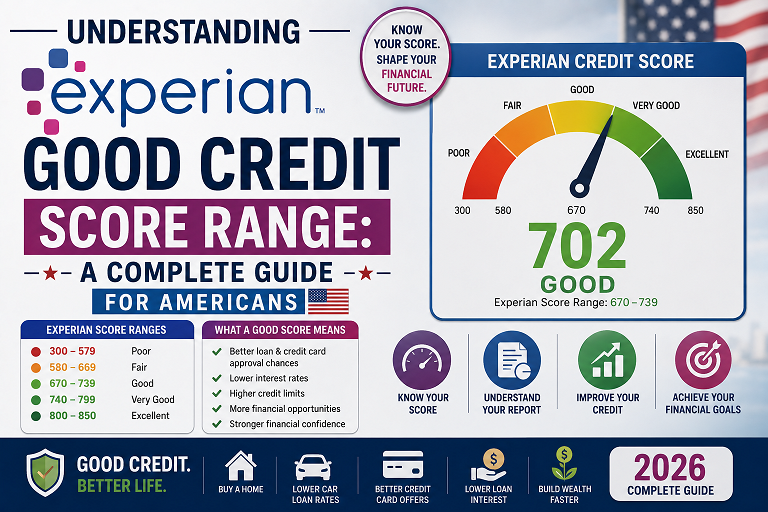
A good Experian credit score is usually 670 to 739 when you are looking at the FICO Score 8 currently supplied with Experian’s free U.S. consumer account. But “Experian” identifies the credit-report data source—not one universal scoring model. A lender can calculate another FICO version from your Experian report and receive a different number.
Last reviewed August 30, 2026: We checked Experian’s current consumer score disclosure, FICO’s model guidance, CFPB credit-report resources and AnnualCreditReport.com. Services, prices and model availability can change, so verify current details before purchasing monitoring or applying for credit.
Experian good credit score range for 2026
Experian’s free consumer service states that the score on its dashboard is calculated using FICO Score 8. Base FICO Scores run from 300 to 850. The following ranges are FICO’s familiar consumer categories:
A 700 Experian-based FICO Score 8 therefore falls within the Good range. A 760 falls within Very Good, while 820 is Exceptional. The category describes the score’s position on that model; it does not reveal which loans, credit cards or APRs a consumer will receive.
If your Experian account later changes the displayed model, use the range published for that exact model. Do not assume every 300–850 score uses FICO category boundaries. VantageScore 4.0, for example, uses different tier names and cutoffs even though it also runs from 300 to 850.
What an “Experian credit score” actually means
Experian is one of the three nationwide credit reporting companies, alongside Equifax and TransUnion. It collects information furnished by creditors and other permitted sources and organizes that information into consumer credit reports. FICO is a separate company that creates scoring models.
When Experian shows a FICO Score 8, the score is the result of applying that FICO model to information in your Experian file at the time of calculation. A useful label is therefore:
Leaving out any of those parts can cause confusion. “My Experian score is 725” does not tell a mortgage lender whether the number is the model used for that application. It also does not mean Experian itself decided that the applicant is approved.
| Component | Role | Why it matters |
|---|---|---|
| Experian | Maintains a consumer credit report | Its file may contain different information or update timing than another bureau |
| FICO Score 8 | Calculates risk from report data | Another FICO version can weigh information differently |
| Lender | Selects models and underwriting rules | Approval, APR and credit limit depend on more than a category label |
| Calculation date | Determines the report snapshot evaluated | Balances and account statuses can change after creditors report updates |
Why your Experian, Equifax and TransUnion scores differ
Score differences do not automatically indicate an error. Creditors may report to one, two or all three bureaus. They may also furnish updates on different schedules. An inquiry can appear only at the bureau accessed by a creditor, and a collection or closed account may not be identical across every file.
Even when report data appears similar, scores can differ if the model, model version or calculation date differs. Comparing an Experian-based FICO Score 8 today with a TransUnion-based VantageScore calculated last week is not an apples-to-apples comparison.
Use this comparison checklist
- Confirm that both numbers use the same score brand.
- Identify the exact version, such as FICO Score 8 or VantageScore 4.0.
- Record which bureau supplied the underlying report.
- Compare calculation dates.
- Review the reports for material account differences.
For a broader explanation, see how credit reports, scoring models and lending decisions work. That guide owns the general topic; this page remains focused on Experian data.
Do lenders use the Experian score you see?
They might use FICO Score 8 based on Experian data, but there is no universal rule. FICO publishes multiple base and industry-specific versions. Credit-card issuers and auto lenders may use specialized bankcard or auto scores that range from 250 to 900. Mortgage lending has its own model and implementation requirements.
Experian itself warns that a lender or insurer may use a different FICO Score from FICO Score 8—or another type of score altogether. A creditor may also access Equifax or TransUnion rather than Experian. Bureau selection can vary by creditor, product and operational policy, so avoid websites claiming that one issuer “always pulls Experian” in every state.
Before an important application, ask the lender what score family it commonly uses and review current eligibility disclosures. The representative may not promise the exact bureau or model in advance, but asking is more reliable than depending on an old crowd-sourced bureau-pull table.
How to check your Experian credit score and report
Experian currently advertises free access to an Experian credit report and FICO Score 8 without requiring a credit card. Read the enrollment screen carefully because optional paid monitoring or multi-bureau products can have separate prices and renewal terms.
AnnualCreditReport.com is the federally authorized source for credit reports from Experian, Equifax and TransUnion. A credit report obtained there may not include a score. That is not a defect: a report is the underlying account record, while a score is a separate calculation.
Verify the website
Type the official address directly or follow links from CFPB resources. Avoid lookalike sites asking for unnecessary payment information.
Record the score details
Save the model name, bureau and calculation date rather than recording only the number.
Review the actual report
Check names, addresses, accounts, balances, payment status, inquiries and public-record information where applicable.
Compare trends carefully
Track the same model and bureau over time. A number from another service may not be directly comparable.
Checking your own report or score is a soft inquiry and does not lower the score. A hard inquiry generally occurs when a creditor accesses a file in connection with a credit application.
What information can affect an Experian-based score?
FICO explains that base scores consider payment history, amounts owed, length of credit history, new credit and credit mix. The influence of each category depends on the information in the individual report; the commonly published percentages are educational summaries, not a personal point calculator.
| Report area | What to review | Common misunderstanding |
|---|---|---|
| Payment history | Late-payment dates, severity and account ownership | Paying a delinquent account does not necessarily erase accurate historical lateness |
| Revolving balances | Reported balance and credit limit on each card | Carrying interest-bearing debt is not required to build credit |
| Account age | Opening dates and established account history | Opening several accounts does not instantly create a mature file |
| Inquiries and new accounts | Businesses that accessed the file and accounts recently opened | Checking your own score is not a hard inquiry |
| Collections and other negatives | Ownership, amount, status and relevant dates | An accurate negative item cannot lawfully be removed through a false dispute |
Income, bank balances, education and marital status do not appear as standard FICO scoring factors merely because a lender may separately request them. Underwriting and credit scoring are connected but distinct processes.
How to correct errors on an Experian report
Start by identifying a specific factual problem. Examples include an account that is not yours, an incorrect late-payment notation, a duplicated collection, a wrong balance or an account reopened by identity theft. Gather statements, payment confirmations, identity-theft reports or correspondence that supports the correction.
You can dispute with Experian and may also submit a direct dispute to the company that furnished the information. Explain what is wrong, identify the account and state the requested correction. Keep copies and track submission dates. An investigation does not guarantee deletion; verified accurate information may remain.
If identity theft caused the account, use IdentityTheft.gov to create a recovery plan and learn about blocking procedures. Debt validation under federal collection law is different from disputing bureau accuracy. Choose the process that matches the facts instead of sending a generic “609 loophole” letter.
Our credit-report error guide explains evidence, investigation timelines and escalation, while the credit dispute letter templates provide copy-ready starting points.
How to improve an Experian-based FICO Score responsibly
No safe method can guarantee a particular point increase or exact timeline. Creditors report on their own schedules, scoring results depend on the complete file, and different models can respond differently.
Protect every payment deadline
Use reminders or automatic payments for at least the minimum amount due and confirm that funds were available. Contact the creditor promptly when financial hardship threatens a payment rather than waiting for an account to become seriously delinquent.
Reduce expensive revolving debt
Paying down card balances can lower interest cost and may reduce reported utilization. Focus on budget and APR instead of chasing an arbitrary utilization percentage. A balance reported on a statement is not the same as carrying it past the due date and paying interest.
Apply only when the product fits
A new credit card or personal loan should solve a real financial need at an acceptable total cost. Opening accounts solely for credit mix can create fees, inquiries and repayment risk.
Keep reports accurate and secure
Review all three reports, not only Experian. Use fraud alerts or credit freezes where appropriate, monitor statements and respond to unfamiliar activity promptly.
Does Experian Boost change every credit score?
No. Experian Boost is an optional service that may add eligible recurring-payment information to an Experian file. Whether that information changes a score depends on the model, qualifying data and individual profile. It does not add the same tradeline to Equifax or TransUnion simply because it appears with Experian.
A lender must obtain a score or report that considers the added Experian data for it to influence that decision. Another bureau, model or underwriting process may not use it. Review current eligibility, privacy, cancellation and data-access terms directly from Experian before connecting financial accounts.
Do not assume a promotional “instant increase” represents the score used for a mortgage, auto loan or credit card. Treat any displayed change as model-specific and compare the actual cost and privacy tradeoffs of the service.
Preparing your Experian data for loans and credit cards
Review credit reports before seeking a mortgage, auto loan, debt-consolidation loan or premium rewards card. Correct genuine errors early and avoid several unrelated applications immediately before a major loan. Keep documentation of income, assets, housing costs and debts because lenders can request information beyond the report.
When shopping, compare the complete offer. For a mortgage, examine APR, rate, points, mortgage insurance and closing costs. For an auto or personal loan, compare APR, origination or dealer fees, term, monthly payment and total repayment. For a credit card, evaluate annual fee, purchase APR, rewards restrictions and penalty terms.
Prequalification using a soft inquiry may help compare potential offers when available, but it is not final approval. The strongest Experian FICO Score cannot make unsuitable loan terms affordable or eliminate the need to review the agreement.
Frequently asked questions
What is a good Experian credit score?
For the FICO Score 8 currently displayed by Experian, 670–739 is Good. Confirm the model shown in your account before applying the label.
Is 700 a good Experian score?
Yes, a 700 FICO Score 8 is within FICO’s Good range. It does not guarantee approval, a particular APR or a credit limit.
Is 750 a good Experian score?
A 750 falls in FICO’s Very Good range of 740–799 when it is a base FICO Score.
Is Experian more accurate than Equifax or TransUnion?
No bureau is universally the most accurate. Review all three reports and dispute factual errors wherever they appear.
Is the free Experian score a real FICO Score?
Experian states that its free consumer score is calculated using FICO Score 8 based on Experian data. A lender can use a different score.
Why is my lender’s score lower than Experian’s?
The lender may use another FICO version, industry-specific model, bureau or calculation date. Report updates can also create differences.
Do all lenders check Experian?
No. Bureau selection varies by creditor, product and policy. Some lenders may access more than one bureau.
Does checking Experian lower my score?
No. Checking your own score or report is a soft inquiry and does not reduce the score.
How often does the Experian score update?
Experian advertises daily FICO Score updates for its current free service, but a score changes only when relevant report data or model inputs change. Verify current service terms.
Does Experian Boost work for mortgages?
Do not assume it affects the score used by a mortgage lender. The result depends on the report, model and implementation used for that application.
Can Experian delete accurate negative information?
Accurate, current information generally cannot be removed merely because it is unfavorable. Disputes are for information that is inaccurate or incomplete.
What is the highest Experian-based FICO Score?
Base FICO Scores top out at 850. Some industry-specific FICO models calculated from Experian data can use a 250–900 range.
Bottom line
A good Experian credit score is 670–739 when the number is the FICO Score 8 currently provided through Experian’s free consumer service. The most important habit is to identify the model, bureau and date—not rely on the word “Experian” alone.
Use the score as one indicator, review the underlying report, correct genuine errors and compare real loan or card offers by total cost. Another lender can use another model or bureau, and no independent score range guarantees approval or pricing.
Related guides
Official sources reviewed
- Experian: free FICO Score disclosure
- Experian: FICO Score disclosure and model ranges
- Experian: FICO and VantageScore ranges
- FICO: why bureau-based scores differ
- FICO: base and industry-specific score versions
- CFPB: understanding credit scores
- CFPB: where to obtain scores and why they vary
- AnnualCreditReport.com: federally authorized reports
- FTC IdentityTheft.gov
Educational and commercial disclosure: This article provides general U.S. consumer-credit education, not individualized financial, legal, tax or lending advice. Scores, approvals, rates, terms and reporting behavior vary by model, bureau, lender and applicant. No score improvement, approval, savings or timing is guaranteed. We do not receive compensation from Experian for describing its free score service. If affiliate links are added later, disclose them clearly and keep editorial conclusions independent.