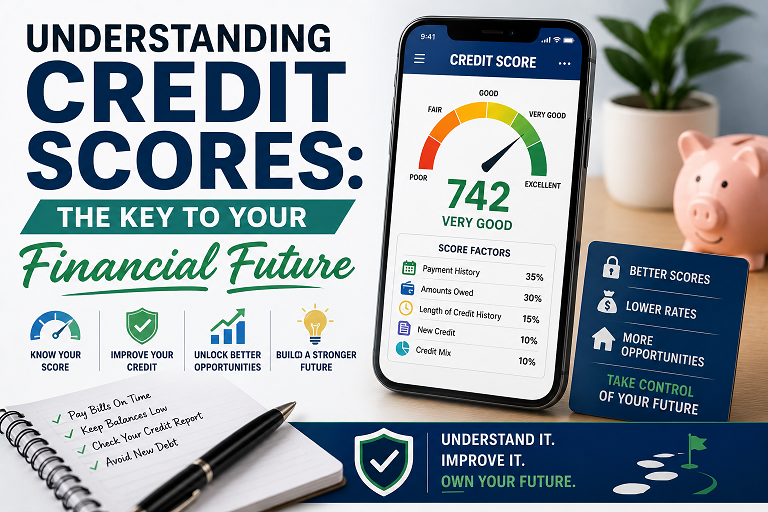
Understanding Credit Scores: The Key to Your Financial Future in 2026
Updated: June 6, 2026 | Read Time: 12 minutes
Your credit score is the GPA of your adult life. Except instead of getting into college, it decides if you get a house, what you pay for a car, and whether you put down a $500 deposit to keep the lights on.
In 2026, that 3-digit number matters more than ever. FICO Score 10T now tracks your balances over 24 months. Buy Now, Pay Later apps report to bureaus. Landlords pull credit for apartments. Employers check it for finance jobs. Insurance companies in 45 states use it to set your premiums.
If you don’t understand how credit scores work, you’re playing the money game blindfolded. This guide breaks down exactly what a credit score is, why it controls your financial future, and how to make it work for you instead of against you.
What Is a Credit Score? The 2026 Definition
A credit score is a number between 300 and 850 that predicts how likely you are to pay bills on time. Lenders use it to decide two things:
- Will we approve you?
- If yes, what rate do we charge you?
The most used score is the FICO® Score. 90% of top lenders use it. The current versions in 2026 are FICO Score 8, 9, and 10T. Mortgage lenders still use older versions: FICO 2, 4, and 5.
The other major score is VantageScore 4.0. You see this on Credit Karma, Chase Credit Journey, and Capital One. It’s not used for mortgages, but some credit card and personal loan companies use it.
Who Creates Your Credit Score?
Three credit bureaus collect your data: Experian, Equifax, and TransUnion. They don’t decide your score. They just hold your credit reports. FICO and VantageScore take that data and run it through their models to spit out a score.
That’s why you have multiple scores. You have a FICO Score 8 from Experian, another from Equifax, another from TransUnion. Then you have VantageScore from each bureau. Then industry-specific scores like FICO Auto Score 8. You easily have 20+ scores at any time.
External Resource: The Consumer Financial Protection Bureau explains how scores are built.
Why Understanding Credit Scores Is Critical in 2026
“I don’t use credit, so I don’t care about my score.” I hear this a lot. Here’s why that thinking costs you money in 2026:
1. Mortgages: The $85,000 Difference
As of June 2026, the average 30-year mortgage rate is 6.25% for a 760+ FICO score. For a 660 score, it’s 7.15%. On a $400,000 loan, that’s $236 more per month. Over 30 years, you pay $84,960 more for having “Fair” instead of “Very Good” credit. That’s a college education or 2 years of salary for many Americans.
FHA loans go down to 580, but you pay mortgage insurance for the life of the loan. Conventional loans at 620+ are cheaper long-term, but only if you hit 740+ do you avoid Loan-Level Price Adjustments.
Related: What Is a Good Credit Score in 2026?
2. Auto Loans: 5% vs 18% APR
June 2026 auto loan data shows “Super Prime” borrowers with 781+ scores get 4.9% on new cars. “Subprime” borrowers at 501-600 get 18.9%. On a $35,000 car for 60 months, that’s $658/mo vs $909/mo. That’s $15,060 more for bad credit. You could buy a used car outright for the difference.
3. Credit Cards: Rewards vs Rejection
With a 750+ score, you get Chase Sapphire Reserve, 5% cash back cards, and 21-month 0% APR offers. With a 600, you get secured cards with $200 limits and $39 annual fees. Good credit is free money via sign-up bonuses and cash back. Bad credit costs you fees.
4. Renting an Apartment
90% of landlords in 2026 run credit checks. Most want 650+. Under 600 means higher deposits, cosigner required, or auto-denial in competitive markets like Austin, Denver, and Miami. Some use VantageScore and deny under 620.
5. Car Insurance: The Hidden Credit Tax
In 45 states, insurers use credit-based insurance scores. The Zebra’s 2026 study found drivers with poor credit pay 68% more than those with excellent credit. That’s $1,400 vs $2,352 per year on average. Only CA, HI, MA, and MI ban the practice.
6. Utilities, Cell Phones, Internet
Verizon, AT&T, and T-Mobile check credit for postpaid plans. Under 600 = $400+ deposit. Same with electric and gas. In Texas, a 550 score means a $350 deposit to turn on power. With 700+, it’s $0.
7. Jobs and Security Clearances
Finance, government, and law enforcement jobs pull credit. They’re not looking at your score. They’re looking for bankruptcies, foreclosures, and delinquent debt over $5,000. Bad credit can cost you a job offer or clearance.
8. Business Loans and SBA Loans
Starting a business? SBA loans require personal credit checks. Most lenders want 680+ personal FICO for SBA 7(a) loans. Even if your business is solid, your personal score gates access to capital.
Bottom line: Understanding credit scores isn’t about debt. It’s about optionality. Good credit gives you choices and saves you money even when you pay cash.
How Credit Scores Are Calculated in 2026: FICO 10T Breakdown
FICO Score 10T is the newest widely used model in 2026. Here’s what it weighs, with 2026 updates:
| Factor | Weight | What It Means in 2026 |
|---|---|---|
| Payment History | 35% | Do you pay on time? One 30-day late = 60-100 point drop. BNPL lates now count. Medical debt under $500 ignored. |
| Amounts Owed | 30% | Credit utilization. But 10T uses trended data. Rising balances over 24 months hurt you. Falling balances help. Keep under 10%. |
| Length of Credit History | 15% | Average age of accounts. Closing your oldest card kills this. Authorized user history helps. |
| Credit Mix | 10% | FICO wants cards + installment loans. In 2026, Experian Boost counts phone/streaming bills here. |
| New Credit | 10% | Hard inquiries. 1 = 5 points. 6 in 12 months = high risk. Rate shopping for mortgage/auto grouped in 45 days. |
What’s New in 2026 Scoring Models
- Trended Data: FICO 10T and VantageScore 4.0 look at 24 months of balances. Paying $3,000 down to $200 scores higher than paying $300 to $200.
- BNPL Accounts: Klarna, Affirm, Afterpay, Apple Pay Later report. Missed payments = late payments.
- Rent/Utilities: Opt-in via Experian Boost, Bilt, Piñata. Helps thin files but weighted less than credit cards.
- Medical Debt: Under $500 not reported. Over $500 not reported until 12 months old. Paid medical debt removed.
External Resource: See full factors at myFICO’s official breakdown.
The 5 Credit Score Ranges and What They Mean for Your Future
Let’s translate the 300-850 scale into real life. See our full 2026 scale guide for details.
300-579: Poor Credit – Financial Defense Mode
Your financial future: You’re paying extra for everything. Deposits on apartments and utilities. 20%+ APRs if approved. Secured cards only. Rebuilding mode.
2026 Impact: Locked out of homeownership unless FHA with 10% down. Car loans predatory. Insurance doubled. Job options limited.
Path forward: Secured card + credit builder loan. No lates for 12 months. Dispute errors. Can hit 600 in 6-12 months.
580-669: Fair Credit – Subprime Territory
Your financial future: You qualify, but you pay “risk premiums.” FHA loans OK. Auto loans 12-18%. High-fee cards.
2026 Impact: You can buy a house but pay $85K more than Very Good tier. Can rent but with bigger deposits. Can get cards but low limits.
Path forward: Pay all cards to under 30% utilization. That alone can add 40-70 points in 30 days. Get to 670 to hit “Good.”
670-739: Good Credit – The Majority
Your financial future: You’re approved for most things. Conventional mortgage, decent auto rates, rewards cards. But you’re still paying 0.25-0.5% more than the best tier.
2026 Impact: You’re fine. But moving to 740+ saves $40K+ on a mortgage. It’s worth the push.
Path forward: AZEO method, credit limit increases, keep aging accounts. 6 months of work can get you to 740.
740-799: Very Good Credit – Prime Borrower
Your financial future: You win. Best mortgage rates, 0% auto promos, premium cards, no deposits. Insurance discounts. You’re in the top 47%.
2026 Impact: Lenders compete for you. You have negotiating power. $0 down mortgages, $0 deposits, lowest rates.
Path forward: Maintain. Utilization under 10%, no lates, don’t close old accounts. You’re set.
800-850: Exceptional Credit – Financial Elite
Your financial future: Red carpet treatment. Highest limits, best perks, instant approvals. But rates aren’t better than 760.
2026 Impact: Bragging rights and peace of mind. You’ll never worry about approval. Focus on wealth building now, not score chasing.
Common Credit Score Myths That Hurt Your Future
Bad advice keeps people stuck. Let’s kill these 2026 myths:
Myth 1: “Checking my score lowers it.”
Truth: Checking your own score is a soft pull. Zero impact. Check weekly on Experian or Credit Karma. Lenders checking it = hard pull. That’s 5 points.
Myth 2: “I need to carry a balance to build credit.”
Truth: This myth costs Americans billions in interest. Paying in full builds credit just as fast. Utilization is based on statement balance, not whether you carry it. Pay in full after the statement cuts.
Myth 3: “Closing cards helps my score.”
Truth: It hurts. You lose available credit, raising utilization. You lower average age of accounts. If it has a fee, product change to no-fee. Never close your oldest card.
Myth 4: “Income affects my credit score.”
Truth: FICO doesn’t see your income. It’s not on your credit report. A $30K earner with 800 score beats a $300K earner with 600. Lenders check income separately for debt-to-income ratio.
Myth 5: “All debt is bad for your score.”
Truth: FICO wants to see you can manage debt. Having a mortgage + one card paid on time scores higher than no debt at all. “No credit” = 0, which is worse than 650.
How to Take Control of Your Credit Score in 2026
Understanding is step one. Action is step two. Here’s your 2026 playbook:
1. Know Your Numbers
Pull all 3 reports free at AnnualCreditReport.com. Weekly access is permanent now. Get FICO 8 free from Experian. Check for errors — 34% of reports have them.
2. Master Utilization
This is 30% of your score and the fastest lever. Find your statement closing dates. Pay balances to 1-9% before that date. If you have $10K total limits, keep reported balances under $1,000. Pay twice per month if needed.
3. Automate On-Time Payments
Payment history is 35%. One late payment costs 90 points. Set autopay for minimums on every account. Then pay extra manually. Include BNPL accounts. A missed $40 Klarna payment now hurts like a credit card late.
4. Build Age and Mix
Don’t close old cards. Become an authorized user on a parent/spouse’s 10+ year card with perfect history. If you only have cards, add a credit builder loan from Self or a credit union. Mix is 10%.
5. Limit Hard Inquiries
Space applications 6 months apart unless mortgage/auto shopping. Those get a 45-day grouping window in FICO 10T. Use prequalification tools that do soft pulls first.
6. Use New 2026 Tools
- Experian Boost: Add phone, utilities, streaming. Average +13 points instantly.
- Bilt/Piñata: Report rent. 2 years of rent = 60+ points for thin files.
- UltraFICO: Opt-in to let FICO see bank balances. Helps if you’re on the edge.
Life Without a Credit Score: Is It Possible in 2026?
Dave Ramsey fans ask this. Can you live cash-only with no FICO score? Yes, but it’s harder in 2026.
What’s possible:
- Manual underwriting for mortgages via Churchill Mortgage. Need 2 years rental history, 20% down.
- Buy cars cash. Dealers won’t finance you with no score.
- Rent from private landlords who don’t check credit.
- Prepaid phones, prepaid utilities.
What’s hard:
- Most apartments require credit checks. No score = denial or $2,000 deposit.
- Insurance 2x higher without credit-based insurance score.
- Can’t rent a car without a credit card. Debit cards require huge holds.
- Some jobs require credit checks.
2026 Reality: You can do it, but you’ll pay a “cash tax.” Building a 700 score and never carrying debt gives you the benefits without the interest. That’s the smarter path for most.
Frequently Asked Questions
Why are credit scores important to your financial future?
Credit scores determine your access to mortgages, auto loans, credit cards, and the interest rates you pay. In 2026, they also impact insurance premiums, apartment approvals, cell phone plans, and some jobs. A higher score saves tens of thousands over your lifetime.
What is the biggest factor in your credit score?
Payment history is 35% of your FICO score. One 30-day late payment can drop a 780 score by 90+ points. In 2026, FICO 10T also heavily weighs trended data, so consistent on-time payments over 24 months matter most.
Can you live without a credit score in 2026?
Technically yes, but it’s harder. You’ll pay cash for cars and houses or use manual underwriting. You’ll face large deposits for utilities, phones, and rentals. Most Americans benefit from building a good score even if they avoid debt.
How often does your credit score update in 2026?
Your score updates when lenders report data, usually every 30-45 days. Most credit cards report on statement closing dates. If you pay down balances, expect to see changes in 30-45 days. You can check free weekly via Credit Karma or Experian.
Your Credit Score Is a Tool, Not a Moral Judgment
In 2026, understanding credit scores isn’t about shame or obsession. It’s about understanding the rules of the game so you can win.
A 750 score doesn’t make you better than someone with 650. But it does mean you’ll pay $85,000 less for the same house. It means you get approved for the apartment without a $1,000 deposit. It means your insurance is cheaper.
The system isn’t perfect. But it’s the system we have. Learn it. Use it. Make it work for your financial future instead of against it.
Start today: Pull your reports. Check your utilization. Set up autopay. One action this week puts you ahead of 60% of Americans who never look.
Your future self — the one buying a house, getting lower rates, and sleeping better — will thank you.
Next Reads: 2026 Credit Score Scale Explained | How Long Does It Take to Build Credit? | Credit Score Needed for a Mortgage in 2026
7 thoughts on “Understanding Credit Scores: The Key to Your Financial Future”