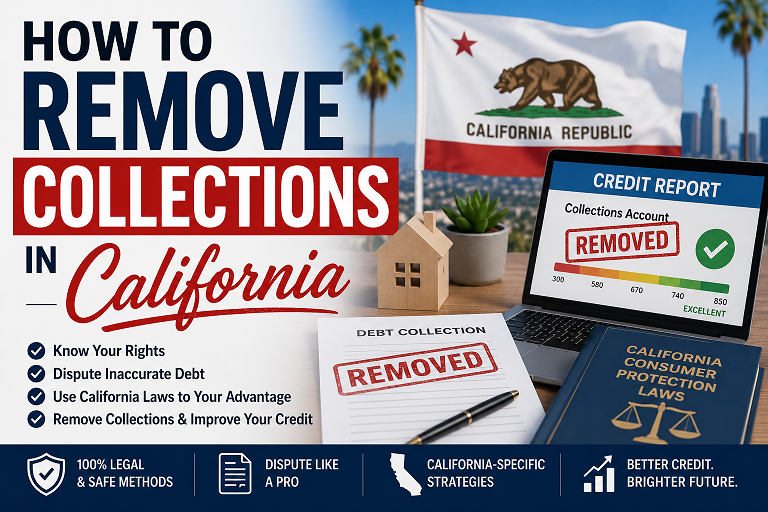
A California collection can be removed when it is inaccurate, duplicated, not yours, too old or tied to identity theft. You can dispute report errors for free. Paying or settling a valid nonmedical collection usually updates its balance and status but does not automatically delete accurate history. Before acting on an old debt, check both California lawsuit deadlines and the separate federal credit-reporting period.
California residents have protections under federal debt-collection and credit-reporting laws as well as state laws such as the Rosenthal Fair Debt Collection Practices Act and Debt Collection Licensing Act. Those protections can stop deception, harassment and lawsuits on certain time-barred debts. They do not create a universal right to erase an accurate collection.
The best first move is not to call and negotiate blindly. Confirm who is contacting you, obtain the written validation information, review all three credit reports and identify the exact problem before sharing sensitive information or sending money.
Check the company and its California licensing status before paying or sharing account information.
The lawsuit limitation period is not the same as the credit-reporting period.
Identify the wrong ownership, amount, status or date and support the requested correction.
California debt-collection protections
The federal Fair Debt Collection Practices Act generally regulates third-party debt collectors. California’s Rosenthal Act adds state protections and can apply to a broader group of consumer-debt collectors, including certain original creditors collecting their own consumer debts. Which law applies depends on the collector and transaction.
California also requires covered debt collectors and buyers to be licensed through the Department of Financial Protection and Innovation. A consumer can use the DFPI’s lookup resources to check a business and file a complaint about unlawful, deceptive or abusive conduct.
| Protection | What it generally means | What it does not mean |
|---|---|---|
| Validation information | A collector generally must provide key information about the debt and explain how to dispute it. | Receiving a notice does not prove every detail is correct. |
| Limits on communications | Collectors cannot harass, deceive, threaten arrest or call at prohibited times without authorization. | A valid cease-contact request does not cancel the debt or prevent every lawful action. |
| California licensing | Covered collectors doing business in California generally need a DFPI license or qualifying status. | A license does not establish that a particular debt or amount is correct. |
| Time-barred debt rules | A collector may not sue or threaten suit when an applicable limitation period has expired. | The debt does not necessarily disappear from a credit report on the same date. |
| FCRA dispute rights | You may dispute inaccurate or incomplete collection reporting with a bureau and furnisher. | The FCRA does not require deletion of accurate, timely information merely because it is negative. |
California privacy law is not a credit-deletion shortcut
The CCPA contains exemptions and rights that depend on the data and business, but it should not be presented as a way to force a collector to erase records needed to service, document or enforce a debt. Use credit-report disputes and debt-collection rights for their intended purposes.
California’s four-year rule and the seven-year credit-reporting period
California Courts explains that common claims based on a written contract, account stated or open book account generally have a four-year lawsuit limitation period. A verbal-contract claim may have a different period. The starting date, governing law, payment history and legal theory can change the analysis, so “every California debt expires after four years” is inaccurate.
Most negative credit information can generally remain for up to seven years under federal reporting law. A collector’s new account-open date is not necessarily the date that controls how long a collection may be reported.
| Question | General rule | Consumer action |
|---|---|---|
| Can a creditor sue? | Many California written-contract debt claims use a four-year limitation period, subject to facts and exceptions. | Check the last activity, contract, payment history and complaint. Get legal advice when uncertain. |
| Can the collector contact you? | A time-barred debt may still be subject to lawful collection attempts, but not a lawsuit or threat of suit. | Request validation, keep records and use a lawful cease-contact request if appropriate. |
| Can it appear on a credit report? | Most collections generally may be reported for up to seven years under FCRA timing rules. | Check the original delinquency timeline and dispute re-aging or obsolete reporting. |
| Can payment change a deadline? | A payment or written acknowledgment may affect lawsuit limitations in some circumstances. | Do not make a token payment on an old debt before understanding the California consequences. |
Never ignore court papers
A statute of limitations is usually a defense that must be raised. If you do not respond properly and on time, the collector may seek a default judgment even when you believe the claim is too old.
How to address a California collection step by step
Confirm that the contact is legitimate
Ask for the collector’s name, address, telephone number, current creditor, original creditor, amount and California license information. Independently verify the business through DFPI resources and the original creditor.
Obtain the validation notice
Do not provide bank credentials or immediate payment to an unfamiliar caller. Review the written notice for the creditor, itemized amount and deadline for disputing the debt.
Pull all three credit reports
Use AnnualCreditReport.com. A collection may appear on one, two or all three reports, and the fields may differ.
Compare the underlying facts
Check ownership, creditor, amount, payment credits, account status and the original delinquency timeline. Save reports and documents before filing anything.
Choose the correct path
Use debt validation when you question a collector’s claim; use an FCRA dispute for inaccurate report data; negotiate only after verifying the debt and understanding its age.
Track every result
Keep letters, receipts, tracking, emails, call notes, settlement terms and updated reports. A complete timeline is useful if you later need DFPI, CFPB or legal help.
How debt validation works
If you dispute a collection in writing within the 30-day validation period, the collector generally must stop collecting the disputed amount until it sends verification responding to the dispute. The validation notice should specify the end date of that period.
Your letter should identify the account, state whether you dispute all or part of it, and ask for the information needed to understand the creditor and itemized amount. Send copies of relevant payment records if the bill was already paid. Keep proof of delivery.
Validation is not an automatic deletion command
Federal law does not create a universal 30-day deadline for the collector to answer, and silence does not itself guarantee deletion from a credit report. The collector generally must pause covered collection activity until it provides verification if your written dispute was timely.
Use our debt-validation and dispute letter templates as editable starting points. Replace every placeholder and never demand documents the law does not necessarily require as though one missing document cancels the debt.
How to dispute an inaccurate California collection
A credit-report dispute should describe a concrete error. Useful evidence can include paid receipts, account statements, insurance explanations of benefits, identity-theft documents, settlement letters or an earlier report showing dates.
- An account belongs to someone else or resulted from identity theft.
- The balance omits payments or includes an unsupported amount.
- A paid or settled account still shows the wrong balance or status.
- The same collection is duplicated rather than properly reflecting distinct furnishers.
- The original delinquency timeline is incorrect or the information is obsolete.
- A medical collection conflicts with current bureau medical-reporting policies.
Dispute with every bureau showing the error and with the furnisher. A bureau generally investigates within 30 days, though some cases may take up to 45 days. Read the result carefully: “verified” does not tell you that every field was reviewed unless you compare the updated report.
For more detail, see how to fix credit-report errors.
Paying, settling and pay-for-delete requests
Once you verify a debt, compare an affordable payment plan, lump-sum settlement and advice from a nonprofit credit counselor or attorney. Get every material term in writing before paying: amount, deadline, whether it resolves the full account, and how the collector intends to update the bureaus.
Pay-for-delete is a request—not a California right. Many furnishers decline because reporting standards favor accurate, complete information. Do not budget on the assumption that a collector will delete, and do not believe websites publishing universal settlement percentages.
Settling for less can have tax consequences in some cases. It can also look different from paying in full during manual review, although neither label guarantees a particular score, mortgage rate, credit-card APR or auto-loan approval. Compare the full financial outcome rather than chasing an estimated point gain.
Medical collections for California consumers in 2026
Nationwide bureau policies exclude paid medical collections, medical collections with an initial reported balance under $500 and unpaid medical collections during a one-year waiting period. Unpaid medical collections of $500 or more may still appear after that period.
The CFPB’s broader 2025 federal medical-debt rule was vacated in July 2025, so it is not an active nationwide ban. California consumers may have additional state medical-debt and hospital financial-assistance protections, but eligibility depends on the provider, debt, dates and household circumstances.
Before paying a medical collector, ask the provider and insurer for an itemized bill and explanation of benefits. Check insurance adjustments, duplicate charges, charity-care eligibility and whether the provider can recall the collection. A medical credit card used to pay a bill may be reported as ordinary credit rather than a medical collection.
If a debt collector sues you in California
Read the summons and complaint immediately. Confirm the plaintiff, case number, court, service date, claimed amount and response deadline. Do not rely on a phone promise that the case will be paused.
Possible defenses can include an expired statute of limitations, mistaken identity, payment, wrong amount, lack of ownership evidence or other contract and procedure issues. Defenses are fact-specific. California Courts’ Self-Help Guide and local legal aid can explain forms, but legal advice is especially important for large balances, wage or bank-account risks, or unfamiliar service.
Email is not ordinary service of a summons in California
DFPI reminded collectors in 2026 that California law permits specific service methods and that getting a consumer to “consent” to email service does not satisfy a licensee’s service obligation. Still, never discard an emailed document—verify the case directly with the court.
Warning signs and unlawful collection behavior
- Threatening arrest, violence or public exposure of the debt.
- Claiming to be law enforcement, a court or an attorney when that is false.
- Refusing to identify the company, address, creditor or California license information.
- Demanding gift cards, cryptocurrency, wire transfers or other hard-to-reverse payment.
- Calling before 8 a.m. or after 9 p.m. without authorization, or repeatedly calling to harass.
- Lying about the amount, lawsuit status or legal consequences.
- Threatening to sue on a time-barred debt.
- Promising guaranteed credit deletion or a fixed score increase for an upfront fee.
Keep records and consider complaints to the DFPI, California Attorney General, CFPB or FTC. A complaint is not a substitute for responding to a pending lawsuit.
Frequently asked questions
How long does a collection stay on a California credit report?
Most collections can generally be reported for up to seven years under federal law. The legally relevant delinquency timeline matters; the collector’s account-open date does not necessarily restart the reporting period.
Is every California debt subject to a four-year statute of limitations?
No. Four years commonly applies to written-contract, account-stated and open-book-account claims, but other claims can have different rules. Dates, governing law and later activity may matter.
Does paying restart the seven-year credit-reporting clock?
Payment does not generally create a new federal reporting period for the original collection. It may affect California lawsuit limitations in some circumstances, which is why old debts require care.
Can a collector report while validating a debt?
Collection and credit reporting involve overlapping but distinct legal duties. A timely written validation dispute requires a pause in covered collection activity until verification; disputed credit information must also be handled accurately. Seek legal advice for a specific violation claim.
Does pay-for-delete work in California?
A collector may consider the request, but no law requires agreement. Payment without a written deletion promise normally updates the balance and status rather than erasing accurate information.
Will deletion guarantee a higher credit score?
No. The result depends on the collection, its age, the rest of the file and the scoring model. No ethical service can promise a fixed increase.
Where can Californians get help?
Use California Courts Self-Help, DFPI consumer resources, the California Attorney General, local legal aid or a qualified consumer-law attorney. Verify any service and its fees before signing.
The bottom line
To remove a collection in California legally, start by verifying the collector and the debt. Dispute specific report errors with evidence. Treat the four-year lawsuit limitation and federal credit-reporting period as separate timelines. Negotiate only after understanding both.
California’s protections are valuable, but they are not shortcuts. Accurate records, timely responses and careful documentation provide more protection than aggressive scripts, false disputes or guaranteed deletion services.
Related guides
Primary sources
- California Attorney General: Debt collectors
- California DFPI: Debt collections—what consumers need to know
- California DFPI: Know your debt-collection rights
- California Courts: Debt lawsuit defenses
- CFPB: Disputing a collection debt
- CFPB: Disputing credit-report errors
- CFPB: Status of the vacated medical-debt rule
2 thoughts on “How to Remove Collections in California”