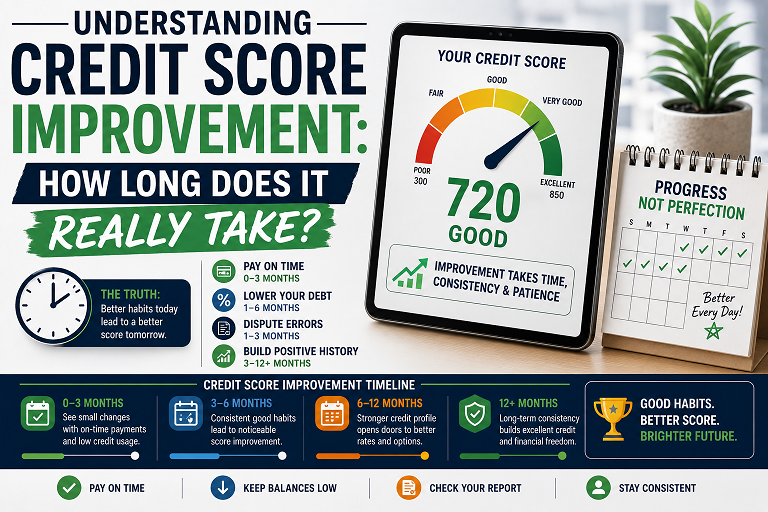
Credit improvement can begin after updated information reaches your credit reports, but meaningful recovery often takes months or longer. Paying down a high card balance may affect a score after the issuer reports the lower balance. Correcting a verified reporting error usually involves a 30-day investigation, sometimes up to 45 days. Rebuilding after missed payments, collections or bankruptcy generally depends on sustained positive history over a much longer period. No legitimate company can promise a specific point increase by a fixed date.
When people ask how long it takes to improve a credit score, they usually want a calendar answer: 30 days, three months or one year. Unfortunately, credit scoring does not run on one universal recovery clock.
A score is calculated from the information in a credit report at a particular moment. It can change when a lender supplies new data, when a credit bureau updates the report, or when a different scoring model evaluates that report. If nothing relevant changes, simply checking again next week may produce the same result.
The starting problem matters too. Lowering a nearly maxed-out card is different from rebuilding after several recent missed payments. Correcting information that never belonged to you is different from waiting for accurate negative history to become older. This guide separates those situations so you can set a realistic timeline.
A lower card balance may appear after the issuer’s next update, but reporting dates vary.
A credit-report dispute investigation generally takes 30 days and may take up to 45 days in certain cases.
Serious accurate negative history requires time and consistent positive behavior; there is no guaranteed recovery date.
Why credit-score improvement has three different clocks
Consumers often treat paying a bill and receiving a new score as one event. In practice, at least three stages sit between them.
1. The account changes
You make a payment, a lender corrects an error, an account becomes current, or a new account opens. The creditor’s own system records the event first.
2. The credit report changes
The lender or other data furnisher sends information to one or more credit bureaus. Furnishers do not necessarily report to every bureau on the same day—or to all three bureaus.
3. A score is recalculated
A score is generated from the report data available at that time. The result can differ by bureau, FICO or VantageScore model, model version and the date of calculation.
This explains why paying a card today does not normally change every score tomorrow. The lower balance must first be reported and incorporated into the particular report used to calculate the score you are viewing.
You have more than one credit score
A free score from a bank or monitoring app may not match the score a mortgage, auto or card lender uses. Always note the scoring company, model version, bureau and date before comparing results.
How long common credit-improvement actions may take
The table below describes when a report might begin reflecting an action—not a promised score gain. The same report change can have a large, small or no visible effect depending on the rest of the credit file.
| Action or event | When the report may change | What to expect |
|---|---|---|
| Pay down credit-card balances | Often after the issuer’s next reporting update | Lower reported revolving utilization may help, especially when prior balances used a large share of limits. Results vary. |
| Bring a past-due account current | After the creditor reports the updated status | Stopping new late-payment reporting is important, but earlier accurate delinquencies can remain and continue affecting the file. |
| Correct an inaccurate report item | A bureau generally investigates within 30 days; some cases allow up to 45 days | If the information is corrected or removed and mattered to the score, a later recalculation may change. Accurate information may remain. |
| Open a secured card or credit-builder account | After the account first reports, then over subsequent months | A new account is not an instant fix. On-time payments and low balances must build useful history. |
| Recover from one recent late payment | Positive history begins with the next on-time reporting, but recovery is gradual | The effect depends on how late the payment was, how recent it is and the rest of the file. Accurate late history can generally remain for years. |
| Pay a collection | After the collector updates the balance or status | The score effect depends on the scoring model and report details. Payment does not guarantee deletion or a particular increase. |
| Age recent inquiries and accounts | Gradually with time | Avoiding unnecessary applications allows recent activity to become older, while existing accounts build history. |
| Rebuild after bankruptcy or multiple serious delinquencies | Positive changes can begin as new history reports; substantial recovery may take years | Accurate public-record and account information may remain for legally permitted periods. Consistent affordability and payment history matter. |
The CFPB explains that most negative account-payment information can generally remain on a report for up to seven years, while some information may remain longer. That does not mean a score stays frozen for the entire reporting period. Recent negative information may weigh differently from older information, and new positive history can develop alongside it.
Why paying a card can look faster than fixing late payments
Credit-card balances are recurring data. When an issuer sends a lower reported balance, the utilization picture can change immediately in the next score calculated from that updated report. A late payment, by contrast, records a failure to pay as agreed. Bringing the account current prevents the problem from continuing, but it does not rewrite accurate history.
That distinction is why “pay down balances” can sometimes produce a quicker visible response, while “rebuild payment history” is normally a longer process.
Four realistic credit-improvement scenarios
Scenario 1: High utilization, no missed payments
Imagine a consumer has two cards with $10,000 in combined limits and $8,500 in reported balances. They pay the balances down to $2,500 and do not add new purchases.
The reports may show a substantial utilization change after both issuers send new balances. A score calculated afterward may improve, but the size cannot be predicted responsibly. It will depend on factors such as individual-card utilization, overall utilization, account age, inquiries and the scoring model.
Assumption behind this scenario
The consumer has no new late payments, collections or applications, and the issuers report the reduced balances. If a statement closes with a new high balance, the expected improvement may not appear.
Scenario 2: A verified reporting error
A report incorrectly shows a 60-day late payment even though bank records demonstrate the account was paid on time. The consumer disputes the error with the credit bureau and the company that supplied the information, including copies of supporting documents.
The CFPB states that a credit reporting company generally must investigate within 30 days and notify the consumer after completing the investigation. Some circumstances extend the investigation to 45 days. If the item is corrected, a score generated from the updated report may change. The investigation timeline is not a guarantee that the dispute will be accepted.
Scenario 3: Recent missed payments
A consumer missed two payments during a temporary loss of income but is now current. The most important immediate action is to keep every account current and prevent another delinquency.
The reports may show the updated current status after creditors report it, yet the accurate missed payments can remain. Improvement is therefore measured over months of stable payments rather than one update. A promise that the score will recover in 90 days would ignore the rest of the file.
Scenario 4: Thin credit file
A consumer has little or no recent credit history. Opening one appropriate, affordable account may begin creating reportable history, but a new account alone does not demonstrate long-term management.
The file needs time to record on-time payments and manageable balances. Opening several accounts at once can create multiple inquiries, new obligations and a younger average account age without guaranteeing a stronger score.
What determines the speed of improvement?
The starting credit profile
A person with one correctable problem may see a different result from someone with several recent delinquencies, high balances and collections. The same action can have different effects because scores evaluate the entire report.
How serious and recent the negative information is
A single older late payment is not the same as a newly reported charge-off. Recent information often matters more to risk assessment, but the exact effect is model-specific and cannot be calculated from a generic chart.
Which bureau receives the update
A creditor may report at different times to Equifax, Experian and TransUnion or may not report to all three. One report can therefore update before another, producing temporarily different scores.
Which scoring model is used
FICO and VantageScore are separate companies, and multiple model versions exist. Collection treatment, available history and other factors may differ between models. Improvement in one score does not guarantee an identical change in every score.
Whether the change is sustained
A temporarily low card balance may help only while it remains low when reported. A stronger credit profile is built by repeatable habits: affordable balances, on-time payments and selective applications.
New activity during the recovery period
A new hard inquiry, recently opened account, increased balance or missed payment can occur while an older issue is improving. Score movement is the net result of all reported changes—not one isolated action.
A practical credit-improvement timeline
Today: prevent additional damage
Bring accounts current where possible, contact creditors before missing payments, set reliable reminders and stop unnecessary credit applications. A workable budget comes before score optimization.
This week: review all three reports
Use AnnualCreditReport.com, the federally authorized source, and check identity details, account ownership, balances, limits, payment status, collections and duplicate information.
Within 30–45 days: follow valid disputes
Dispute only information you believe is inaccurate or incomplete. Preserve documents and review investigation results. Accurate negative information generally cannot be removed merely because it hurts.
Over the next reporting cycles: reduce revolving balances
Prioritize affordability and expensive debt. Monitor statements to confirm lower balances reach reports. There is no universal need to carry interest-bearing debt to build a score.
Over three to six months: build consistency
Pay every account by the due date, keep card balances manageable, avoid avoidable inquiries and track whether reports—not just scores—reflect the expected changes.
Over six to twelve months and beyond: reassess
Compare progress using the same score type when possible. If borrowing is planned, examine affordability, income, debt-to-income ratio and savings along with the score.
For detailed actions, use our separate guide on how to improve your credit score responsibly. If you found inaccurate information, follow the documentation process in how to fix errors on a credit report.
What does not reliably improve a credit score?
- Paying someone to dispute accurate information: accurate negative information generally cannot be removed simply because it is inconvenient.
- Carrying a card balance and paying interest: a balance is not required to demonstrate responsible use. Pay statement balances in full when affordable.
- Opening several accounts quickly: more accounts do not guarantee more points and can add inquiries, fees and debt.
- Using debit or prepaid cards: these normally use your own funds and do not establish repayment history with the nationwide credit bureaus.
- Taking a payday loan to build credit: the CFPB notes payday loans are generally not reported to the three major nationwide credit reporting companies, while an unpaid debt sent to collection may cause harm.
- Using a credit privacy number or false identity: misrepresenting identifying information on a credit application may be illegal and exposes consumers to fraud.
- Closing old cards automatically: closing an account can reduce available revolving credit. Consider annual fees, overspending risk and account history first.
Warning signs of a credit-repair scam
Be cautious of guaranteed point increases, a promise to remove all negative items, pressure to pay before services, instructions to dispute information you know is accurate, or advice to use an identity other than your own.
How to measure real progress
A score is useful, but it is not the only progress measure. Track the underlying behaviors and report data that you can control.
| Measure | What improvement looks like | Why it matters |
|---|---|---|
| On-time status | No new missed payments and past-due accounts brought current where possible | Payment history is a major part of credit-risk assessment. |
| Reported card balances | Balances use a smaller, manageable share of individual and total limits | Lower revolving utilization can strengthen the profile without adding accounts. |
| Total expensive debt | High-APR balances decline month by month | Financial improvement matters even when a score moves slowly. |
| Report accuracy | Accounts, limits, balances and statuses match reliable records | A score is only as sound as the report information used to calculate it. |
| Emergency cushion | Some cash is available for irregular expenses | Savings can prevent the next car repair or medical bill from becoming new revolving debt. |
| Application activity | New credit is requested only for a real need | Selective applications limit unnecessary inquiries and obligations. |
When comparing scores over time, use the same bureau, scoring model and source when possible. A FICO Score from one bureau should not be treated as a direct before-and-after comparison with a VantageScore calculated from another bureau.
Checking your own report is safe
The CFPB states that requesting your own credit report does not hurt your credit score. Regular review can help you confirm that expected updates occurred and detect inaccurate or unfamiliar information.
Frequently asked questions
Can a credit score improve in 30 days?
It can change within that period if relevant new information reaches the report—for example, a lower card balance or a corrected error. A change is not guaranteed, and no one can responsibly promise a particular number of points.
How fast does paying off a credit card improve credit?
The lower balance may affect a score after the issuer reports it and a new score is calculated. Timing varies by issuer, bureau and score source. The effect depends on the full report and whether other card balances remain high.
How long does a credit-report dispute take?
According to the CFPB, a credit reporting company generally must investigate within 30 days. Certain circumstances allow up to 45 days. It must notify you after completing the investigation, but filing a dispute does not guarantee removal.
Will paying a collection raise my score?
It may change the reported balance or status, but the score effect depends on the scoring model and the rest of the report. Payment does not automatically remove accurate collection history or guarantee a score increase.
How long does it take to recover from a late payment?
There is no universal recovery period. Becoming current stops additional delinquency from accumulating, while months of on-time payments build better recent history. The seriousness, recency and surrounding file all matter.
Does checking my score slow improvement?
Checking your own credit report or score is generally a soft inquiry and does not hurt scores. A lender’s hard inquiry after an application is different.
Should I pay for credit repair to improve faster?
You can dispute inaccurate information yourself at no cost. Be skeptical of anyone guaranteeing deletion of accurate items or a fixed score increase. A legitimate service cannot lawfully change correct information merely because it is negative.
The bottom line
Credit improvement is not one event. It is a sequence: the financial action happens, updated information reaches a credit report, and a scoring model evaluates the new file. A lower card balance or corrected error may show results relatively quickly; rebuilding after serious accurate negative history takes sustained positive behavior and time.
Focus first on preventing new late payments, reviewing all three reports, correcting genuine errors and reducing expensive revolving debt. Measure progress in accurate reports, affordable balances and reliable payments—not only in points. Those fundamentals are valuable even before a score reaches the number you want.
Related guides
Primary consumer sources
- Consumer Financial Protection Bureau: Understand your credit score
- Consumer Financial Protection Bureau: How to rebuild your credit
- Consumer Financial Protection Bureau: Credit-report dispute timelines
- Consumer Financial Protection Bureau: How long information stays on reports
- AnnualCreditReport.com: federally authorized credit-report access
- FICO: What’s in your FICO Score?
7 thoughts on “How Long Does It Take to Improve Your Credit Score?”