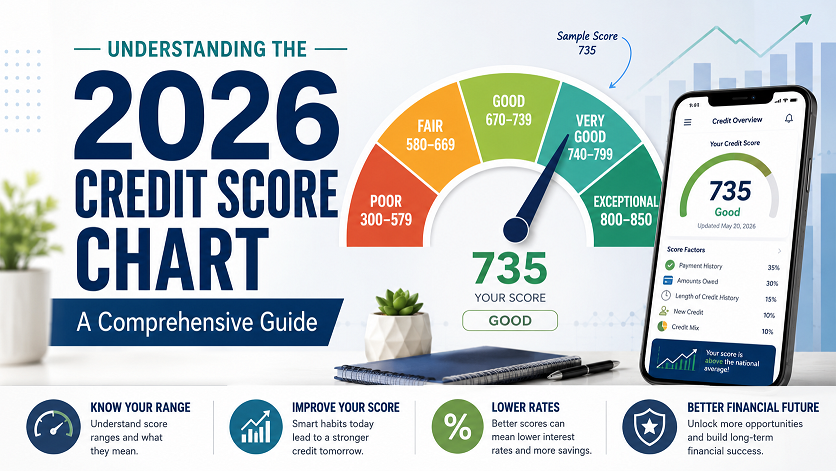
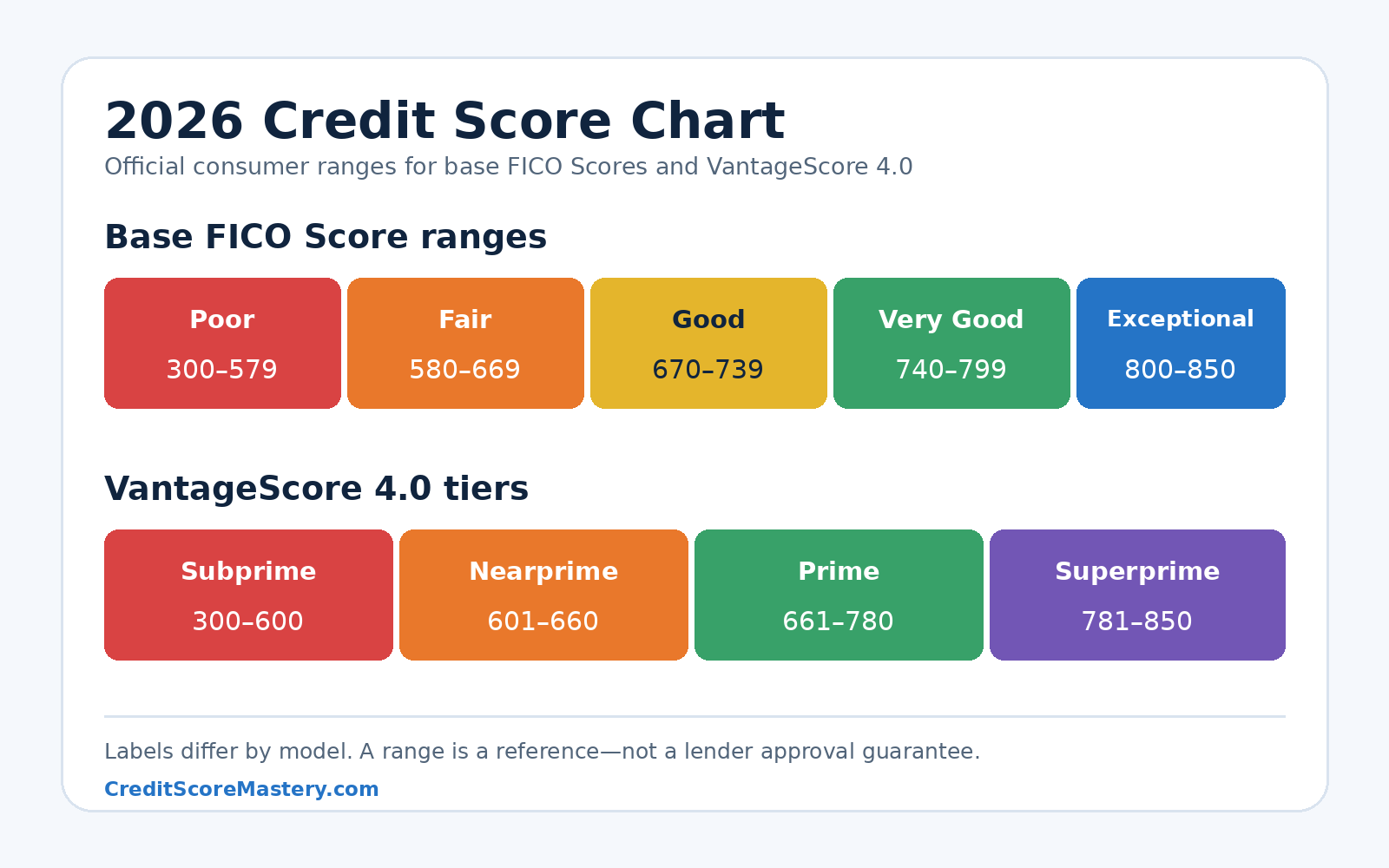
Most base FICO Scores and current VantageScore models use a 300–850 scale, but their category boundaries are different. FICO describes 670–739 as Good, while VantageScore 4.0 places 661–780 in its broader Prime tier. These labels are educational reference bands—not universal approval thresholds. A lender may use a different model, bureau, industry-specific range and underwriting rules.
This 2026 credit score chart is designed as a reference page. It shows the official published bands side by side, explains why two scores can differ and connects each borrowing question to a dedicated guide. It does not repeat a complete credit-improvement program or pretend that one number determines every loan rate.
2026 FICO Score chart
Most base FICO Scores: 300–850. Categories below follow FICO’s published consumer guidance.
| FICO range | FICO label | Reference meaning | Important limitation |
|---|---|---|---|
| 300–579 | Poor | Report data indicates substantially elevated credit risk under the model | Approval is not impossible, but options may be limited or expensive |
| 580–669 | Fair | Below FICO’s Good range; may qualify for some products | Product rules, income, DTI and recent history can outweigh the label |
| 670–739 | Good | FICO’s published Good range | 670 is not a universal lender cutoff or guaranteed rate |
| 740–799 | Very Good | Generally signals lower risk than the Good band | Best pricing thresholds vary by lender and product |
| 800–850 | Exceptional | Highest base-FICO category | An 850 is not required for strong lending terms |
FICO says a score of 670 or above is generally considered Good, 740 and above Very Good, and 800 or higher Exceptional. The categories help consumers interpret a score; they do not force a bank, credit union, card issuer or landlord to make a particular decision.
2026 VantageScore 4.0 chart
VantageScore 4.0: 300–850. VantageScore’s official tier terminology is not the same as FICO’s.
| VantageScore 4.0 range | Official tier | Reference meaning | Do not assume |
|---|---|---|---|
| 300–600 | Subprime | Higher modeled risk within the VantageScore framework | That every lender defines subprime at 600 |
| 601–660 | Nearprime | Between the published Subprime and Prime tiers | That 660 and 661 cause an automatic approval change |
| 661–780 | Prime | Broad VantageScore Prime category | That all people within this wide band receive the same pricing |
| 781–850 | Superprime | Top VantageScore 4.0 risk tier | That a score above 780 guarantees the best available offer |
VantageScore’s tier structure is much broader than the five FICO consumer bands. A 700 can therefore be called Good under FICO guidance and Prime under VantageScore guidance. Neither label is “wrong”; each belongs to a different classification system.
FICO versus VantageScore: side-by-side
| Feature | FICO | VantageScore |
|---|---|---|
| Common base range | 300–850 | 300–850 for current widely encountered models |
| Published bands | Poor, Fair, Good, Very Good, Exceptional | Subprime, Nearprime, Prime, Superprime |
| Model versions | Multiple base and industry-specific versions, including FICO 8, 9 and 10T | Multiple versions, including VantageScore 3.0 and 4.0 |
| Data source | A report from Equifax, Experian or TransUnion | A report from Equifax, Experian or TransUnion |
| Scoreability | Criteria depend on the FICO model | VantageScore markets broader ability to score consumers with thinner files |
| Lender use | Version and bureau depend on creditor and product | Version and bureau depend on creditor and product |
The same underlying report can produce different FICO and VantageScore numbers because the formulas weigh data differently. Even two FICO versions can disagree. A mortgage creditor, auto lender and credit-card issuer may use different versions for the same applicant.
Never combine the two charts into one invented scale
Calling 661 “Good FICO” or 670 “VantageScore Prime” without identifying the model confuses separate systems. Always display the score brand, version, bureau and calculation date.
Why you have more than one credit score
The CFPB explains that consumers do not have only one score. A score changes with four identifiers:
- Credit bureau: Equifax, Experian and TransUnion reports may contain different accounts, balances or update dates.
- Scoring brand and version: FICO and VantageScore publish multiple formulas.
- Product purpose: a creditor may select a general model or an industry-specific model designed for cards, autos or mortgages.
- Calculation date: a newly reported balance, payment, inquiry or correction can change the input data.
Suppose a card issuer reports a lower balance to Experian on Monday, Equifax on Wednesday and TransUnion on Friday. A consumer checking scores during that week could see three numbers even if the formulas were identical. If the services also use different models, the difference can be larger.
The useful question is not “Which score is real?” Each correctly calculated score is real for its stated model and data. Ask which score is relevant to the decision you are preparing for.
Base scores, industry-specific scores and mortgages
Base FICO Scores
Most base FICO Scores use 300–850. They estimate general likelihood of serious delinquency. The five-band FICO chart on this page applies to that familiar base range.
Industry-specific FICO Scores
FICO states that industry-specific versions can range from 250 to 900. A 825 auto-enhanced score is therefore not directly comparable with an 825 base FICO Score. The model name and range must travel with the number.
Mortgage scores in 2026
Mortgage scoring is changing, but implementation status matters. FHFA approved FICO 10T and VantageScore 4.0 for use by Fannie Mae and Freddie Mac and describes implementation requirements on its credit-score page. Do not infer that every U.S. mortgage application instantly switched to one new model on the announcement date.
FHFA’s April 2026 material states that, once implemented, lenders will deliver both FICO 10T and VantageScore 4.0 scores when available with loans sold to the Enterprises. A borrower should ask the lender which model, bureau data and representative-score method apply to the specific transaction. For a deeper model comparison, use our FICO 10T mortgage guide and VantageScore 4.0 guide.
What score ranges mean for loans, cards and rates
A higher score generally signals lower modeled credit risk, and the CFPB notes that it can make qualifying easier or lead to better terms. But a chart cannot quote a rate or guarantee approval. Creditors also evaluate income, DTI, collateral, down payment, loan amount, recent account history and their own risk policy.
| Credit decision | How a chart helps | What must be checked separately | Dedicated guide |
|---|---|---|---|
| Credit card | Shows general risk positioning | Issuer underwriting, income, debt, recent accounts, annual fee and current offer | Discover score guide |
| Mortgage | Helps identify whether preparation may be needed | Mortgage model, program, DTI, down payment, reserves, property and lender overlays | Mortgage score requirements |
| Auto loan | Provides a general tier reference | Vehicle value, amount financed, term, down payment, lender tier and add-ons | Auto-loan score guide |
| Personal loan | Explains why pricing can differ | APR, origination fee, net proceeds, term, income and total repayment | Personal loans near 580 |
| HELOC | Shows general report strength | CLTV, property value, DTI, line terms, index, margin and lender minimums | HELOC requirements |
Do not use national loan-rate tables as personal quotes. Rates change daily and advertised pricing often assumes a particular score, term, collateral, points and transaction. Compare formal disclosures from multiple providers.
Do rent, utilities, streaming and BNPL count?
Only data present in the relevant credit report and recognized by the selected model can influence that score. The answer is therefore conditional.
- Rent: it may affect a score when a rent-reporting provider furnishes the history to a bureau and the model uses that data. Reporting coverage and fees vary.
- Utilities and telecom: ordinary payments may not appear automatically. A service may add eligible history, while unpaid accounts sent to collection can create separate consequences.
- Buy now, pay later: reporting differs by provider, product, bureau and date. An inquiry, loan tradeline or delinquency may be treated differently across models.
- Streaming subscriptions: paying Netflix or another service does not universally create a credit tradeline. A separate data program must report eligible information, and the scoring model must consider it.
FHFA has discussed newer models’ ability to consider additional payment histories when available, including rent, utilities and telecom. “When available” is essential: it does not mean every payment is automatically on all three reports or used by every lender.
Review our focused guides for rent reporting, utility payments and Klarna plan reporting.
How to read a credit score correctly
Identify the brand
Confirm whether the number is a FICO Score, VantageScore or another educational/proprietary score.
Find the model version
Record FICO 8, FICO 9, FICO 10T, VantageScore 3.0, VantageScore 4.0 or the exact model shown.
Check the bureau
Note whether Equifax, Experian or TransUnion supplied the report data.
Check the date
A score is a snapshot. Compare it only after accounting for reporting and calculation dates.
Use the matching chart
Apply FICO labels to a FICO score and VantageScore tiers to a VantageScore—never mix boundaries.
Ask the creditor
Before a major application, ask which score model and report source the lender expects to use.
A band is a benchmark, not a goalpost
Crossing from 669 to 670 changes the FICO reference label from Fair to Good, but it does not force every lender to change its approval or price. Build a strong overall file rather than chasing one boundary.
Credit-score ranges are not lender approval cutoffs
A published score band describes how a scoring company groups numbers for consumer education. A lender cutoff is an institution’s own eligibility or pricing rule for a particular product. Those concepts are related, but they are not interchangeable. A card issuer may evaluate applicants differently from a mortgage company, auto lender or personal-loan provider. Even two lenders offering similar products may use different models, bureau files and underwriting policies.
This is why a “Good” FICO label should never be converted into a promise of approval. Creditors may also review income, existing monthly obligations, debt-to-income ratio, recent applications, account history, loan-to-value ratio, collateral, requested amount and identity-verification results. A thin credit file with a certain score can present a different risk profile from a long, established file showing the same number.
How to use the chart before applying
First, confirm which model your displayed score uses. Next, review all three credit reports for errors and check current product terms directly with the lender. If a provider offers a prequalification process using a soft inquiry, it may help you compare potential offers without immediately submitting a full application; prequalification still is not final approval. For a mortgage or other major loan, ask the lender which scoring model and bureau data it expects to evaluate.
Compare the complete cost, not only the score recommendation. For credit cards, examine the annual fee, purchase APR, penalty terms, security deposit and rewards conditions. For personal loans, compare APR, origination fees, term, monthly payment and total repayment. For auto or mortgage financing, include down payment, loan term, closing or dealer charges and the cost of any optional products. A loan with a lower monthly payment can cost more overall when repayment lasts longer.
Avoid “guaranteed approval” score charts
No independent chart can know every creditor’s current underwriting rules. Treat pages promising guaranteed approval at a specific number—or guaranteed score gains—as marketing claims, not reliable financial guidance.
Frequently asked questions
What is a good credit score in 2026?
FICO describes 670–739 as Good. VantageScore 4.0 uses a broader Prime tier of 661–780. Identify the model before applying a label.
Is 700 a good credit score?
A 700 is within FICO’s Good band and VantageScore 4.0’s Prime tier, but it does not guarantee approval or a particular rate.
Is 600 a bad credit score?
600 falls in FICO’s Fair band but at the upper edge of VantageScore 4.0’s Subprime tier. The different labels demonstrate why the model matters.
What is the highest credit score?
Most base FICO Scores and VantageScore 4.0 top out at 850. Industry-specific FICO models can use a 250–900 range.
What is the lowest credit score?
Most base FICO and current VantageScore models begin at 300. A person can also be unscoreable when the model lacks sufficient qualifying report information.
Why is my FICO Score different from Credit Karma?
The service may show a VantageScore based on a particular bureau, while a creditor may use a different FICO model and report date.
Which credit bureau has the most accurate score?
Bureaus supply report data; scoring models calculate scores. Review all three reports for accuracy rather than declaring one bureau universally best.
Do lenders use FICO or VantageScore?
Both are used in the market. The selected brand, version and bureau depend on the creditor, product and implementation requirements.
Does checking my own score lower it?
No. Checking your own report or score is a soft inquiry and does not lower the score.
Can two lenders use different scores?
Yes. They may use different models, bureaus, calculation dates and internal underwriting systems.
Does an 850 guarantee the best rate?
No. Rate and approval also depend on the product, income, DTI, collateral, term, loan amount and lender policy.
How often does a credit score update?
A score is recalculated when requested from the report data available then. It can change after creditors furnish new balances or statuses.
Bottom line
The 2026 credit score chart is not one universal ladder. Use FICO’s five consumer bands for a base FICO Score and VantageScore’s four tiers for VantageScore 4.0. Always attach the brand, model, bureau and date to the number.
Use the chart to understand relative risk, then use official product requirements and real offers for financial decisions. A category name cannot guarantee approval, pricing or savings.
3 thoughts on “2026 Credit Score Chart: FICO and VantageScore Ranges”